
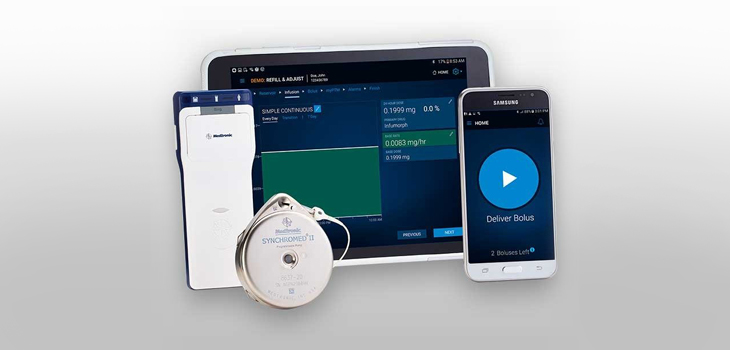
Fridley, Minnesota-based Medtronic announced that it has enrolled its first patient in the Embrace TDD (targeted drug delivery) clinical study. The purpose of this study is to measure the effectiveness of the SynchroMed II intrathecal drug delivery system (“Medtronic pain pump”).
New Test of Medtronic’s Pain Pump Announced
2 min read Premium comments
#medtronicSecondary#paincontrol#embracetdd
Intrathecal drug delivery systems are a comparatively new method of back pain management. Here’s how Medtronic’s SynchroMed version works.
The key first step to using SynchroMed is to taper the patient off their current oral medications including Opioids. Call it a drug “holiday” for a few weeks. That “resets” the body’s pain tolerance levels.
The physician then inserts a small catheter into the spine through a small needle. The catheter tip is placed at the level of the pain. A very small amount of morphine or morphine equivalent medication is placed through the catheter to the specific pain location. The doctor then increases dose levels over a 3-day period to see if the patient’s pain significantly improves.
The procedure is typically performed in the office. If the patient responds favorably, then a permanent catheter and pump can be implanted in an outpatient hospital procedure. The pump is fully programmable so that the right amount of medication is provided at the pain location. The pump is refilled every 2-3 months.
This new study, called “Embrace TDD study” is a prospective, multi-center, post-market study. Medtronic hopes to enroll approximately 100 patients who are presenting with chronic intractable non-malignant primary back pain with or without leg pain. Medtronic also hopes to use as many as 15 sites around the U.S. to enroll patients.
“The Embrace TDD study is important because it will evaluate the impact of weaning patients completely off oral opioids before treating them with intrathecal therapy using the Medtronic pain pump,” said John A. Hatheway, M.D., owner and provider, Northwest Pain Care, Spokane, Washington, who enrolled the first patient.
“My goal is to provide patients with effective pain relief and help them eliminate long-term oral opioid use. Understanding the effect of being opioid free prior to TDD treatment may be clinically relevant as clinicians seek to optimize the use of long-term alternatives to oral opioids.”
“As part of our commitment to helping address the opioid crisis, Medtronic is investing in clinical research and tools that can increase understanding of how to use proven alternative treatments, like TDD, for patients with uncontrolled chronic pain,” said Charlie Covert, vice president and general manager, Targeted Drug Delivery, Medtronic Pain Therapies. “We hope the Embrace TDD study will provide valuable insights about how to best optimize use of the Medtronic pain pump and enable clinicians to help more patients with chronic pain, which has a significant personal and societal impact.”
Charlie Covert told OTW, “Embrace TDD builds on the existing single-center studies of oral opioid reduction and elimination with intrathecal drug delivery. We’re excited to assess opioid elimination in a prospective, multi-center design.”
“For patients with chronic back pain that is not treatable with surgery, targeted drug delivery may be an option to manage pain while reducing or eliminating systemic opioids.”
Author
React:
Discussion
This is a fascinating development. In my practice we've seen similar outcomes with the revised protocol. The key differentiator seems to be patient selection criteria. Has anyone else noticed the correlation with BMI thresholds?
Great point. I'd push back slightly on the conclusion, the sample size in the cited study is too small to draw population-level inferences. That said, the directional signal is compelling and worth a larger RCT.
We implemented a similar approach last year. Early results are promising but we're still gathering 12-month follow-up data. Happy to share our protocol if anyone is interested.
Join the conversation
Orthopedic professionals are discussing this. Sign in and upgrade to read every comment and add your voice.