
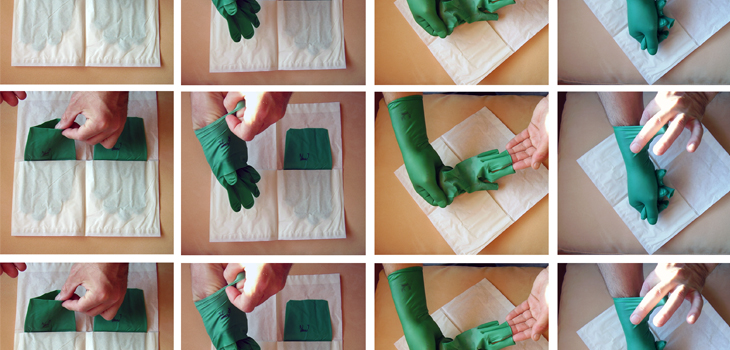
A team from Duke University Medical Center set out to prove that putting gloves on before donning a surgical gown would decrease or eliminate sleeve contamination. Their work, “Donning Gloves Before Surgical Gown Eliminates Sleeve Contamination,” appears in the January 16, 2019 online edition of The Journal of Arthroplasty.
Gloves First REALLY Cuts Infection Risk
2 min read Premium comments
Secondary#surgicalgloves#surgicalgown#sleevecontaminarion#surgicalcontamination
Colin T. Penrose, M.D., a third year orthopedic surgery resident at Duke University Medical Center and co-author, explained the genesis of this study to OTW, “We were noticing the stark difference between how well most total joints patients do with surgery compared to how disastrous the results can be for the rare patients who have severe prosthetic joint infections and the complications potentially associated with them. Any efforts focused on keeping patients from getting an infected total joint, will help them to enjoy the benefits of these phenomenal operations.”
For the study, the Duke researchers used three gown and glove donning techniques. The participants were Duke surgeons and they ranged from first year residents to attending surgeons.
For the study, “each participant covered their hands with ultraviolet (UV) light disclosing lotion and then donned surgical gown and gloves with their preferred technique and with the proposed technique in a randomly assigned order. The gowns were then removed and analyzed under UV light for distance and quantity of sleeve contamination.”
Dr. Penrose, in looking at the results of the study, said, “The most striking result was how for every single participant, regardless of level of training, the gloves first technique resulted in zero contamination compared to the more traditional techniques of putting on gloves which always had at least some contamination.”
“Something so simple as putting on gloves, and it is easy to learn this new technique, could potentially have a significant positive impact on the surgical outcome.”
“Just consider the little things that surgeons and others in the operating room do every day that might impact infection risk. The glove gown interface is an important source of infection and simply putting gloves on prior to the gown and then another pair of gloves over the gown can decrease contamination from the hand to the sleeve transferred via the glove cuff.”
“There is a simple solution involving existing technology and no additional cost that we think has the potential to decrease the risk of infection combined with other infection control measures like handwashing, perioperative antibiotics, etc. We plan to pursue additional studies to further validate this technique on a larger scale.”
Author
React:
Discussion
This is a fascinating development. In my practice we've seen similar outcomes with the revised protocol. The key differentiator seems to be patient selection criteria. Has anyone else noticed the correlation with BMI thresholds?
Great point. I'd push back slightly on the conclusion, the sample size in the cited study is too small to draw population-level inferences. That said, the directional signal is compelling and worth a larger RCT.
We implemented a similar approach last year. Early results are promising but we're still gathering 12-month follow-up data. Happy to share our protocol if anyone is interested.
Join the conversation
Orthopedic professionals are discussing this. Sign in and upgrade to read every comment and add your voice.