
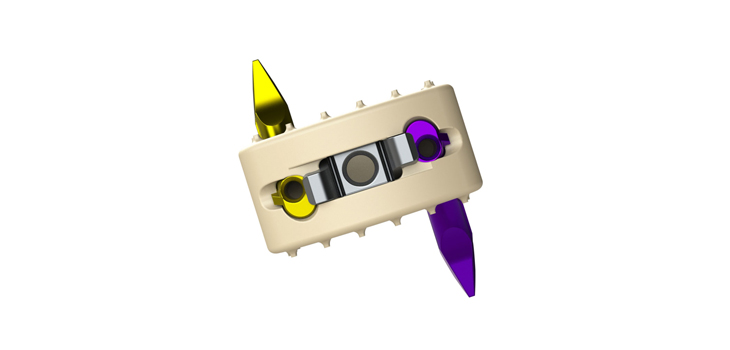
The Hannover, Germany-based iF International Forum Design GmbH has announced that Austin, Texas-based Genesys Spine has won this year’s iF DESIGN AWARD for its AIS-C Stand-Alone System. The AIS-C is a non-screw based, zero-profile, direct-anterior stand-alone interbody system for the cervical spine.
Genesys Spine Wins iF DESIGN AWARD 2019
1 min read Premium comments
Secondary#aiscstandalonesystem#genesysspineifdesignaward
As indicated by Genesys Spine, “The AIS-C Stand-Alone System won over the 67-member jury, made up of independent experts from all over the world, with its simplicity to implant, zero-step locking mechanism, and ease of removal or revision. The competition was intense: over 6,400 entries were submitted from 50 countries in hopes of receiving the seal of quality.”
Scott Bryant, principal, Genesys Spine, told OTW, “We are excited to bring the latest stand-alone technology to the market. It allows surgeons to more efficiently treat their patients and have confidence in the results.”
“The most unique features of the Genesys Spine AIS-C Stand Alone are that both of the fixation nails for the implant can be deployed in one step, without the need for impaction. A smooth squeeze of the inserter is all that is needed for implantation. Also, there is a visible lock on the posterior of the implant which allows the surgeon to see that the nails have been fully deployed and are locked in place. In addition to these two features, the implant is fully revisable by using the included removal tools in the set allowing the surgeon, if needed, to re-set the implant in the optimal position for the patient.”
Author
React:
Discussion
This is a fascinating development. In my practice we've seen similar outcomes with the revised protocol. The key differentiator seems to be patient selection criteria. Has anyone else noticed the correlation with BMI thresholds?
Great point. I'd push back slightly on the conclusion, the sample size in the cited study is too small to draw population-level inferences. That said, the directional signal is compelling and worth a larger RCT.
We implemented a similar approach last year. Early results are promising but we're still gathering 12-month follow-up data. Happy to share our protocol if anyone is interested.
Join the conversation
Orthopedic professionals are discussing this. Sign in and upgrade to read every comment and add your voice.