
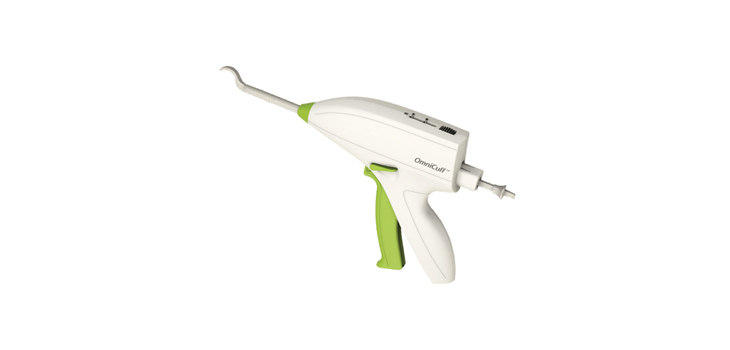
MinInvasive Ltd, a company based in Magal, Israel, has launched a new rotator cuff repair device into the U.S. market called OmniCuff.
New Rotator Cuff Repair Device Launched
2 min read Premium comments
#rotatorcuffrepairSecondary#mininvasiveltd#omnicuff
The new device is a transosseous rotator cuff repair tool which eliminates the need for suture anchors. The device itself is disposable.
The company told OTW that 26 OmniCuff system cases have been used during the first two months of the device’s limited release in the United States since October.
“We are very pleased that within the first 8 weeks of limited U.S. market release, the OmniCuff System has been successfully used by several very reputable sports medicine surgeons in 26 rotator cuff repair procedures,” said MinInvasive CEO Ronen Raz.
Joseph Abboud, M.D., utilized OmniCuff at the Rothman Institute at Thomas Jefferson University in Philadelphia for several rotator cuff repair surgeries. He said he is “extremely pleased with the technical ease and reproducibility of the device as well as the tremendous potential for direct cost savings.”
At Beth Israel Deaconess Hospital in Plymouth, Massachusetts, orthopedic surgeon Walter Stanwood, M.D., has completed more than a dozen surgeries with OmniCuff. He said that system offers “a very straightforward technique that minimizes steps, with an elegant device to consistently create transosseous fixation in a rotator cuff repair model. OmniCuff has enormous potential in any location that a tendon bone repair is performed.”
According to Nikhil Verma, M.D., professor and director of the Division of Sports Medicine and Shoulder Surgery at Rush University Medical Center in Chicago, the device also “allows for a seamless transition between traditional anchor-based repair, and an anchorless solution.”
“In addition, the availability of a technologically advanced and easy to use anchorless device has the potential to disrupt the market with a lower cost solution which is of paramount importance given recent movement of these types of cases to outpatient facilities and the emphasis on value-based care,” Verma said.
At the Hospital for Special Surgery in New York, Frank Cordasco, M.D., M.S., professor of orthopedic surgery and 35th president of the American Shoulder and Elbow Surgeons association, said that he has observed “remarkably diminished pain in the post-operative period in patients treated with the OmniCuff System compared to those treated with the transosseous equivalent rotator cuff repair technique during the first 3 weeks following surgery. This has resulted in a decreased need for opioid medications in the patients treated with the OmniCuff System.”
MinInvasive is planning to gradually expand OmniCuff’s availability in the United States.
Author
React:
Discussion
This is a fascinating development. In my practice we've seen similar outcomes with the revised protocol. The key differentiator seems to be patient selection criteria. Has anyone else noticed the correlation with BMI thresholds?
Great point. I'd push back slightly on the conclusion, the sample size in the cited study is too small to draw population-level inferences. That said, the directional signal is compelling and worth a larger RCT.
We implemented a similar approach last year. Early results are promising but we're still gathering 12-month follow-up data. Happy to share our protocol if anyone is interested.
Join the conversation
Orthopedic professionals are discussing this. Sign in and upgrade to read every comment and add your voice.