
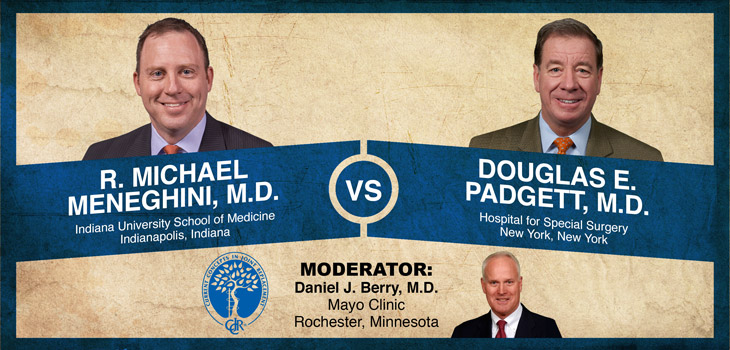
This week’s Orthopaedic Crossfire® debate was part of the 34th Annual Current Concepts in Joint Replacement® (CCJR®), Winter meeting, which took place in Orlando. This week’s topic is “Posterior Stabilized Knee Designs: Vestigial Organs.” For is R. Michael Meneghini, M.D., Indiana University School of Medicine, Indianapolis, Indiana. Opposing is Douglas E. Padgett, M.D., Hospital for Special Surgery, New York, New York. Daniel J. Berry, M.D., Mayo Clinic, Rochester, Minnesota is serving as the moderator.
Meneghini v. Padgett: Posterior Stabilized Knee Designs: Vestigial Organs
8 min read Premium comments
#anteriorcruciateligamentGreat Debates#posteriorstabilizedknee#vestigialorgans
Moderator Berry: Maybe surprisingly or shocking. “Posterior Stabilized Knee Designs: Vestigial Organs” is an interesting topic because 60% of the knees in the United States are now posterior stabilized [PS] knees. Speaking in the affirmative with a bit of an uphill battle is Michael Meneghini.
Dr. Meneghini: Yeah, an uphill battle. More importantly an uphill battle because moderator Berry taught me years ago during my fellowship to use a posterior stabilized design. Awkward? We’ll see.
I truly admire and respect Dr. Padgett, so it’s really going to hurt me to crush him in this debate. Well, not that much.
Twenty years ago, a younger looking Tom Thornhill and a very distinguished Robert Booth debated cruciate retaining versus posterior stabilized tibial inserts. Why are we bringing it back 20 years later? Why did even it fade away?
I would argue that total knee replacement has evolved. Twenty years ago, there was no clear advantage of cruciate retaining or posterior stabilized designs. The pros and cons were largely theoretical. The focus was on survivorship, not on patient outcomes. The metrics that we used back then were not sensitive enough to pick up small differences between implant designs.
I would argue that newer tibial inserts have enhanced sagittal conformity with anterior lipped designs to substitute for the posterior cruciate ligament, if it’s not competent. The cam-post mechanism is now obsolete.
So vestigial organ, appropriately named, what is that actually? The definition is “a structure in an organism that has lost all or most of its original function in the course of evolution.”
I’m going to use two arguments. An intuitive argument and then a scientific and data-driven argument.
The intuitive one starts something like this. So, the total knee, all of our body, is more fluid. The four-bar linkage, the total knee moves in very fluid, smooth mechanisms. So, it doesn’t really seem intuitive that you would replace that with something like a cam and a post.
I would argue that nothing in the human body really wants to slam into a post repetitively, over and over again as you walk or bend. That can’t be good either externally or internally in the long-term. The post-cam mechanism is not benign. You can have post wear and impingement. You can have fatigue fractures; patella clunk, which albeit has improved over time. And then just removing the extra step…removing the bone for the box prep…you can have additional bone loss at revision and a potential for condyle fracture, which has also been seen in PS designs.
Let’s look at the science.
In a recently published study by my senior partner (Biyani, et al., Surg Technol Int 2017) who did PCL [posterior cruciate ligament] resection in two different knees. He took away the cruciate ligament and replaced it with either an anterior lipped or a PS tibial insert. No functional differences reported at one year.
Brian Parsley and co-authors reported the same thing years ago using an ultra-congruent bearing versus posterior stabilized (J Arthroplasty 2006).
David Scott, et al. presented at AAHKS [American Association of Hip and Knee Surgeons] and subsequently published in the Journal of Arthroplasty, a prospective, randomized study of approximately 50 knees in each group, anterior lipped total knee versus PS total knee. The PCL was resected in all cases. There was no difference in functional outcomes at two years.
An elegant Mayo Clinic study of 8,000 total knees (Abdel, et al., JBJS-Am 2011). Fifteen years survivorship; 90% for cruciate retaining; 77% for posterior stabilized; and the risk of revision was lower in the cruciate retaining knees.
Finally, as we continue to evolve total knee designs, we bring technology into the picture. One of the big advances will be highly cross-linked polyethylene. It minimizes wear. But its Achilles heel is the fatigue properties. So, you cannot use a post in those designs. Long-term—you’ll see issues.
The emergence of anterior lipped cruciate retaining inserts obviates the need for a posterior stabilized total knee replacement with a cam and a post.
Surgical technique remains critical because the knee must be balanced in flexion whether you use a cruciate retaining or posterior stabilized design.
There is currently no scientific evidence to support a cam and post mechanism to replace a posterior cruciate ligament in total knee arthroplasty.
Dr. Padgett: Vestigial, according to Webster, is “an organ or part of the body that becomes functionless, such as your recta pila muscles, male nipples, tonsils.” Is the post-cam vestigial? This is the debate. I respect Michael and we are friends. But Michael on this—you are wrong.
Meneghini says, “cruciate retaining works.” Padgett says, “posterior stabilized post not only works, it predictably works.”
Mike let’s agree on this. The best knee is the natural knee. It’s the number one knee. It’s the bomb, right? No question about that. And the best gait data, is the bi-cruciate retaining gait. This goes back to Cloutier in the 80s. The problems with the bi-cruciate knees—they are technically difficult and while the gait data supports its more normalcy, clinical results demonstrate no advantage.
Modern day total knee. What’s the first step? We reset the ACL. And what happens with that? The kinematic data shows an increase in the degree of anterior translation in the ACL-deficient knee. Which, by the way, is what the cruciate retaining knee is, right?
But we want to drive contact posterior. How do we do this? Articular geometry, reliance on the PCL, or perhaps a post/cam mechanism.
So, what about that PCL? In most cases, in my experience, it’s degenerative, and it’s the Goldilocks effect. It’s too loose. It’s too tight. Ah, yes, it’s just right. Despite this though, let’s save the PCL. Michael has a bumper sticker on his car that says that.
Let’s assess TKR kinematics. Fluoroscopic and intraoperative sensor studies. Fluoroscopically it’s a loaded environment, reproducible by following the contact point through motion and the use of assessment to determine the impact of design variables on rollback.
In one prospective, randomized study—cruciate retaining versus posterior stabilized—at 5 years, taken through range of motion (Victor, et al., JBJS-Br 2005). The results showed greater rollback with the posterior stabilized. Greater amount of posterior translation. Forward displacement in the cruciate retaining knee. However, I will admit the clinical outcomes were similar.
What about more novel ways to assess this—intraoperative sensing? Michael, you’re familiar with this…right? I think you’ve actually written about this. Three pieces of work (J Arthroplasty 2017 and 2016).
Summary of Michael’s work … Early phenomena of lateral rollback equals better clinical outcomes in the cruciate retaining anterior lipped design. Getting a tighter grouping of the differences in the pressures on the medial and lateral sides yielded better UCLA scores. I think that’s important.
My problem with the cruciate retaining—with or without an anterior lip—is that the kinematics are unpredictable and you’ve got the risk for later dysfunction. Tearing. Stretching out.
What do you get with a posterior stabilized knee? You get a post-cam mechanism that’s durable. A post-cam mechanism that’s predictable. And a post-cam mechanism that’s reliable.
We started on the subject of vestigial structures. It is my suggestion, ladies and gentlemen, that the PCL in the total knee is the vestigial structure. That, in fact, the post lives on…long live the post.
Moderator Berry: Alright, gentlemen. Thank you both. You’ve made your points quite well. So, Mike people gradually have, not altogether, moved away from them to a PS design. Why? My guess is that it’s probably for two of the reasons Doug mentioned. One, is the PCL is kind of tough to balance and it’s easy to get a little too loose. There is unpredictability to that process. And then fluoroscopic data showed unpredictable kinematics once the PCL is gone. Can you address those two? Is the world different now? Or have you just decided it doesn’t matter?
Dr. Meneghini: To your first point, I think that the anterior lip gives those surgeons who want to try and retain the cruciate ligament a factor of safety. There is a factor of safety built in with modern designs that can help people transcend that. We’ll see if that maintains…if the world continues to be 60% PS, which it may do for the foreseeable future.
The second comment on the kinematic data…and its great fluoroscopic kinematic data…is that there is no correlation with that data and outcomes. We’ve talked about anterior paradoxical translation and femoral rollback for 30 years. Great work. But we have yet to correlate with outcomes. And our patients have changed. Our patients now come into our office with high-end activity levels.
Moderator Berry: I think you make a really good point.
Doug let’s look at the downside of the PS knee. Virtually every big, big, big registry study shows a slight—1 or 2% at 5-10 years—advantage of cruciate retaining versus posterior stabilized knees in terms of survivorship. Do you think a cruciate retaining knee, just because it’s a little less constrained, has a slight survivorship advantage or not? And if so, does it matter?
Dr. Padgett: I think that your points are appropriate, Dan, and it’s obviously hard to tease that out of the data. It doesn’t make a lot of sense to me that the survivorship would be matched for the degree of deformity and complexity of the patients. Quite frankly, it should be different for the two groups.
Institutional data, larger registries certainly support that concept. Unclear exactly what the etiology is behind that.
Moderator Berry: Fair enough. Is there a functional difference or advantage to the type of implant that you’re advocating compared to the one your opponent is advocating? I’ll start with Michael and then we’ll go back to Doug.
Dr. Meneghini: My argument is that there is absolutely no difference. With our current metrics and the data we have to date they are equivalent. There is data that if you resect the PCL or recess the PCL in cruciate retaining knees you get better motion. But they may also have less stability.
Dr. Padgett: I’ll tell you the one functional advantage of a posterior stabilized knee is that you’re not re-operating on posterior stabilized knees because of flexion instabilities. Mike, I think you’d agree with that.
Dr. Meneghini: Doug, I know that you live in Manhattan and seeing all those skyscrapers and the posts and all those things it makes sense. But those of us in the Midwest, that makes no intuitive senses to us. You guys walk into buildings all the time. We don’t want to do that. We like smooth transitions. I would argue that that mechanical device is showing up in the registries as less durable over 10-20 years.
Moderator Berry: Doug, so let’s go back to the post for just a quick second. The post does seem like a primitive way of getting rollback, I have to admit, even though I am a posterior stabilized user. Is there anything on the horizon that’s going to move us beyond the post but still get the kind of predictable kinematics that a PS knees gives us?
Dr. Padgett: I think unless we get over the first step of the total knee replacement, which we do right now, which is quite frankly resection of the ACL, and basically having a cruciate deficient knee, then what we have to use is what’s in our armamentarium
Moderator Berry: Gentlemen, thank you very much.
Please visit www.CCJR.com to register for the 2019 CCJR Spring Meeting, May 8 – 11 in Cleveland, Ohio.
Author
React:
Discussion
This is a fascinating development. In my practice we've seen similar outcomes with the revised protocol. The key differentiator seems to be patient selection criteria. Has anyone else noticed the correlation with BMI thresholds?
Great point. I'd push back slightly on the conclusion, the sample size in the cited study is too small to draw population-level inferences. That said, the directional signal is compelling and worth a larger RCT.
We implemented a similar approach last year. Early results are promising but we're still gathering 12-month follow-up data. Happy to share our protocol if anyone is interested.
Join the conversation
Orthopedic professionals are discussing this. Sign in and upgrade to read every comment and add your voice.