
If you want to learn how to join a class.
To cook, speak or potter in brass.
An apple for the teacher.
May help you reach’er.
And, if you’re lucky, you might rate a pass!
Limerick Researchers Test the Notion of Patient Education
2 min read Premium comments
#totalkneearthroplasty#totalhiparthroplasty#jointreplacementSecondary#patientanxiety
Or, for orthopod seeking improved patient outcomes, maybe pre-op education is the ticket!
A research team from Limerick, Ireland, decided to check out that particular hypothesis and the results of their work appears in the December 2018 edition of International Orthopaedicsunder the title: “Educational impact of joint replacement school for patients undergoing total hip and knee arthroplasty: a prospective cohort study.”
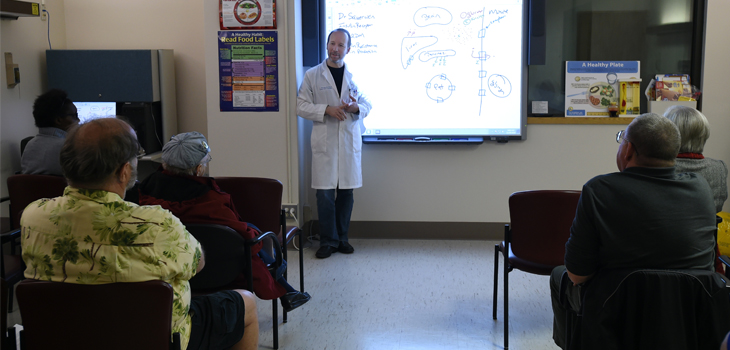
Co-author Marc O’Reilly, M.D., with the Department of Trauma and Orthopaedic Surgery Tullamore Hospital in Ireland, as well as the University of Limerick explained his work to OTW: “Improving patient outcomes and experience is what all centers strive for. As such we development the ‘Joint School’ at our institution for patients and we’ve found that it plays an extremely important role in this regard in the setting of elective arthroplasty surgery. Patient empowerment is a key element of modern medicine practice and any opportunity to educate and facilitate patient decision making should be seized.”
For their study, the authors enrolled “…27 male (47.3%) and 30 female (52.7%) patients all of whom completed surveys. Mean age overall was 64.5 years. All survey questions except those related to anesthesia and physiotherapy showed a statistically significant improvement after the joint school session. A total knowledge score was calculated and revealed a statistically significant difference between pre- and post-joint school survey answering…”
Dr. O’Reilly told OTW, “The first point to make is that from our review of the literature pre-operative education helps to alleviate patient anxieties and improves patient understanding. Undergoing surgery can be a very frightening and stressful event for patients and as doctors we have a duty to ease these concerns.”
“The main results from our study showed that overall patient knowledge or ‘Total Knowledge Score’ improved (statistically significant p<0.001) between pre and post educational sessions so we know we are achieving our objective in terms of content form and delivery. Patients’ own understanding of their proposed surgery was improved and overall satisfaction levels with the process were very high.”
“The ‘Joint School’ session is not a difficult entity to resource and if there is a collective willingness in a unit across the necessary specialties it is very attainable with clearly visible and positive outcomes. Also, in the age of tablets and rapidly improving technology the concept of augmenting our current session with a web-based adjunct is currently underway.”
“One of the key take home messages from this research is: Patient education = patient empowerment = valid informed consent. Patients need to fully comprehend what they are consenting to otherwise we are doing them a disservice.”
Author
React:
Discussion
This is a fascinating development. In my practice we've seen similar outcomes with the revised protocol. The key differentiator seems to be patient selection criteria. Has anyone else noticed the correlation with BMI thresholds?
Great point. I'd push back slightly on the conclusion, the sample size in the cited study is too small to draw population-level inferences. That said, the directional signal is compelling and worth a larger RCT.
We implemented a similar approach last year. Early results are promising but we're still gathering 12-month follow-up data. Happy to share our protocol if anyone is interested.
Join the conversation
Orthopedic professionals are discussing this. Sign in and upgrade to read every comment and add your voice.