
In females, says a multicenter team of California researchers, it is possible to alter brain signaling and have it increase (or decrease) bone density.
Estrogen Critical to Bone Density – New Research
2 min read Premium comments
#osteoarthritisSecondary#fracture#osteoporisis#bonedensity
The study, “Estrogen signaling in arcuate Kiss1 neurons suppresses a sex-dependent female circuit promoting dense strong bones,” appears in the January 11, 2019 edition of Nature Communications.
Holly A. Ingraham, Ph.D., professor and vice chair of Cellular and Molecular Pharmacology and the Herzstein Distinguished Investigator of Molecular Physiology at the University of California, San Francisco and co-author explained her study to OTW, “Our findings evolved from the lab’s efforts to determine how metabolic endpoints in female and male mice are influenced by estrogen’s actions in the brain.”
“My research program is motivated by the fact that while most research on estrogen is focused on peripheral tissues (breast, uterus, bone, etc.), the function of estrogen in the brain has largely been neglected.”
“Furthermore, historically most researchers exclusively relied on male subjects so as to avoid potential issues of fluctuating hormones in females. Our research program on the central actions of estrogen is likely to provide new insights into women’s health, especially as more post-menopausal women in the U.S. live longer and longer in an estrogen-depleted state.”
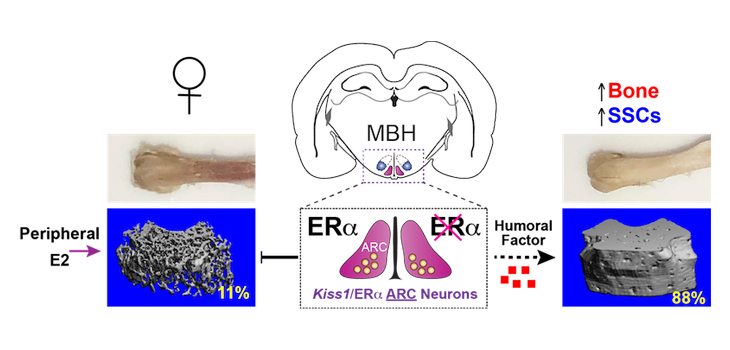
“In this study, we set out to understand the role of estrogen in a specific brain region by creating a genetic strain of mice lacking the estrogen receptor, ER α in the hypothalamus. The hypothalamus is considered the master regulator of many functions, including reproduction, metabolism, and adaptive stress responses.”
“Unexpectedly, after eliminating ER α in this brain region, a significant increase in bone mineral density (BMD) was detected only in mutant female mice. Not only is their trabecular bone mass higher, mechanical strength testing of the femur and the L5 vertebrae revealed that their bones are also significantly stronger.”
“We then carried out a series of experiments to determine which set of neurons in the brain might be responsible for this bone phenotype. To do this, we used several genetic mouse strains, as well as a method to delete ER α after surgical delivery of virus only in the brain.”
“This last line of investigation proves that the increase in bone density is due to estrogen’s actions in the brain and not in peripheral tissues—thus, establishing a new brain-to-bone pathway in female mice.”
“Because we have eliminated the ability of estrogen to act in these neurons, we suggest that this brain-to-bone pathway normally suppresses bone formation. After permanently disrupting this pathway, these restraints are lifted causing a massive build up in bone. We are now working with others to identify the factor that is responsible for these age-defying, ultra-sturdy bones. Finding this factor might be used to treat osteoarthritis, osteoporosis, and fracture repair.”
“We found remarkable increases in bone density in multiple models after manipulating hormone signaling in the brain. We learned that bone can be built up in older female mice at a life-stage when bone density normally declines. It turns out that a small cluster of neurons in the brain has such a profound effect on female bone metabolism.”
Author
React:
Discussion
This is a fascinating development. In my practice we've seen similar outcomes with the revised protocol. The key differentiator seems to be patient selection criteria. Has anyone else noticed the correlation with BMI thresholds?
Great point. I'd push back slightly on the conclusion, the sample size in the cited study is too small to draw population-level inferences. That said, the directional signal is compelling and worth a larger RCT.
We implemented a similar approach last year. Early results are promising but we're still gathering 12-month follow-up data. Happy to share our protocol if anyone is interested.
Join the conversation
Orthopedic professionals are discussing this. Sign in and upgrade to read every comment and add your voice.