
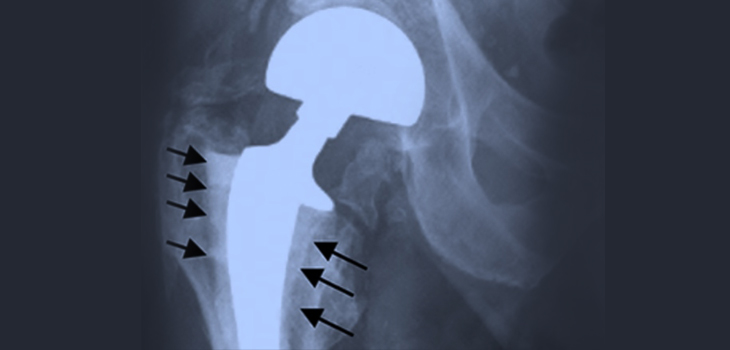
A failed joint replacement leaves patients and surgeons with big problems. Rutgers researchers homed in on the role of the immune system in the inflammation and bone loss that can occur after such as surgery.
Elegant New Work From Rutgers Explains Implant Loosening
1 min read Premium comments
#jointreplacementSecondary#inflammation#rutgersuniversity
Their study, “Sterile particle-induced inflammation is mediated by macrophages releasing IL-33 through a Bruton’s tyrosine kinase-dependent pathway,” appears in the January 21, 2019 edition of Nature Materials.
According to the Rutgers researchers, the study “found white blood cells, called macrophages, respond to the particles as if they were harmful invaders and engulf them. But the cells then die and secrete a specific molecule that triggers an even stronger immune response – including inflammation which can cause tissue damage and bone destruction which leads to loosening of the implants.”
“Bone degradation can occur within 10 to 15 years and often requires complex revision surgery to replace the implant and treat bone loss,” said lead author William Gause, director of the Center for Immunity and Inflammation at Rutgers New Jersey Medical School. “However, many people start experiencing pain from this inflammation shortly after surgery. They are prescribed medications for the pain, but the loosening continues.”
More generally, say the researchers, these studies reveal new insights into how inert and sterile microparticles, including pollutants such as diesel exhaust particles or silica, can cause robust and harmful inflammation, ultimately leading to disease.
“Although we typically think of infectious agents or toxins as causing disease, apparently the response of the body to these particles, which have essentially no intrinsic activities, can result in considerable tissue damage and pathology,” Dr. Gause said.
Dr. Gause told OTW, “We showed that sterile microparticles of a similar size and composition to wear debris particles trigger a type 2 inflammatory response in joint tissue and further showed that this could be inhibited by targeting specific signaling pathways including Bruton’s tyrosine kinase and IL-33.”
“Implant failure may result from harmful inflammation that leads to bone damage and aseptic loosening. This inflammation can be triggered by sterile microparticles that induce a particular type of immune response, which may be controlled by targeting Bruton’s tyrosine kinase or IL-33.”
Author
React:
Discussion
This is a fascinating development. In my practice we've seen similar outcomes with the revised protocol. The key differentiator seems to be patient selection criteria. Has anyone else noticed the correlation with BMI thresholds?
Great point. I'd push back slightly on the conclusion, the sample size in the cited study is too small to draw population-level inferences. That said, the directional signal is compelling and worth a larger RCT.
We implemented a similar approach last year. Early results are promising but we're still gathering 12-month follow-up data. Happy to share our protocol if anyone is interested.
Join the conversation
Orthopedic professionals are discussing this. Sign in and upgrade to read every comment and add your voice.