
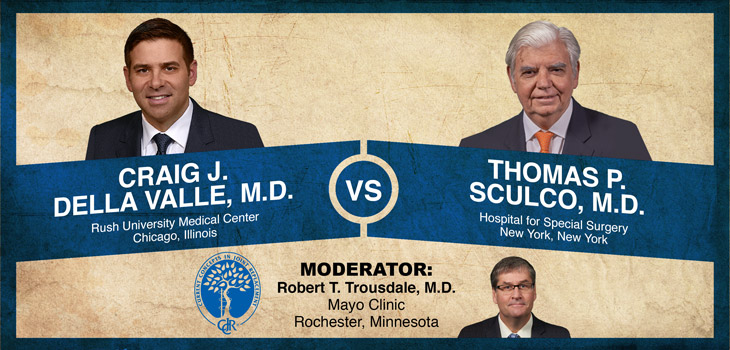
This week’s Orthopaedic Crossfire® debate was part of the 34th Annual Current Concepts in Joint Replacement® (CCJR®), Winter meeting, which took place in Orlando. This week’s topic is “Della Valle v. Sculco: Dual Mobility Cups: The Emergent Solution for Recurrent Dislocation.” For isCraig J. Della Valle, M.D., Rush University Medical Center, Chicago, Illinois.Opposing isThomas P. Sculco, M.D., Hospital for Special Surgery, New York, New York. Moderating is Robert T. Trousdale, M.D., Mayo Clinic, Rochester, Minnesota.
Della Valle v. Sculco: Dual Mobility Cups: The Emergent Solution for Recurrent Dislocation
10 min read Premium comments
#totalhiparthroplasty#thomassculco#craigdellavalle#dualmobilitycupGreat Debates
Dr. Della Valle: I think dislocation remains, no matter what surgical approach that you choose, one of the most common complications we see after total hip replacement and one of those most common we see after revisions. It’s morbid for patients, it’s expensive, and it’s something we certainly would like to treat better and ideally prevent.
The number one rule when it comes down to managing the patient with instability, like many things in revisions, is to understand the root cause. You really need to understand why the patient is dislocating to appropriately treat them.
The main benefit of dual mobility is to reduce the risk of dislocation. First released in France in the 1970s, it was introduced in the U.S. market in 2009.
There certainly have been design changes since 2009. Improved fixation is probably the biggest one. One design uses a monobloc metal cup with fins. It’s got a titanium sintered surface and today, most utilize crosslinked polyethylene. Some of the contemporary designs still use a stainless steel bearing, but many of them use a cobalt chrome alloy.
A major concern with dual mobility is intra-prosthetic dislocation, that’s basically the polyethylene disassociating from the small head. It’s generally secondary to wear at the introitus with that retentive rim, and I think most of the contemporary series have reported a reduced risk with better designs.
There are still concerns over greater wear because there are two articulations and again, with cobalt chromium counter bearings as well as crosslinked polyethylene, I think this is going to be less of a problem, but nonetheless something to certainly keep an eye on.
So, there are several studies out there that basically show that if you use a dual mobility bearing in revision total hip replacement, there is a low risk of dislocation. Rob Trousdale has shown that from his series at the Mayo Clinic and we’ve also shown it in one of our series at Rush. It also has a low risk of failure when used to treat instability specifically.
Indications for dual mobility. In the first dual mobility case I did, the manufacturer came to me, said that this design helped reduce the risk of dislocation. I had a case of modular, oncology, infected, proximal femoral replacement that we were revising. I figured, “Hey well if it works for instability, let’s try it in this case.” This case is now about 7 or 8 years old and it hasn’t dislocated. I use dual mobility in patients who are abductor deficient—again revisions for instability, but also for inadequate intraoperative instability or if you are unable to get a head size larger than 36mm at the time of revision surgery.
So, we’ve done 36 dual mobility bearings in high-risk patients and followed them for a minimum of two years. We had one dislocation that was closed reduced and it’s very important to understand, if one of these does dislocate, you need to reduce it under strict paralysis in the operating room with fluoroscopy because we’ve now seen several cases where someone did not do it in the operating room, did not do a paralysis and they caused an intra-prosthetic dislocation with a forceful attempt at a closed reduction.
The other thing I want to point out here, in addition to the two deep infections, we had two cases early on where we tried to take a modular dual mobility liner, scratch up the back like you would a polyethylene liner and then cement it into a shell. We did three of them and within 6 weeks two of those failed so, that is something that you really do want to avoid.
Dual mobility is a compelling option—its big advantage is its decreased risk of instability. We’ve used it for patients at high risk in primary total hips. We’ve used it in revisions to specifically treat instability as well as in lieu of a constrained liner, we also have a series using it as a salvage operation for failed monobloc metal-metal cups.
There are concerns out there regarding overall durability and intra-prosthetic dislocation. But I think with the contemporary designs, the risk of that should be lower, but I tell you we do need to follow these closely.
Dr. Sculco: I want to talk about the role of constrained sockets in hip instability and as Craig pointed out, there is no more traumatic event for the patient than having a hip dislocation and they’re frantic when this happens.
In the United States, dislocations are currently the most common cause of revision hip replacement surgery. There are lots and lots of causes, as Craig pointed out, for hip instability and even though you put your implant in perfectly, the hip can still dislocate, which is a very frustrating problem.
In terms of treatment, we have three major treatments available for the patient with a chronic hip dislocation: jumbo or bipolar heads, dual mobility liners, and the constrained liner.
I think using larger heads gets you some increased stability but not a lot, and I don’t think that’s a great option at this point in time if you really have a patient with persistent hip instability. With the larger heads, yes, you may get less prosthetic impingement, but you can also get more bony impingement which leads to instability.
I like dual mobility. I’m going to be an advocate for constrained sockets, but I do believe there is a great place for dual mobility.
A recent paper we published in the Bone and Joint Journal was a meta-analysis looking at 59 different studies comprising 18,000 hip replacements. The dislocation rate with dual mobility for the primary THAs was 0.9% and for the revision THAs was 3.0%, so it’s a very good device for these problems.
What are the potential disadvantages of dual mobility? Well, if you use the ADM system, the non-modular system, you can’t visualize the floor because it’s a monobloc—that can be a problem in terms of positioning. It’s cobalt chrome and that can be a little harder to seat because it’s a rigid metal.
Intra-prosthetic dislocation we talked of, the wear we really don’t know a lot about and we’ll know more in the future. I think with highly crosslinked polyethylene it will be better. The thing that concerns me about the MDM, so called the modular dual mobility, is we’re putting cobalt chrome against titanium, and we’ve been burned a lot with that in other systems, in other areas, and I have concerns that it may be a problem with the modular dual mobility system.
So, what about constrained liners? I think it’s important to realize there are two different categories of constrained liners, and that’s where I think some of the bad data—and the bad names for constrained liners—has come from. You have the focal constraint designs with a locking ring and the constrained tripolar which is the more conventional and time-proven device. And they’re very different.
We looked at 149 patients who had tripolar constrained devices and followed them for over 4 years. Complicated patients, 3.8 previous operations in this series. Primarily female patients and the reason that the procedure was done. Recurrent dislocation: 55%. Poor stability at revision: 45%. The tripolar systems were used differently: a new shell and socket in 38%, a liner into a compatible shell 35%, and a cemented tripolar into an existing shell, 27%.
This is the data: 16 revisions in a little over 4 years, complicated group of patients. Only 3.3% of patients had recurrent dislocation. A problem with the tripolar systems is that the ring that goes around the polyethylene, a certain number of them will break.
Here’s some data for the Duraloc focal constraint design, 16% dislocation rate, I think this is Craig’s paper (Della Valle CJ, J Arthroplasty 2005). The S-ROM, focal constraint, not the tripolar constraint, 18% dislocation rate (Berend KR, J Arthroplasty 2005). The Trilogy system, again, focal constraint, 12% dislocation rate (Andersen AV, ISRN Orthopedics 2013). Another Trilogy, focal constraint, 19% dislocation rate (Chalmers BP, J Arthroplasty 2016). And a tripolar system (Osteonics), 101 revision total hips using the tripolar 10.2-year follow-up—dislocation rate, 6% (Bremmer BR, J Arthroplasty 2003).
I think there is a place for the constrained liner in some of these more complex revisions we do. We did demonstrate joint stability in over 96%; there are issues in this more complex group of patients that can cause a problem.
When you look at tripolar constrained sockets, they are probably best for those with severe neuromuscular disease; Parkinson’s and things like that; those with an absent abductor mechanism—although Craig had some data where the dual mobility looks good in those patients; patients that fail with the dual mobility. And I have concerns about the use of these dissimilar metals in the modular systems as we look long term.
Moderator Trousdale: Routine primary total hip replacement, fair to say no role for dual mobility?
Dr. Della Valle: In my practice, no role.
Dr. Sculco: I believe there is a role for dual mobility in the primary hip and I’m talking about the older female patient.
Moderator Trousdale: Yeah, so high-risk instability patient.
Dr. Sculco:Right, that high-risk primary population is a good place for dual mobility.
Moderator Trousdale: Craig, for routine revision surgery, they’re all high risk for instability, of course, but no terrible back problems, no muscle problems, fixed bearing is the gold standard for total hip?
Dr. Della Valle: I’d still think so. I’m still using a large head, but I wouldn’t fault someone for using a dual mobility in a revision.
Dr. Sculco: Yeah. I agree with that. I think if it’s a chip shot revision, bone quality is good, soft tissues are good, dual mobility is an option and the modular dual mobility is a very good option for it and I would not again fault for using it.
Moderator Trousdale: Tom brought up the corrosion issue so let me give a clinical scenario: 60-year-old patient, trunnion problem, abductor mechanisms compromised, certainly ultra-high risk for instability…
Dr. Della Valle: So that’s the exact scenario where I worry because I want to be able to monitor that patient post-operatively. If we use a modular dual mobility design we are putting in another junction that could potentially generate cobalt or chromium. So, if I’m trying to monitor them, I try to avoid using a modular dual mobility in that specific scenario. They also are high risk for dislocation and if they are abductor deficient then I might actually use a constrained liner because I don’t want to put in that extra metal-metal modular interface.
Dr. Sculco: Yeah, I think that’s actually the ideal setting for a constrained acetabular component. Very poor soft tissues, the abductor mechanisms have been mucked up, the bone is not great, you’re worried about the metal-on-metal potential problem. I think that is the ideal setting for a constrained socket.
Moderator Trousdale: Craig, any role for cementing in the modular shiny cobalt chrome implant?
Dr. Della Valle: Yeah, if I want dual mobility and I have to cement something in, I use a cup. I’ll use a brand name because it’s what it is, it’s made for cement, it’s now owned by Smith & Nephew, it’s the Polar Cup. It’s a European product that’s made for cementation and you usually have to have about a 12 to13mm difference so if you have a 60mm shell you can usually get in a 49mm or 47mm Polar Monobloc dual mobility shell and you can cement that in there.
Moderator Trousdale: Yeah, we’ve had some success cementing the cobalt chrome dual mobility that’s made for primary, so it’s got a very rough HA surface on it and that interface is outrageously strong. Trying to take those out could be a chore so that could be a problem.
Dr. Sculco: Yeah, I think just to follow with the constrained sockets I think we’ve had failures trying to cement that liner into an existing shell and the reason is, it’s a fairly bulky liner and you tend, if you don’t have good cement margins and you try to just use a modicum of cement, they loosen and they fail. We’ve had failures with that so as you point out, Craig, I think you need a larger shell when you use that liner so you get good cement coverage, otherwise they potentially will fail.
Moderator Trousdale: So, maybe give the audience and me some clues here. How do you decide, Craig and Tom, between a dual mobility and a constrained liner? What are your criteria to say, “I’m going to do a dual mobility in this patient group or a constrained liner in this patient group?”
Dr. Della Valle: I would say the only scenario where I would favor constraint is that specific scenario where it’s a corrosion type issue because I’m worried about that extra modular junction just in terms of monitoring that patient post-operatively.
Moderator Trousdale: So, you’ll give dual mobility a shot and if it fails, you’ll go to next step of constraint.
Dr. Della Valle: Usually. There are several manufacturers that make shells that will take either a large head or a constrained or a modular dual mobility and I feel it just gives me the most options. Again, our experience, if you look at all comers, our risk of instability when we last looked was about 8% so that’s big.
Moderator Trousdale: Real deal, Tom.
Dr. Sculco: As I said earlier, if we are a straightforward revision, I think dual mobility works well. I think for the more complex revisions, poor soft tissue, older patients, you’re worried about instability, I still have more confidence you’re they’re going to be stable with a constrained socket.
Moderator Trousdale: Fair enough. Thank you, gentlemen, for a lively debate.
Please visit www.CCJR.com to register for the 2019 CCJR Spring Meeting, May 8-11 in Cleveland, Ohio.
React:
Discussion
This is a fascinating development. In my practice we've seen similar outcomes with the revised protocol. The key differentiator seems to be patient selection criteria. Has anyone else noticed the correlation with BMI thresholds?
Great point. I'd push back slightly on the conclusion, the sample size in the cited study is too small to draw population-level inferences. That said, the directional signal is compelling and worth a larger RCT.
We implemented a similar approach last year. Early results are promising but we're still gathering 12-month follow-up data. Happy to share our protocol if anyone is interested.
Join the conversation
Orthopedic professionals are discussing this. Sign in and upgrade to read every comment and add your voice.