
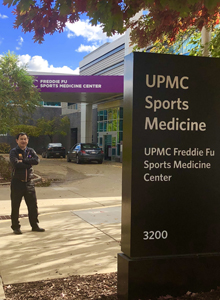
The University of Pittsburgh Medical Center (UPMC) recently honored sports medicine pioneer Freddie Fu, M.D., for his over 30 years of innovative work in sports medicine by renaming the medical building on the campus of the UPMC Rooney Sports Complex, the UPMC Freddie Fu Sports Medicine Center.
UPMC Sports Medicine Building Renamed for Dr. Freddie Fu
2 min read Premium comments
Secondary#freddiefu#universityofpittsburghmedicalcenter
Fu founded UPMC’s sports medicine program in 1986. The original location was a 1,500-square-foot suite in the Iroquois Building in Pittsburgh’s Oakland neighborhood. Under his leadership, UPMC Sports Medicine quickly grew to become one the largest and most comprehensive clinical and research program in its field, including not only sports medicine physicians and orthopedic surgeons, but also physical therapists, athletic trainers, nutritionists and neuropsychologists.
In addition, as first team physician for Mount Lebanon and Central Catholic High Schools in 1984, Fu spearheaded the first high school athletic trainer program in western Pennsylvania which now has grown into one of the largest in the country with 44 high schools, 7 of which have onsite team physicians. That same year Fu became the company physician for the Pittsburgh Ballet Theatre, a position he still holds today.
UPMC Sports Medicine eventually moved to a second location at Baum Boulevard and North Craig Street and when it outgrew that space too, the program moved to its current location, the UPMC Rooney Sports Complex in 2000.
The 37,000-square-foot facility on Pittsburgh South Side was partly designed by Fu and houses the indoor and outdoor training facilities of the University of Pittsburgh Panthers and the Pittsburgh Steelers.
Fu has served as the head team physician and orthopedic surgeon for the University of Pittsburgh athletic department for the past 32 years and has been the David Silver Professor and chair of the Department of Orthopaedic Surgery at the University of Pittsburgh School of Medicine since 1997.
He is an author of over 600 peer-reviewed articles and has made over 1,200 national and international presentations, co-authored 173 book chapters and edited 30 major orthopedic textbooks. His research has helped revolutionize anterior cruciate ligament (ACL) reconstruction.
Because of his medical achievements and his contributions to the Pittsburgh community, Pittsburgh Magazinenamed him one of the 100 most influential Pittsburghers of the 20th century in 1999.
More recently, in July 2016, Fu was inducted into the American Orthopaedic Society for Sports Medicine Hall of Fame and to celebrate that honor the council of the City of Pittsburgh dedicated September 13, 2016 to be Dr. Freddie Fu Day.
Author
React:
Discussion
This is a fascinating development. In my practice we've seen similar outcomes with the revised protocol. The key differentiator seems to be patient selection criteria. Has anyone else noticed the correlation with BMI thresholds?
Great point. I'd push back slightly on the conclusion, the sample size in the cited study is too small to draw population-level inferences. That said, the directional signal is compelling and worth a larger RCT.
We implemented a similar approach last year. Early results are promising but we're still gathering 12-month follow-up data. Happy to share our protocol if anyone is interested.
Join the conversation
Orthopedic professionals are discussing this. Sign in and upgrade to read every comment and add your voice.