
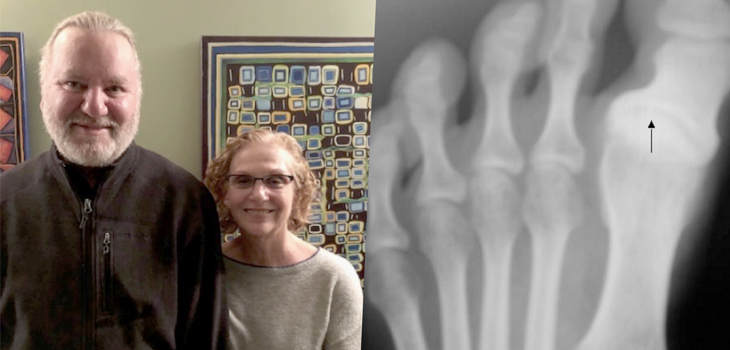
Joy and Arthur Leinoff, a couple in their 60s, have been suffering from toe arthritis for years forcing them to curtail their normally active lifestyle. Thanks to a new synthetic cartilage implant though, they have a new lease on life.
Synthetic Cartilage Offers Better Quality of Life
2 min read Premium comments
#hospitalforspecialsurgerySecondary#hailuxrigidus#toearthritis
The Leinoff’s enjoy tennis, hiking and traveling together, but the pain from their toe arthritis had grown more frequent and more intense.
“I had really bad pain and swelling in my big toe, particularly when I played tennis or when I would walk for long periods of time,” Joy Leinoff said.
“I was not able to wear high heels. Over the last few years, it got progressively worse. It was really awful.”
For her husband, Arthur, it was even worse, she said. He had severe arthritis in both his big toes.
“He tried everything, from ibuprofen to all kinds of liniments, you name it. He was desperate, but he didn’t want to have the joint in his big toe fused because that would end his tennis career and a lot of other things we like to do.”
Last year Joy had the synthetic cartilage (Cartiva, Inc.) implanted in the big toe on her left foot at the Hospital of Special Surgery in New York and a few months later, Arthur had the surgery on one of his big toes, coming back this year for the second surgery on his other foot. Now they are both pain free and have resumed their active lifestyle.
The implant is made from the same material that is used in contact lenses, and it is designed to mimic the natural cartilage found in the joint.
According to the physician who performed the surgeries on the Leinoffs, Andrew Elliott, M.D., an orthopedic surgeon at Hospital for Special Surgery, “Technically known as hallus rigidus, [toe arthritis] is one of the most frequent arthritis problems we see as foot and ankle surgeons. It occurs when the cartilage in the joint starts to wear out, and it usually gets worse over time.”
Elliott added that patient selection is very important. Patients who qualify have advanced arthritis that does not respond to conservative treatments such as anti-inflammatory medication. Patients also must still have motion in their big toe, and the bones in their joint must be able to support the implant.
“In carefully selected patients, I’ve seen the synthetic cartilage work well. Many have gotten back to activities they enjoy,” he says. “Still, we caution patients not to engage in intense athletics or exercises that put extreme stress on their toe to ensure that the implant will last.”
Elliott told OTW that five-year data on the implant out of Canada shows good results, but there are still concerns with patients experiencing persistent pain and needing revision surgery because of implant wear. He said that he hasn’t experienced these problems with his patients however.
“Most of my concern is about patient selection. Not all people with hallux rigidus should get this procedure,” he said.
Author
React:
Discussion
This is a fascinating development. In my practice we've seen similar outcomes with the revised protocol. The key differentiator seems to be patient selection criteria. Has anyone else noticed the correlation with BMI thresholds?
Great point. I'd push back slightly on the conclusion, the sample size in the cited study is too small to draw population-level inferences. That said, the directional signal is compelling and worth a larger RCT.
We implemented a similar approach last year. Early results are promising but we're still gathering 12-month follow-up data. Happy to share our protocol if anyone is interested.
Join the conversation
Orthopedic professionals are discussing this. Sign in and upgrade to read every comment and add your voice.