
A team from the Massachusetts Institute of Technology (MIT) is helping out in an area where there aren’t a lot of treatment options: osteoarthritis.
Study: Nanocarrier Delivers Drugs Directly to Cartilage
2 min read Premium comments
#osteoarthritisSecondary#knee#cartilage
Their study, “Cartilage-penetrating nanocarriers improve delivery and efficacy of growth factor treatment of osteoarthritis,” appears in the November 28, 2018 edition of Science Translational Medicine.
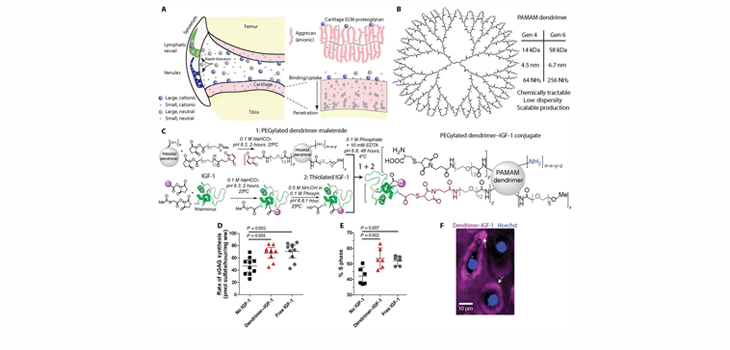
Brett Geiger, a Ph.D. candidate at MIT in Cambridge, Massachusetts, and lead author on the study, explained the study to OTW, “Our colleague and co-author Professor Alan Grodzinsky, Sc.D. had been studying transport, mechanics, and the biology of cartilage for decades and made this exciting discovery that positively charged nano-sized materials would stick to negatively charged cartilage and move through it much more quickly than neutral materials.”
“He thought this could be useful for better drug delivery to cartilage, which has been a challenging problem that has caused many biologic, potentially disease-modifying pharmaceuticals for osteoarthritis to fail in clinical trials.”
“Our lab (led by Professor Paula Hammond, Ph.D.) has a great deal of experience with chemistry and drug delivery with nanomaterials so we teamed up with the Grodzinsky lab to combine our knowledge. We set out to design a positively charged nanocarrier that could penetrate cartilage and deliver a growth factor more effectively. This has been my thesis project and this article describes the main thrust of this work.”
“When our technology was used to delivery IGF-1 to rat joints by intra-articular injection, the IGF-1 lasted 10 times longer in the joint that it does on its own. When osteoarthritic rat joints were treated with unmodified IGF-1, they did not show significant improvement over untreated rats. When osteoarthritic rat joints were treated with dendrimer-IGF-1 (our technology), they showed significant reduction in area and width of cartilage degeneration and volume of osteophytes compared to untreated rats (greater than > 50% reduction in all of these endpoints).”
“In short, we showed that we could improve the delivery of biologics to joints with a positively charged nanomaterial, and that this improved delivery would increase the efficacy of the biologic drug in a rat model of osteoarthritis.”
“Many of the difficulties intra-articular pharmaceuticals face in osteoarthritis are rooted in their poor delivery to cartilage. Improved drug delivery can improve the efficacy of drugs in osteoarthritis. Drug delivery is an important challenge facing potential disease-modifying drugs. We have developed an exciting solution to this challenge that can in theory be applied to nearly any drug but will need additional expertise and funding to move it towards clinical testing. Please reach out to us if you are interested in learning more or collaborating.”
Author
React:
Discussion
This is a fascinating development. In my practice we've seen similar outcomes with the revised protocol. The key differentiator seems to be patient selection criteria. Has anyone else noticed the correlation with BMI thresholds?
Great point. I'd push back slightly on the conclusion, the sample size in the cited study is too small to draw population-level inferences. That said, the directional signal is compelling and worth a larger RCT.
We implemented a similar approach last year. Early results are promising but we're still gathering 12-month follow-up data. Happy to share our protocol if anyone is interested.
Join the conversation
Orthopedic professionals are discussing this. Sign in and upgrade to read every comment and add your voice.