
Sunnyvale, California-based Simplify Medical Pty Ltd. has announced the completion of the “enrollment and treatment of all patients in its U.S. Investigational Device Exemption (IDE) pivotal trial evaluating the SimplifyDisc for two-level cervical disc replacement.”
Simplify Wraps Up 200-Patient Study Enrollment
2 min read Premium comments
#cervicaldiscreplacementSecondary#simplifymedical#simplifydisc
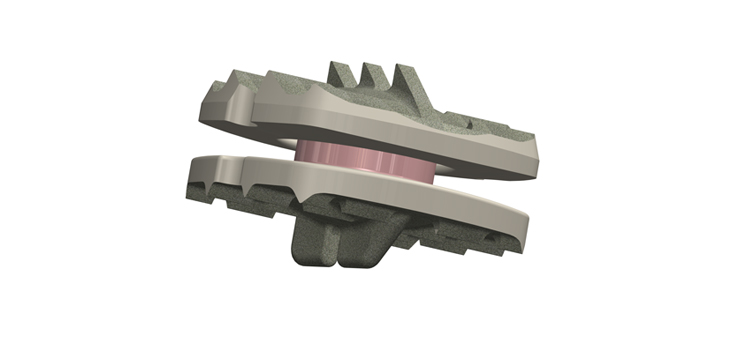
“The Simplify Disc is designed for biomechanical motion, anatomical height-matching, and MRI compatibility with a goal of simplifying the treatment of degenerative disc disease.”
According to the company, “The prospective, multi-center clinical trial enrolled a total of 200 patients at 18 clinical sites across the United States. The primary endpoint of the study is the clinical success rate of Simplify Disc in two contiguous levels from C3 to C7 compared with two-level anterior cervical discectomy and fusion (ACDF). The company announced the completion of enrollment for its one-level IDE trial in February 2018.”
Company CEO David Hovda said, “Our two-level trial has generated an exceptional level of interest, which has allowed us to complete study enrollment more quickly than anticipated. We thank all of our dedicated surgeon investigators who have participated in the trial and look forward to working with them to complete the study.”
Domagoj Coric, M.D., chief of Neurosurgery at Carolinas Medical Center and national co-primary investigator for the study as well as co-primary investigator of the one-level study, stated, “Given its compelling feature set and the early positive feedback, I believe the Simplify Disc represents the future of cervical disc arthroplasty. I look forward to providing my patients with this technology as it becomes commercially available and am eager to share clinical data when available.”
Richard Guyer, M.D., is chairman of the Texas Back Research Institute Foundation and national co-primary investigator for the two-level study as well as co-primary investigator of the one-level study. He commented to OTW, “The Simplify Disc is designed to match patients’ anatomy by offering lower height implant options (4-6mm), than what is currently commercially available. These lower height options better match patients’ natural disc heights. This is achieved with a domed superior endplate, which fits into what is typically a domed vertebral body above the disc space.”
“We analyzed the disc heights of patients in our previous clinical trial and found that the average disc height was about 4mm tall. The rationale is that a disc that appropriately matches a patient’s natural (healthy) anatomy is going to offer patients better biomechanics, reduced facet strain and overall better long-term clinical outcomes.”
“Simplify Disc contains no metal on the articulating surfaces of the disc. It is comprised of a medical-grade polymer called PEEK [polyetherketone] for the endplates and a ceramic core. The Simplify Disc was designed for durability and to eliminate metal wear. Our wear testing has shown favorably low levels of wear rates.”
Author
React:
Discussion
This is a fascinating development. In my practice we've seen similar outcomes with the revised protocol. The key differentiator seems to be patient selection criteria. Has anyone else noticed the correlation with BMI thresholds?
Great point. I'd push back slightly on the conclusion, the sample size in the cited study is too small to draw population-level inferences. That said, the directional signal is compelling and worth a larger RCT.
We implemented a similar approach last year. Early results are promising but we're still gathering 12-month follow-up data. Happy to share our protocol if anyone is interested.
Join the conversation
Orthopedic professionals are discussing this. Sign in and upgrade to read every comment and add your voice.