
A 109 patient study concludes that anterior cervical discectomy (ACD) with or without fusion, provides an equivalent outcome to anterior cervical disc arthroplasty (ACDA).
New Study: Cervical Discectomy Equivalent to Arthroplasty
2 min read Premium comments
#arthroplastySecondary#anteriorcervicaldiscectomyandfusion#discherniation#interbodyfusion#intervertebraldevice
This study, “The NECK trial: Effectiveness of anterior cervical discectomy with or without interbody fusion and arthroplasty in the treatment of cervical disc herniation; a double-blinded randomised controlled trial,” appears in the December 21, 2018 edition of The Spine Journal.
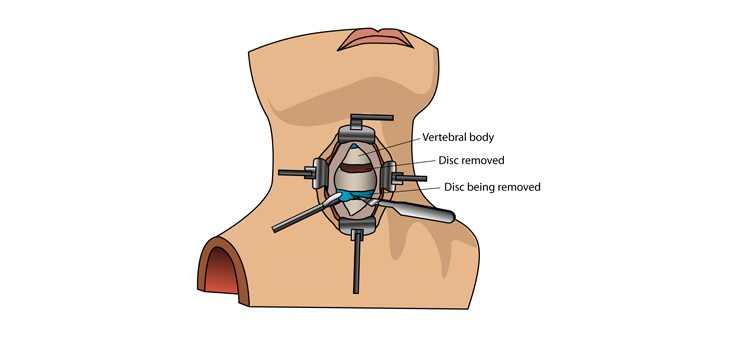
The patients either received ACDA, anterior cervical discectomy and fusion (ACDF) with an intervertebral cage, or ACD without fusion.
Carmen L.A. Vleggeert-Lankamp, M.D., M.Sc., Ph.D.neurosurgeon at Leiden University Medical Centre inthe Netherlands and investigator on the study explained the rationale to OTW, “This particular topic got our interest because so many of our colleagues started to implant this device. We were perfectly happy with the treatment method that we applied, namely placing an intervertebral cage after anterior discectomy or leaving the intervertebral space happy.”
“We therefore searched the literature in order to get some proof that the new prosthesis would indeed give better results. We could however not find this. Because the prosthesis got so much attention though, we decided to start a randomized controlled trial. We not only wished to evaluate the prosthesis, but we also wanted to evaluate our method of not placing an intervertebral cage.”
The authors described their results as follows, “The NDI [Neck Disability Index] declined from 41 to 47 points at baseline to 19±15 in the ACD group, 19±18 in the ACDF group, and 20±22 in the ACDA group after surgery. VAS [Visual Analog Scale] arm and neck pain declined to half its baseline value and decreased below the critical value of 40mm. Quality of life…increased in all three groups…”
Dr. Vleggeert-Lankamp commented to OTW, “The most important result is that there is no difference between the three types of surgery. Not only does placing a prosthesis in the intervertebral space give the same results as a cage (note that the prosthesis is more expensive!), but it also appeared that not placing a cage gives comparable results. It may be so that in a particular subgroup of patient results would be different however, but our results have no indication in that direction.”
“Practical recommendation: do not place a prosthesis, it is more expensive and does not give better results. Academic interest: if not placing a device in the intervertebral space gives the same result: what would be the advantage of placing a cage in the intervertebral space?”
Author
React:
Discussion
This is a fascinating development. In my practice we've seen similar outcomes with the revised protocol. The key differentiator seems to be patient selection criteria. Has anyone else noticed the correlation with BMI thresholds?
Great point. I'd push back slightly on the conclusion, the sample size in the cited study is too small to draw population-level inferences. That said, the directional signal is compelling and worth a larger RCT.
We implemented a similar approach last year. Early results are promising but we're still gathering 12-month follow-up data. Happy to share our protocol if anyone is interested.
Join the conversation
Orthopedic professionals are discussing this. Sign in and upgrade to read every comment and add your voice.