
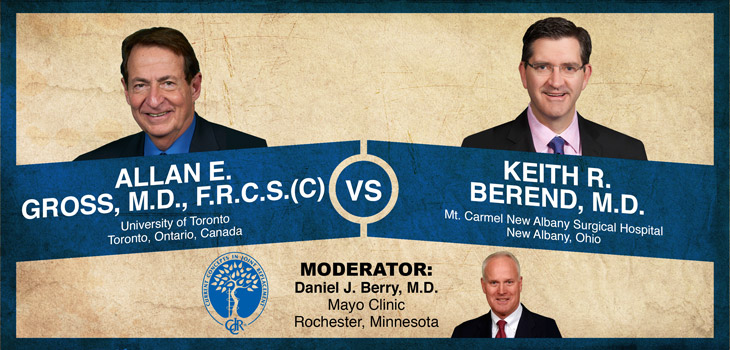
This week’s Orthopaedic Crossfire® debate was part of the 34th Annual Current Concepts in Joint Replacement® (CCJR®), Winter meeting, which took place in Orlando. This week’s topic is “The Cup Cage Construct: Preferred Solution for Pelvic Discontinuity.” For is Allan E. Gross, M.D., F.R.C.S.(C), University of Toronto, Toronto, Ontario, Canada.Opposing is Keith R. Berend, M.D., Mt. Carmel New Albany Surgical Hospital, New Albany, Ohio. Moderator is Daniel J. Berry, M.D., Mayo Clinic, Rochester, Minnesota.
Gross v. Berend: The Cup Cage Construct: Preferred Solution for Pelvic Discontinuity
12 min read Premium comments
Great Debates#pelvicdiscontinuity#ccjr#trochantericosteotomy
Dr. Gross: The options for chronic pelvic discontinuity are:
- plate and an uncemented cup
- a cage and structural allograft
- a large uncemented cup plus or minus an augment with pelvic distraction
- a triflange cup
- 3D printed custom implants and
- finally, the cup cage.
The custom triflange cup. A study from the Hospital for Special Surgery (J Arthroplasty, 2016)—63 patients – reported fairly good results, although the dislocation rate was high. The revision rate was 13.5%. And they did not separate discontinuity in the series. There is a big difference in the results of these reconstructions between those with and without discontinuity.
A study from my worthy opponent’s center (Clin Orthop Relat Res, 2015)—23 patients—reported very good results with 0% dislocation. But, once again, they didn’t separate pelvic discontinuity. I’m sure we’ll get more up-to-date data.
A very good series because part of it comes from Nashville—which actually talked a lot about the triflange cup (Clin Orthop Relat Res, 2012)—57 patients; pretty good follow-up (average 65 months); 81% had a stable reconstruction. Twelve patients, however, had instability and 10 of those required revision.
Now the cup cage construct. A paper we published back in 2014 (Bone Joint J, 2014) showed that the cup cage did better than conventional cages.
The cup actually bridges the discontinuity and ingrowth occurs on both sides of the discontinuity. You don’t get a primary healing of the discontinuity. It’s like a fracture due to a metastasis. It will not heal primarily so what we try to do with the cup cage is get ingrowth on both sides of the discontinuity.
In our latest publication (Clin Orthop Relat Res, 2016), we describe all of our cup cages, but a large percentage were discontinuity. Seventy-five cup cages, three tumor cases and one acute fracture were excluded and we lost four patients to follow-up so we had 67 cup cages in 64 patients with a good follow-up (average 73.5 months) for a revision series.
Within this study, there were 26 Type IV defects (bone loss greater than 50% of the acetabulum) and 41Type V defects with pelvic discontinuity. For cases without pelvic discontinuity, the revision rate was 7.6%. For cases with pelvic discontinuity, the revision rate was 9.1%. So there is a difference, but still a very good result.
In more recent results—121 patients have had cup cages. We’ve had 60 with a pelvic discontinuity. The average follow-up is almost four years (range: 1 – 153 months) and we’ve had an 11% revision rate. Pretty good.
Now the advantages of the cup cage—it’s off the shelf customization. Pelvic discontinuity may be an intraoperative finding. You can do a demitasse cup. If you come from Canada and you speak French—you know that a demitasse is a half of a cup. In one particular case, on the one side we did a cup cage but on the other side, we could not stabilize the cup for a cup cage, so we did the demitasse cup cage and used an augment to bridge the discontinuity.
Bone stock can be restored when you do a cup cage…by bone or by augments. Surprises can be managed by our big box of toys. If you like Ikea or Lego, cup cage is for you.
Finally, in one very, very difficult case I thought definitely we would need a triflange cup, so we ordered one. Wrong! We can make a cup cage look like a triflange cup. There’s almost nothing we can’t tackle without having to order a custom device.
In closing, as Donald Trump would say…”I think this is probably the greatest invention in the history of mankind.” Except perhaps, well no, not perhaps, a distant second or third would be the wheel and fire.
Dr. Berend: So, I’m going to take an approach that is slightly different.
We all know what acetabular disasters are and what we’re really talking about here are the combined disasters or the discontinuities. And the real question of this debate is…is the cup cage the preferred solution for these significant acetabular problems.
It’s a great concept. As was just said, interestingly, it is the ultimate Lego set. And if I had a pair of twins running around that were age 3 or 4 at home and I played with Legos every day—which I don’t…I’m an empty nester—I would be into things where I can reconstruct and pull the box of toys out and put the green Lego with the blue Lego. And if I did this at home every day…I’d probably be very, very good at it. And that’s what Legos accomplish and I think that’s what Dr. Gross is very, very good at accomplishing.
The issue for me is, I’m an empty nester and so instead of playing with Legos at night, I have to get my instructions and follow the instructions in order to have a successful result. And I want to be able to do the same thing in the operating room.
I need to identify the bad problem. I need to understand the deformity. I need to use mypreferred solution and I need to get stable fixation.
We’re all trying to accomplish the same thing. Put something between the butt and the ground.
Consider the case of a patient who had a right total hip replacement. Felt something crack or pop. Felt like her leg seemed shorter. The resulting major problem is a significant pelvic discontinuity with significant bone loss. And in myhands the preferred solution is a custom triflange.
But why is that? Number 1: I receive the images ahead of time. I know exactly what I’m dealing with. I don’t have to pull the box of toys out to figure out which widget, which Lego—the green, the blue or the red—is going to fit this patient best. In myhands I want to know ahead of time exactly how I’m going to attack this reconstruction. It also helps me with the dissection during the operating room.
Number 2: I receive a model preoperatively that I can play with and plan my attack and a sterile model intraoperatively of both the pelvis and the implant that I can play with in the operating room. Figure out my anatomic and boney landmarks. Figure out the level of dissection I need. And then also, finally, I can take the whole thing and put it together in a web-based conference with the manufacturer and plan out the operation. Plan out the procedure ahead of time. And for me, having that plan; having those instructions, is the preferred solution.
The final thing is the fact that with this design you actually get a cheat sheet. You have your model in the operating room. And then you drill your holes.
You don’t have to worry about deep penetration, injuring neurovascular structures, etc. You know right where the good bone is. In addition, you can use locking screws to enable this thing to become an internal/external fixator between the discontinuity. Just as Dr. Gross mentioned, we’re not trying to get the discontinuity to heal, we’re trying to get a stable construct above and below the discontinuity to span it such that we’ve got stable fixation in 3 planes.
As I mentioned, you get a model preoperatively and intraoperatively, which helps with “Where do I need to remove bone?” “Where do I need the implant to sit?” “Where do I need to do my dissection?” I think, in my hands, this is safer and easier than trying to just play it by ear and wing it out of a box.
We were part of a multicenter cohort study which looked at 95 hips and represented just under 4% of all the hip revisions at these sites. BMI [body mass index] was light. They averaged just under 2 prior surgeries per patient. And they had an average of about 5 years since their last surgery.
In this group of 95 hips, there were 8 discontinuities, but also 29 subsequent femoral revisions were performed as well.
We ended up using an average of 12 screws per implant; 3 of those were locking screws. We’ve had no dislocations. Most common head size was 36mm. We used 14 constrained liners. There’s HA [hydroxyapatite] coating on all of the devices.
Again, one big advantage is that the screw map gives me the ability to put in the so-called “home run” screw up into the ilium. Instead of trying for where the best bone is, I know exactly where it is. The implant itself drives the screw into that home run position. And you can place a 40, 50, 60 or even sometimes a 70mm screw to obtain excellent fixation.
The clinical results…3-5-year follow-up…the Harris hip scores improved modestly as you’d expect in this difficult group of patients (47 pre-op vs. 69 post-op).
But this is not for the faint of heart—22% had at least 1 complication; 6 dislocations; 6 infections; and 2 femoral-related issues. One cup was repositioned at 6 weeks to the same implant and has achieved fixation. One loosened due to metastatic cancer to the pelvis.
Aside from the one loosening for metastatic cancer, there were no other cases of aseptic loosening.
So, the question is…the cup cage…is it preferred? I say it’s okay. And it’s okay if you’re very good. It’s okay if you’re good with Legos.
In my hands it is not the preferred solution. A custom triflange is. I believe that it works. I believe it’s easier. And it may, in fact, be better because of all the tools that come along with it. The web conference call to design helps you. The screw map helps you. A modular poly locking mechanism allows you to use whatever level of constraint or size of ball you feel you need.
We use liberal constraint particularly in the abductor deficient hip. We’re able to use locking screws, which we believe increases the ability to achieve fixation and stable fixation above and below the discontinuity. We’ve had 1 case of aseptic loosening, but it was not in a discontinuity.
Moderator Berry: We’ve all just heard 2 excellent talks on 2 different ways to handle one of the toughest problems in revision hip replacement, which is pelvic discontinuity. One thing I’d like to emphasize to everyone in the audience is that while both of the techniques are quite different, they still emphasize a similar concept.
They both are trying to turn the hemipelvis into a unit and get a stable socket without necessarily trying to get this chronic nonunion to heal itself across the nonunion.
Both of the speakers emphasized that and it’s worth pointing out that a third technique that you didn’t hear about this morning, which Wayne Paprosky has popularized where you actually kind of distract the pelvis, put in a big cup and allow the elastic recoil of the sides of the pelvis to squeeze the cup in and hold it together; and hold it against the pelvis also does the same thing. It creates a unit out of the hemipelvis but doesn’t require healing of this bone that’s so hard to be to heal.
Now let me turn to the debate for the moment. Allan, Keith made a valuable point which is if you’re willing to play with lots of little pieces and put them together and enjoy the jigsaw puzzle element of things, you can make a cup cage work. But on the other hand, it does take a certain element of 3-dimensional thinking and familiarity with all the pieces and figuring out…and patience, if you will…kind of reconstruct it in surgery.
What do you think about the idea of dropping in a big thing that somebody’s already done on the back table? Pros and cons of that. You want to give us that from your standpoint? Why haven’t you gone to that?
Dr. Gross: For one thing, I think that we actually do a custom device, but we do it intra-operatively. And we have trials for all of the different cups, cages and augments. So, we put the thing together with trials, intra-operatively, as opposed to some engineers doing it based on a 3D reconstruction. The other thing is that occasionally a triflange cup can be delivered and it’s too large or too small.
We don’t have those problems. I agree that there are certain advantages to a triflange cup. For us, even though a cup cage is expensive, a triflange cup is much more expensive and you have that long waiting period. The other thing about a cup cage is that sometimes you get surprises in the operating room. The bone loss is bigger than you expected radiographically. You find a pelvic discontinuity when you didn’t expect one and we can address that on the spot. We didn’t have to order in a custom device.
Moderator Berry: One of the problems with a triflange is it’s a great big device and requires a lot of exposure to get in. Occasionally they go bad. If they go bad, of course, it’s a big problem. You reported 22% complication rate in your triflanges and only a small proportion of those were pelvic discontinuity patients. And the pelvic discontinuities are a much tougher subset than the whole group that you reported on. So, we can assume that in the pelvic discontinuity group your complication rate would be at least that high.
Tell us, how do you go about trying to minimize the risk of big complications if you’re putting in a big implant like that?
Dr. Berend: I think that exposure-wise the model is very helpful in knowing where I’m going to need to be putting my parts and my screws and what I need to get exposed. In having the model to me ahead of time allows me to customize my approach. Am I going to do a trochanteric osteotomy?A trochanteric slide? Do I need to take the femur out? Do I need to do something more complex to get that exposure?
At the end of the day where we’re putting the fixation, where we’re putting the part…it is a big part to put in, but it’s not any bigger than putting together a large cup cage custom with an augment, let’s say. You’re seeing the same stuff.
Moderator Berry: They are tough cases. Everybody will agree on that point. Allan, when you’re doing these cases, how do you try to protect the abductors?
Dr. Gross: I think actually doing a trochanteric osteotomy protects them to a degree. Because you are keeping them intact. Most of our cup cages are either a trochanteric osteotomy or what we call a fake trochanteric osteotomy where there is no trochanter but we kind of pretend there is one and we take the abductors and whatever is left of the greater trochanter and the vastus and retract it anteriorly.
The other thing is that you have to get down to bone and have to stay on bone. That’s really important. As soon as you wander off the bone when you’re going up into the ilium, you’ve got the superior gluteal branches and the nerve.
Dr. Berend: And that’s true of the pubis and that’s true for the ischium as well because you’ve got to get on bone and stay on bone. It reduces your risk of nerve and vascular injury. If you wander away, you’re in big trouble.
Moderator Berry: Finally, one of the big bugaboos about pelvic discontinuities is the sciatic nerve. Give me 15 seconds on how you protect the nerve, how do you avoid trouble with it with your technique.
Dr. Berend: I do an anterior-based approach so I’m away from it as far as possible. As Allan said, get on bone and stay on bone. You can dissect the entire ischium as long as you’re on bone when you get there.
Dr. Gross: We always slot that inferior flange into the ischium. Don’t put it on top of the ischium because your retractors are too close to the sciatic nerve.
Moderator Berry: Gentlemen, thank you both very much for an informative and very valuable debate.
Please visit www.CCJR.com to register for the 2019 CCJR Spring Meeting, – May 8 – 11 in Cleveland.
React:
Discussion
This is a fascinating development. In my practice we've seen similar outcomes with the revised protocol. The key differentiator seems to be patient selection criteria. Has anyone else noticed the correlation with BMI thresholds?
Great point. I'd push back slightly on the conclusion, the sample size in the cited study is too small to draw population-level inferences. That said, the directional signal is compelling and worth a larger RCT.
We implemented a similar approach last year. Early results are promising but we're still gathering 12-month follow-up data. Happy to share our protocol if anyone is interested.
Join the conversation
Orthopedic professionals are discussing this. Sign in and upgrade to read every comment and add your voice.