
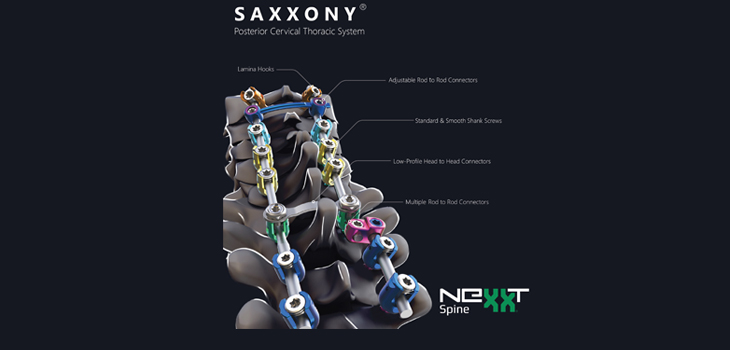
On December 4, 2018, Nexxt Spine, LLC, announced that the FDA 510(k) had cleared and therefore allowed full commercial launch of its Saxxony Posterior Cervical Thoracic System.
FDA Clears Nexxt Spine Cervical Thoracic System
1 min read Premium comments
Secondary#fusion#nexxtspine#fda510k
The system, according to FDA documents, is intended to “immobilize and stabilize cervical (C1 to C7) and thoracic (T1 to T3) spinal segments as an adjunct to fusion for the treatment of the following acute and chronic instabilities:
- traumatic spinal fractures and/or traumatic dislocations;
- instability or deformity;
- failed previous fusions (e.g. pseudarthrosis);
- tumors involving the cervical/thoracic spine; and
- degenerative disease, including intractable radiculopathy and/or myelopathy, neck and/or arm pain of discogenic origin as confirmed by radiographic studies, and degenerative disease of the facets with instability.”
The system is also intended to “restore the integrity of the spinal column even in the absence of fusion for a limited time period in patients with advanced stage tumors involving the cervical spine in whom life expectancy is of insufficient duration to permit achievement of fusion.”
“In order to achieve additional levels of fixation…” the system rods, according to the documents, “may be connected to cervicothoracic or thoracolumbar stabilization systems ranging in diameter from 3.5mm to 6.5mm, using corresponding rod to rod connectors and/or transition rods.”
The company said the Saxxony, manufactured from cobalt chrome, includes standard and smooth shank screws which are available in a variety of diameter and length combinations. It also includes low profile cross connectors featuring multi-axis adjustability and various configurations of offset, parallel, and axial connectors.
The Noblesville, Indiana-based company submitted its clearance notification on September 9, 2018 and received the clearance on November 13, 2018.
Andy Elsbury, the company’s president, said the Saxxony system, “adds a robust posterior complement to our well received anterior cervical fixation offering as we continue to innovate and grow our fusion portfolio.”
Author
React:
Discussion
This is a fascinating development. In my practice we've seen similar outcomes with the revised protocol. The key differentiator seems to be patient selection criteria. Has anyone else noticed the correlation with BMI thresholds?
Great point. I'd push back slightly on the conclusion, the sample size in the cited study is too small to draw population-level inferences. That said, the directional signal is compelling and worth a larger RCT.
We implemented a similar approach last year. Early results are promising but we're still gathering 12-month follow-up data. Happy to share our protocol if anyone is interested.
Join the conversation
Orthopedic professionals are discussing this. Sign in and upgrade to read every comment and add your voice.