
On November 2, 2018, the FDA and Department of Defense (DoD) announced a Memorandum of Understanding (MOU) to accelerate regulatory assessment of medical products for military personnel.
FDA and Pentagon Agree on Expedited Medical Reviews
1 min read Premium comments
#fdaSecondary#pentagon#warinjuries
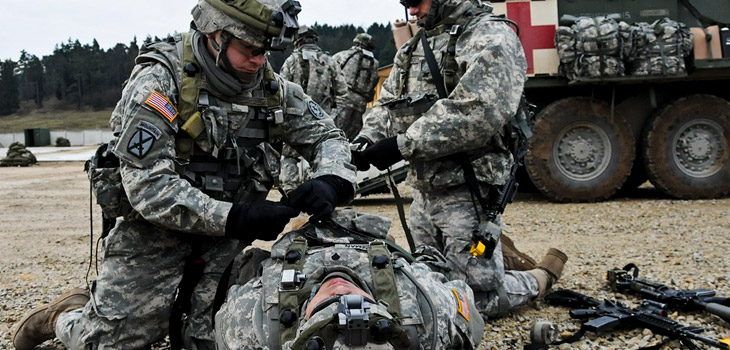
Hippocrates is often quoted as saying that “war is the only proper school for a surgeon.” It is not surprising then that medical advancements often come from the battlefield. For example, we have written of tourniquet technology developed for soldiers in Iraq and Afghanistan that is now in use in U.S. hospitals.
This MOU comes after the President signed an Act last December to, “authorize additional emergency uses for medical products to reduce deaths and severity of injuries caused by biological, chemical, radiological or nuclear (CBRN) agents or agents that may cause, or are otherwise associated with, an imminently life-threatening and specific risk to the U.S. military forces.”
Specifically, the MOU allows the Secretary of Defense to “request, and authorizes FDA to take, specific actions to expedite the development of medical products, and the review of investigational submissions, applications for approval/licensure, and submissions/notifications for clearance for such medical products reasonably likely to diagnose, prevent, treat, or mitigate a specific and life-threatening risk to the U.S. military.”
The MOU acknowledges that discussions among the participants may involve trade secret, commercial confidential, or other non-public information. “Participation in such discussions also requires avoiding the appearance of impropriety or conflicts of interests by participants. This MOU governs how the Parties will address these issues.”
The Pentagon and FDA agree that there will be at least a semi-annual meeting between them, coordinated through the Office of the Commissioner, ensuring participation of the Directors of the Center for Drug Evaluation and Research (CDER), Center for Biologics Evaluation and Research(CBER), and the Center for Devices and Radiological Health (CDRH), or their designees.
FDA Commissioner Scott Gottlieb, M.D., said, “The FDA has already been working closely with the DoD to identify opportunities to expedite availability of medical products, particularly those products used to treat injuries in battlefield settings. For example, the Emergency Use Authorization for French freeze-dried plasma that was issued earlier this year.”
Author
React:
Discussion
This is a fascinating development. In my practice we've seen similar outcomes with the revised protocol. The key differentiator seems to be patient selection criteria. Has anyone else noticed the correlation with BMI thresholds?
Great point. I'd push back slightly on the conclusion, the sample size in the cited study is too small to draw population-level inferences. That said, the directional signal is compelling and worth a larger RCT.
We implemented a similar approach last year. Early results are promising but we're still gathering 12-month follow-up data. Happy to share our protocol if anyone is interested.
Join the conversation
Orthopedic professionals are discussing this. Sign in and upgrade to read every comment and add your voice.