
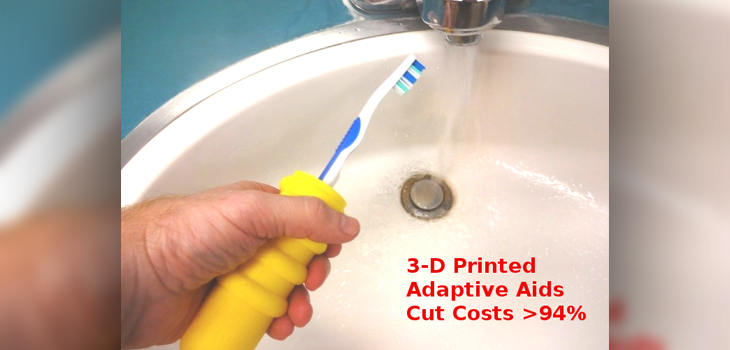
In an attempt to address the economic barrier that arthritis patients often encounter, a team of researchers has looked into the viability of manufacturing adaptive aids (i.e., cane holder aid, sock aid, zipper pull aid, pen holder) using low-cost desktop 3-D printers.
3D Printer for Patients in Assisted Living? Yes!
2 min read Premium comments
Secondary#3dprinting#arthritis#adaptiveaids
The study, “Economic Potential for Distributed Manufacturing of Adaptive Aids for Arthritis Patients in the U.S.,” appears in the December 6, 2018 edition of Geriatrics. (file:///C:/Users/Suzanne/Downloads/geriatrics-03-00089%20(1).pdf)
Jennifer Bow, M.D., with the Department of Materials Science & Engineering at Michigan Technological University and co-author on the study, told OTW, “We decided to look at adaptive aids for arthritis since these devices are amenable to 3D printing, generally being small and made of plastic, can benefit from creativity in their engineering, and are most functional when customized to their user. This is an area where engineering concepts can be applied to real life problems, where the designs have the potential to really help people. These types of designs showcase the abilities of 3D printers to customize a design to the end-user.”
Co-authorJoshua Pearce, Ph.D., also with Michigan Technological University and professor in the department of Electronics and Nanoengineering at Aalto University in Finland, explains, “Low-cost desktop 3D printers have advanced enough to be used for real distributed manufacturing—where consumers can fabricate the products they need and want. The ability of these 3D printers to easily customize products makes them particularly well suited for manufacturing custom adaptive aids.”
“We investigated a small subset of the free and open source designs for adaptive aids available on the internet. Our work showed that 3D printed adaptive aids were not only functional, but also produced significant savings—on average about 94% compared to commercial offerings. The savings were so substantial that in general even Medicare patients were better off financially making their own.”
Dr. Bow added, “Orthopedic surgeons should know that 3D printing provides an economic method of producing adaptive aids for arthritis patients. Patients can be treated with surgery, medications, exercises and adaptive aids or braces.”
“Medical devices usually have a significant markup which may put them out of reach of the patients who need them. Free and open source designs allow patients to access such devices at a huge cost savings while also allowing for individual personal customization. At the moment, patients still need a bit of technical savvy to be able to customize and print these devices, but interested physicians, nurses, physical and occupational therapists, athletic trainers and other health care providers could offer low cost devices to patients in need.”
“As the software platforms become more user-friendly, patients will have an easier time accessing these types of designs directly. The bottom line is that the cost of adaptive aids and braces should no longer be prohibitive.”
“The wide variety of free 3D printable designs for adaptive aids means that there are now real options for medical professionals to point economically constrained patients to, who would not otherwise be able to afford adaptive aids.” said Dr. Pearce, “A wide variety of locations (e.g., fablabs, makerspaces, and libraries) have 3D printers and staff who could assist patients make what they need if they do not want to get a 3D printer for themselves. In addition, there appears to be a significant opportunity to provide lower-cost adaptive aids by having 3D printers on site in rehab centers, community centers for the elderly, and assisted living facilities.”
Author
React:
Discussion
This is a fascinating development. In my practice we've seen similar outcomes with the revised protocol. The key differentiator seems to be patient selection criteria. Has anyone else noticed the correlation with BMI thresholds?
Great point. I'd push back slightly on the conclusion, the sample size in the cited study is too small to draw population-level inferences. That said, the directional signal is compelling and worth a larger RCT.
We implemented a similar approach last year. Early results are promising but we're still gathering 12-month follow-up data. Happy to share our protocol if anyone is interested.
Join the conversation
Orthopedic professionals are discussing this. Sign in and upgrade to read every comment and add your voice.