
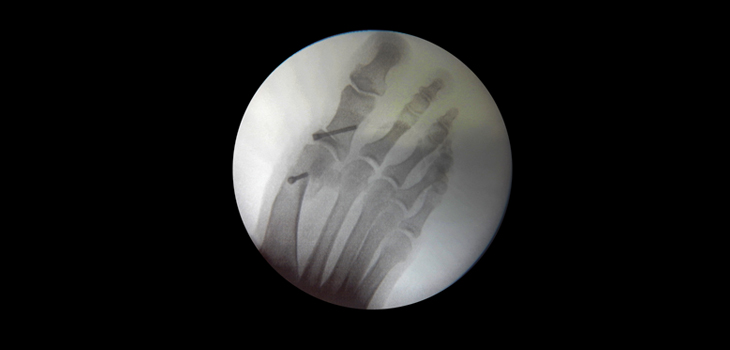
The ALIGN3D, a prospective, multicenter, unblended study on 3D bunion correction, recently enrolled its first patient at Jefferson City Medical Group in Jefferson City, Missouri, where J.P. McAleer, DPM, FACFAS is the principal investigator.
3D Bunion Correction Focus of New Clinical Study
2 min read Premium comments
Secondary#align3d#bunionsurgery
The aim of the study is to validate long term maintenance of three-dimensional correction of symptomatic hallux valgus with early return to weight-bearing.
Ultimately they will enroll up to 200 patients, aged 18 to 55 years, at up to 15 clinical sites in the United States. “The primary endpoint is radiographic recurrence of the hallux valgus deformity at 24 months follow up.”
“Secondary endpoints include change in three-dimensional radiographic alignment, clinical radiographic healing, time to start of weight-bearing in a boot and in shoes, quality of life and range of motion of the big toe joint.”
“High radiographic recurrence rates for surgical procedures that don’t address all 3 dimensions of the hallux valgus deformity have been well-documented. Studies critically evaluating metatarsal osteotomy surgeries demonstrate recurrence rates as high as 50-78 percent for these procedures,” said Dane Wukich, M.D., professor and chairman, department of orthopaedic surgery at the University of Texas Southwestern Medical Center and lead investigator.
“Previously presented clinical data on the Lapiplasty procedure [Treace Medical Concepts, Inc.] with early return to weight-bearing demonstrated a 3.3 percent recurrence rate at 13.5 months. The ALIGN3D study will determine recurrence at 24 months and produce a robust dataset that will provide additional insight into the Lapiplasty procedure across a number of endpoints.”
He said, “We are pleased to be participating in the ALIGN3D study designed to further validate the clinical benefits of the procedure. My partner, Dr. William Duke and I have treated over 150 patients with the Lapiplasty procedure and have experienced excellent clinical outcomes while enabling our patients to get back on their feet significantly faster.”
“The [procedure] is designed to correct all three planes of the bunion deformity and address the root cause of the bunion, while allowing patients to start ambulating on the operative foot within days of surgery.”
Enrollment in the study should be completed by December 31, 2019. Primary endpoint/recurrence is evaluated at two years. Long-term subject follow-up is for five years. Secondary endpoints/correction will be shared as data becomes available over the 2019 and 2020 with primary endpoint completion in late 2021/early 2022.
Paul Dayton, DPM, FACFAS of the Foot & Ankle Center of Iowa in Des Moines, Iowa, told OTW, “When we contrast the high recurrence and complication rates for traditional bunion surgery to our very low complication and recurrence reported in a recent 13 month multicenter dataset presented at the 2018 American Orthopaedic Foot & Ankle Society meeting in Boston, we are now able to prove the benefits of triplane correction. Rapid surgeon adoption of the technique underscores the need for a more reliable method for bunion correction and the benefits provided.
Author
React:
Discussion
This is a fascinating development. In my practice we've seen similar outcomes with the revised protocol. The key differentiator seems to be patient selection criteria. Has anyone else noticed the correlation with BMI thresholds?
Great point. I'd push back slightly on the conclusion, the sample size in the cited study is too small to draw population-level inferences. That said, the directional signal is compelling and worth a larger RCT.
We implemented a similar approach last year. Early results are promising but we're still gathering 12-month follow-up data. Happy to share our protocol if anyone is interested.
Join the conversation
Orthopedic professionals are discussing this. Sign in and upgrade to read every comment and add your voice.