
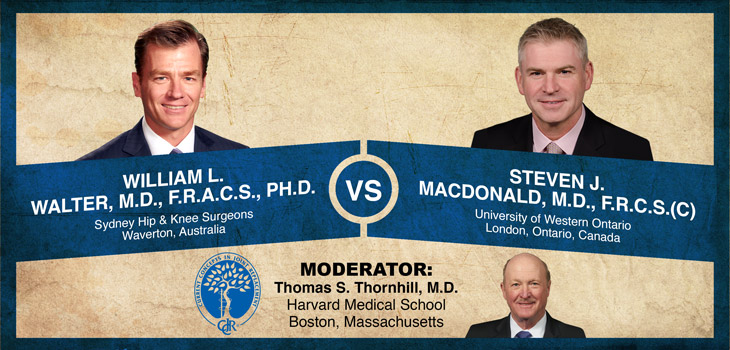
This week’s Orthopaedic Crossfire® debate was part of the 34th Annual Current Concepts in Joint Replacement® (CCJR®), Winter 2017 meeting, which took place in Orlando. This week’s topic is Ceramic-Ceramic: Articulations of Longevity for the Young Active”. For is William L. Walter, M.D., F.R.A.C.S., Ph.D., Sydney Hip & Knee Surgeons, Waverton, Australia.Opposing is Steven J. MacDonald, M.D., F.R.C.S.(C), University of Western Ontario, London, Ontario, Canada. Moderating is Thomas S. Thornhill, M.D., Brigham and Women’s Hospital, Boston, Massachusetts.
Walter v. MacDonald: Ceramic-Ceramic: Articulations of Longevity for the Young Active Patient
8 min read Premium comments
Great Debates#stevenmacdonald#williamwalter#ceramiconceramic#youngpatient
Dr. Walter: I’m here to talk to you about ceramic-on-ceramic bearings.
Around the world, ceramic-on-ceramic bearings are used more frequently than they are in this country. In the United States, ceramic-on-ceramic is used less than 5% of the time but worldwide it’s higher. In Australia, it’s about 1 in 4 hips are ceramic-on-ceramic.
Ceramic-on-ceramic bearing use in Australia, according to data from our registry, is increasing although the most common is still polyethylene on the acetabular side. In terms of revisions by bearing surface in all ages, ceramic-on-ceramic bearings perform well at 15 years and the registry data shows less than a 10% revision rate at 20 years.
When we look at the younger patients, conventional polyethylene has a higher failure rate while ceramic-on-ceramic has good data out to 15 years. Fifteen-year data for patients under 55 years with ceramic-on-ceramic had a 6.6% revision rate. And ceramic-on-crosslinked polyethylene is a 5.1% revision rate at ten years.
So, we know that younger patients have a higher revision rate than all the patients and the under 55-year age group experienced the highest revision rate of all age groups. The Australian registry data shows 9.9% revision at 15 years for the under 55-year age group as compared to 6.3% for the over 75-year group.
Younger patients have 1.4 times higher risk for revision compared to the 75-year-old or older patient.
We’ve done a lot of work in our own practice with midterm results and are currently looking at the 15-year results of the first 300 ceramic-on-ceramic bearings. We’ve done over 5,500 arthroplasty surgeries with 4,000 ceramic-on-ceramic hip surgeries.
We’ve had 55 retrievals. Most were revisions due to aseptic loosening of the cup or for femoral and pelvic fracture. We had very few revisions in our 4,000 ceramics for bearing failure—two for squeaking and a couple of broken ceramics.
We analyzed those 55 retrievals. One patient was a 47-year-old female who had a hip replacement and had psoas tendon irritation at 33 months post-op. We went in to release the psoas tendon and at the same time retrieve the bearing. On the retrieved bearing we saw the characteristic stripe wear or edge lining wear on the edge of the cup and a long stripe on the head. Using the RedLux machine we’ve analyzed a large number of these bearings now and measured the rate of median head wear. It is 0.2 mm3per year, so it’s a very low volume.
We also measured the acetabular component position and related that to wear and found that wear is related to cup position. So, if you have high anteversion and high inclination you’ll have anterosuperior wear. If you have low anteversion and low inclination, you’ll have posterior edge loading and posterior wear. In our patients, compared to the conventional polyethylene, we’ve had a dramatic reduction in osteolysis.
What about the histology of ceramic-on-ceramic bearings?
It’s relatively benign. We do see mild synovitis in the synovium of the hips where we revise the ceramic-on-ceramic bearing. So, we’ll get mild synovitis and polymorphs, that’s different to polyethylene where you have the granuloma, or you have visible wear debris on the microscope, and more synovitis. It’s much different to metal-on-metal where you have the necrosis. So, we do see a yellowish grainy debris in the ceramic-on-ceramic retrieval in the tissue around the hips.
We have seen about two cases of osteolysis with ceramic. In those cases we saw black debris and the ceramic debris. When we looked at it under backscattered scanning electron microscope, we could see paradoxically a lot of titanium as well as the alumina ceramic.
So paradoxically the dominant wear debris in a ceramic bearing is titanium not the alumina. We’ve also looked at squeaking, but squeaking is generally infrequent, and it generally occurs with bending not walking.
We also use a lot of large diameter ceramic-on-ceramic bearings and for me that’s one of the big advantages.
So, in conclusion ceramic-on-ceramic has low wear, the wear debris is inert, the fracture risk is low and the squeaking is usually benign.
Dr. MacDonald: I do agree that ceramic-on-ceramic is the articulation of choice for the young patient—if you want to choose a bearing with higher failure rates, that has a substantial price premium, and that has unique and unresolved complications.
There is no perfect bearing.
Let’s start with longevity. To actually answer that question, you need large numbers, so avoid small case series and here is the advantage of registries, and Bill did a nice job of showing some of it from the Australian registry with 324,000 total hips. What is the best performing bearing in those 324,000 patients? Ceramic-on-highly crosslinked polyethylene at 5.1%.
What’s second best? Cobalt chrome-on-highly crosslinked polyethylene at 6.3%, and I would say a very distant and sad third, Dr. Walter, is ceramic-on-ceramic at 7.2%.
So, ceramic-on-ceramic is definitely not the bearing of choice if you plan on living more than 15 years.
In the young patient, ceramic-on-crosslinked polyethylene is that bearing of choice. This is not just in Australia. The New Zealand registry had 100,000 primary total hips in their registry (Sharplin et al, Hip Int2018). Ceramic-on-highly crosslinked polyethylene had the lowest all cause revision rate. They concluded the paper by saying it ‘… was the most durable and successful coupling used in primary THA irrespective of age, gender, and head size.’
When we say ceramic, we are really talking in 2017 about the Delta ceramic.
Next let’s look at the cost.
At my institution, using cobalt chrome-on-highly crosslinked polyethylene as the base price, to add a Delta ceramic head adds 60% to the cost of that construct. Adding a Delta liner, makes that 120% plus your base so, a substantial cost premium.
Additionally, we have unique complications with ceramic-on-ceramic of squeaking and fractures. Robert Barrack led a five-center study of young patients, ceramic-on-ceramic (Nam et al., Clin Orthop Relat Res2016). He reported increased grinding, popping, clicking, with an odds ratio of 5 and a half times. Noise generation was associated with pain and stiffness. Another study, (Salo et al.,Bone Joint J2017), reported on 336 ceramic-on-ceramic total hip arthroplasties with a 17% incidence of noise, half of which was frequent, lower mean hip scores, and decreased physical function.
This isn’t just an annoyance; these patients are not doing as well.
In 2017, with our current implants, we have an incidence of squeaking of about 10-30%. They’re not being revised for the most part so that’s not captured in registries, but it is significantly affecting the patient outcomes.
What about ceramic fractures? It seems like the Delta ceramic head has pretty much solved that so the rate of fracture in the ceramic head in the Australian registry is 1 in 70,000 so pretty uncommon, however, that’s not the liner.
A great paper recently published (Howard et al., Bone Joint J2017) looked at 111,000 ceramic-on-ceramic total hip arthroplasties. Fracture rate for the Delta head in 2017, 1 in 11,000, this is the UK registry. The Delta liner, 1 in 893, that’s a significant difference.
The researchers concluded that previous studies have underestimated the risk of fracture. That’s not taking into consideration what happens in the OR when you get a little chip or mal-seating, which happens.
And then there are adverse soft tissue reactions. The National Registry for England and Wales published this year put the relative risk of adverse soft tissue reactions at 2.5 times higher in ceramic-on-ceramic bearings compared with hard-on-soft.
So, my friend you got it half right. Ceramic-on-crosslinked polyethylene is the bearing of choice in my opinion for young patients. Adding the ceramic liner increases your failures, increases your cost, increases noise, increases complications, with decreased satisfaction outcomes, and in my opinion is not the bearing of choice in 2017.
Moderator Thornhill: Bill, your thoughts.
Dr. Walter:Well Steve is a bit mischievous there because he showed the Australian registry data for all ages and then represented that as correlating with young patients, but there is actually registry data for young patients which shows that the ceramic-on-ceramic bearings are performing better than they were compared to the crosslinked polyethylene.
Dr. MacDonald: We have not solved the young patient regardless, we can both agree. Whether it’s crosslinked … it’s like knees, they have a higher failure rate.
Dr. Walter: So, mid 60s or 60s even for crosslinked polyethylene and then below that will be ceramic-on-ceramic. Wear rates being so low with the ceramic-on-ceramic I’m more confident that at 40 years the ceramics will be functioning better than the crosslinked polyethylene.
Moderator Thornhill: Do you agree that the squeakingin a ceramic-on-ceramic has decreased or you don’t think it has?
Dr. MacDonald:Well, there was one particular design that did have an issue, which isn’t even sold anymore so the rate overall has come down, but it’s not minimal. I think what we’ve done is a bit of a disservice where we say patients are okay with it and they cope with it, but they don’t like it.
Dr. Walter:You showed a video of a squeaking hip but there was also a clunk there. Sounds like neck-to-rim impingement and subluxation, and that’s not good for any bearing. If you use good surgical technique and good implants, our squeaking rate is 2% which is not insignificant but they’re almost completely benign.
Dr. MacDonald:Yeah, and I don’t disagree. I’m sure your squeaking rate is lower than many, and you’ve got a generation of experience with ceramic-on-ceramic but it’s more when we are all using it in all of our hands, doing our hips the way we do, it’s not as low as 2%.
Moderator Thornhill: Bill, you have a lower squeaking rate and obviously you are looking carefully at this. Is it technically harder to do a ceramic-on-ceramic than a ceramic-on-highly crosslinked polyethylene?
Dr. Walter:I think if you do a well-balanced hip with components that are positioned well, both bearings will function well. If you malposition your component, if the tension is not right, you’ll find out about it in the ceramic in the form of noise, so you’ll have impingement, you’ll have clunking, you’ll have squeaking. If you malposition a ceramic-on-crosslinked polyethylene bearing, you may get a dislocation, you may get a rim fracture, it may take a bit longer, but it will be a different kind of complication.
Dr. MacDonald:The question is then, ‘Is the ceramic-on-ceramic a bit more at risk with outlie?’ It probably is, like a metal-on-metal was, if you get edge loading. Your point is exactly right, you’ll see it sooner, it’s not good for highly crosslinked polyethylene either it’s just that could be a 10-12-year outcome as opposed to a 2-3-year outcome.
The other thing to understand is the nuance of putting in a ceramic, a modular ceramic insert, is that when cups are placed they sometimes deform in very hard bone, and you will sometimes see this when you go to put that liner in, it’s got an equatorial pivot point that you just do not see in a crosslinked polyethylene liner. So, be aware of that, because that’s when you get mal-seating and chipping.
Moderator Thornhill: Alright great job and thank you all for this nice debate.
Please visit www.CCJR.com to register for the 2018 CCJR Winter Meeting, – December 12 – 15 in Orlando.
Author
React:
Discussion
This is a fascinating development. In my practice we've seen similar outcomes with the revised protocol. The key differentiator seems to be patient selection criteria. Has anyone else noticed the correlation with BMI thresholds?
Great point. I'd push back slightly on the conclusion, the sample size in the cited study is too small to draw population-level inferences. That said, the directional signal is compelling and worth a larger RCT.
We implemented a similar approach last year. Early results are promising but we're still gathering 12-month follow-up data. Happy to share our protocol if anyone is interested.
Join the conversation
Orthopedic professionals are discussing this. Sign in and upgrade to read every comment and add your voice.