
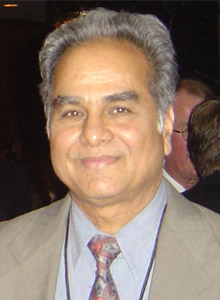
Vijay K. Goel, Ph.D. is the winner of the International Sheikh Hamdan bin Rashid al Maktoum Award for Medical Sciences. The award, to be delivered in Dubai on December 12, 2018, will be presented by H.H. SheikhHamdan bin Rashid al Maktoum, Deputy Ruler ofDubai, United Arab Emirates Minister of Finance and the Patron of the Award. Dr. Goel is receiving the award for his work in orthopedic mechanics.
Vijay Goel, Ph.D. to Receive Award for Medical Sciences
2 min read Premium comments
#vijaygoel
Dr. Goelis a Distinguished University Professor, Endowed Chair, and McMaster Gardner Professor of Orthopaedic Bioengineering, as well as the co-director of Engineering Center for Orthopaedic Research Excellence (E-Core) at theUniversity of Toledo(UT) in Ohio.
After obtaining a Ph.D. in mechanical engineering with a concentration in orthopedic biomechanics at the University of New South Wales in Australia, Dr. Goel held a faculty position at the Indian Institute of Technology in New Delhi. He then relocated to the U.S., accepting a position in the Department of Orthopedics at Yale Medical School in Connecticut as a research associate in 1979.
He worked at Yale for three years under the mentorship of Professor Manhor Punjabi, a world-renowned scientist in the area of spine biomechanics. Professor Goel’s work at Yale earned his group the Volvo Research Award from the International Society of the Study of Lumbar Spine – ISSLS. He developed the stereophotogrammetry technique to record load-displacement characteristics of a spine specimen, a first in the field.
In 1982, Professor Goel moved to the University of Iowa, Iowa City as an Assistant Professor in Biomedical Engineering and established his own spine biomechanics lab. This is where Dr. Goel launched his independent career in the fields of education, research and service to the society.
In December 2000, Professor Goel joined The University of Toledo’s Department of Bioengineering as Professor and Chairman. He developed from scratch the orthopedic sub-track (labs and courses) for undergraduate, graduate students, residents and fellows.
He established the Spine Research Center in collaboration with the Department of Orthopaedic Surgery. Professor Goel also developed a proposal for a doctoral program in Biomedical Engineering in collaboration with UT’s Medical School campus, which was approved by the Board of Regents. This is the only discipline-specific Ph.D. program in the College of Engineering, another peer-recognition of his efforts in the field of education.
Dr. Goel stated, “This is my first introduction to surgeons and engineers in the Gulf Countries, especially UAE. As such I am honored and humbled to receive the highest-level recognition from my peers in that part of the world. It is my sincere hope that the Sheikh Hamdan Bin Rashid Al Maktoum Award for Medical Sciences in Orthopedic Mechanics will lead to mutually beneficial innovative collaborative opportunities.”
Asked about his current research, Dr. Goel told OTW, “At present I am working on the biomechanics of male and female sacroiliac joint, spinal imbalance biomechanics, proximal junctional kyphosis, along with the incorporation of muscle forces within the existing ligamentous spinal finite element models that we have developed over the years to study the effects of spinal devices, like pedicle screw fusion devices, cages, dynamic systems, artificial discs, etc.”
Author
React:
Discussion
This is a fascinating development. In my practice we've seen similar outcomes with the revised protocol. The key differentiator seems to be patient selection criteria. Has anyone else noticed the correlation with BMI thresholds?
Great point. I'd push back slightly on the conclusion, the sample size in the cited study is too small to draw population-level inferences. That said, the directional signal is compelling and worth a larger RCT.
We implemented a similar approach last year. Early results are promising but we're still gathering 12-month follow-up data. Happy to share our protocol if anyone is interested.
Join the conversation
Orthopedic professionals are discussing this. Sign in and upgrade to read every comment and add your voice.