
Vancouver, British Columbia-based Precision OS Technology has received $2.3 million in Series A funding led by AO Invest, based in Davos, Switzerland, alongside other undisclosed investors.AO Invest is a new investment fund backed by the renowned AO Foundation. The funds will be used to further orthopedic training efforts around the world.
Precision OS: $2.3 Million for VR Orthopedic Education
2 min read Premium comments
Secondary#precisionostechnology#virtualreality
“Precision OS is delighted to be cooperating with an international organization that is a recognized leader in education for surgeons and operating room personnel around the world,” says Dr. Danny P. Goel, orthopedic surgeon, co-founder and CEO at Precision OS. “Precision OS Technology is working to create a virtual language able to add depth of understanding that simply cannot be achieved using current simulation tools. Adopting VR [virtual reality] as a way of improving decision-making is directly relevant for patients and value-based care.”
“For all of us at AO Invest, as is the case for our partners at Precision OS, the patients and surgeons are always center stage: their needs are of the utmost importance to us,” said Michel Orsinger, chairman of AO Invest. “In addition to responding to requirements they have already identified, we also work to pre-empt needs that will arise as the healthcare environment changes and technology advances. We evaluated several VR companies all over the world, and Precision OS’s technology convinced us through its accuracy, quality, and overall approach to education in VR…”
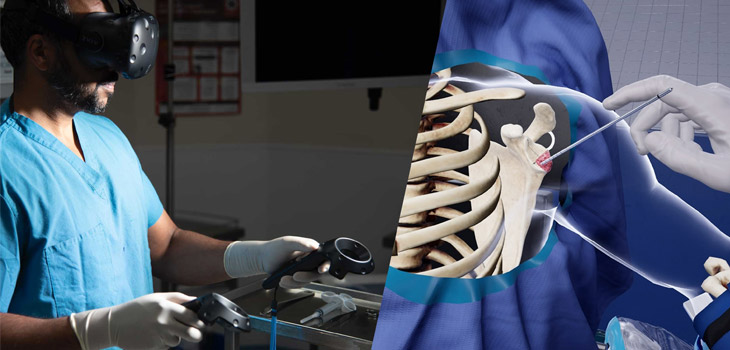
As for details on how the software allows “interactive simulations that objectify and enhance performance,” Dr. Goel told OTW, “Precision OS software allows the user to freely interact, requires focus and autonomous decision making in a case based immersive and realistic VR environment.”
“The simulation detects individual behavior/decisions of implant position, choice and quantifies it in comparison to the optimal position. These performance metrics and critical steps are all recorded and delivered in a feedback loop to permit reflection and repetition consistent with our philosophy of deliberate practice.”
“This ability to receive immediate feedback on technical and cognitive parameters permits a concentrated, deeper level of understanding to enhance performance. Similar to the aviation industry which highlights the need to learn from failure, we have adopted a similar approach which has been shown to result in the greatest learning when the stakes are high.”
Asked about the preoperative planning tool that allows the introduction of images of a specific patient’s anatomy, Dr. Goel commented to OTW, “Progress has been exponential for this tool. We are factoring in all relevant elements that would provide value for the end user and importantly the patients. We are excited to announce that we have received ethics approval for a large study to address the utility and benefit of the preoperative software. In addition, we anticipate hospital use within 2019.”
Author
React:
Discussion
This is a fascinating development. In my practice we've seen similar outcomes with the revised protocol. The key differentiator seems to be patient selection criteria. Has anyone else noticed the correlation with BMI thresholds?
Great point. I'd push back slightly on the conclusion, the sample size in the cited study is too small to draw population-level inferences. That said, the directional signal is compelling and worth a larger RCT.
We implemented a similar approach last year. Early results are promising but we're still gathering 12-month follow-up data. Happy to share our protocol if anyone is interested.
Join the conversation
Orthopedic professionals are discussing this. Sign in and upgrade to read every comment and add your voice.