
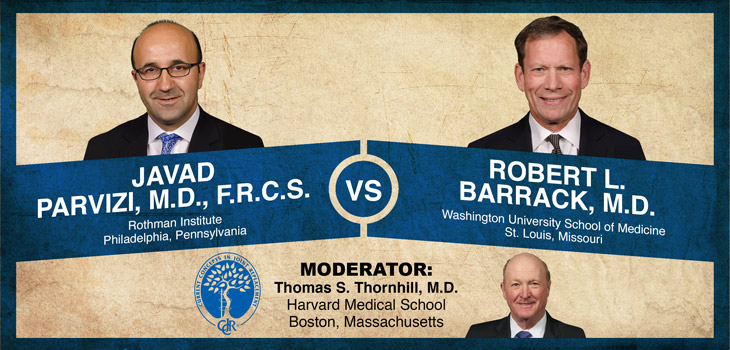
This week’s Orthopaedic Crossfire® debate was part of the 34th Annual Current Concepts in Joint Replacement® (CCJR®), Winter meeting, which took place in Orlando. This week’s topic is “Parvizi v. Barrack: Ceramics Decrease the Incidence of Peri-Prosthetic Joint Infection” For isJavad Parvizi, M.D., F.R.C.S.,Thomas Jefferson University, Philadelphia. Opposing isRobert L. Barrack, M.D., Charles F. and Joanne Knight Professor of Orthopedic Surgery, Saint Louis, Missouri. Moderating is Thomas S. Thornhill, M.D., Brigham and Women’s Hospital, Boston, Massachusetts.
Parvizi v. Barrack: Ceramics Decrease the Incidence of Peri-Prosthetic Joint Infection
8 min read Premium comments
#periprostheticjointinfectionGreat Debates#robertbarrack#jaredparvizi
Dr. Parvizi: So, I’ve been given the task to talk about the ceramic bearings and its influence on infection.
Reasons for revisions after total hip arthroplasty have been fairly well studied. What is really interesting is that the incidence of infection after total hip arthroplasty may be higher than what’s been led to believe.
There are numerous factors that lead to infection after joint replacement.
When you are doing a total hip replacement, the first decision you have to make is the type of implant fixation. The second decision relates to the type of bearing surface. The most commonly used bearing surfaces include, among others, ceramic-on-ceramic and ceramic-on-polyethylene.
Does the type of bearing surface in THA influence the incidence of SSI [surgical site infection] and PJI (prosthetic joint infection)? Data from the Medicare registry suggests that metal-on-metal bearings may be associated with a higher risk of PJI. Kevin Bozic published in 2010 (Clin Orthop Relat Res) on a series of Medicare patients showing that the metal-on-metal bearing surface hazard ratio was 3 when compared to ceramic-on-ceramic bearings in terms of its risk for infection.
That was again repeated later (Bozic, J Arthroplasty2012) showing that even after you adjust for patient and hospital factors, metal-on-metal bearing surfaces carry a higher incidence of PJI compared to metal-on-polyethylene and ceramic-on-ceramic bearing surfaces.
That’s now been reflected in numerous registries.
We did a study in which we looked at our own registry and what we found was that the incidence of infection of metal-on-polyethylene was higher than the ceramic-on-polyethylene. The first criticism that came to mind was, of course this would be the case because ceramic-on-polyethylene or ceramic-on-ceramic is being used on younger and healthier patients.
So, we did a multivariate analysis and even after adjusting for those confounding variables it looked like the signal still stood and the metal-on-polyethylene and metal-on-metal had higher incidences of infection. Use of cobalt chromium was an independent factor in causing the issues.
But we all know that studying infection using registry data is not as clean or clear because a lot of these confounding variables that influence infection are not usually seen in the registry data.
The question is, “Does bearing surface affect the incidence of PJI?” It appears that it does.
Why does it?
It is unknown, but perhaps it relates to the metal-on-metal bearing total hip releasing cobalt and chromium that appears to be cytotoxic and aligned with necrosis of the tissues and possibly allows for bacteria to survive in that environment.
There may be an influence of cobalt chromium on the immune system and this could possibly lead to that issue. Of course, we are aware of the ALTR [adverse local tissue response]problem that arises with the cobalt chromium perhaps through this mechanism, influences the incidence of infection.
The real reason remains unknown, but I think the signal is strong enough that it should stimulate us to study this phenomenon further.
There has been a recent study showing that the biomass accumulations, (ISTA 2015, Rimondini), actual biofilm formation on ceramic appears to be less compared to other bearing surfaces.
Thank you very much.
Dr. Barrack: I’d like to say at the outset I thought this would be a quite minor type topic, sort of far-fetched, but it’s really not a debate about ceramics and infection, it’s really about how to interpret data because using big data to support a specific device is fraught with peril.
To say that ceramics decrease PJI is entirely inaccurate and without basis in data or fact. Why? Because it implies causation when in fact it is a correlation and the current data is very weak, unconvincing, and entirely flawed.
So, what’s the data? In the New Zealand joint registry there was a slightly decreased incidence of infection with ceramic-on-ceramic. It didn’t occur in the first six months which you’d expect if there was some improvement. The differences were very small, and they are easily explained by differences in the patient populations. The disclaimers actually exceed the findings.
For example, they say the results were very preliminary, that some or all of the differences may have been driven by other factors such as ASA class and BMI [body mass index] which were not included in the analysis.
What are the factors in that same registry that predispose to infection? Their ASA grade, which they didn’t say they considered with an odds ratio of 6. Obesity, which they didn’t consider, and RA [rheumatoid arthritis], with odd ratios of 2.15 and 2.72, respectively.. Who’s more likely to get a ceramic-on-ceramic? None of these patients. So, they didn’t consider any of the important variables that predispose to infection.
I could stop right now but I see I have a few more minutes so I’ll continue.
Every known risk factor that is likely to cause infection is less likely to be included in a ceramic-ceramic hip or a ceramic-on-polyethylene hip. You look at all of these – diabetes, obesity, steroid dependent, renal insufficiency, skin disorders – and you say who’s more likely to get a ceramic? None of these are likely to get a ceramic; all of these are more likely to get an infection.
Henrik Malchau is going to publish a study where he saw the same pattern in the Australian registry. A slight decrease in infection risk but not if you are over 70, not if you are cemented, not if your head size is 28, and again, they did not include medical comorbidities.
The problem is also accuracy of the diagnoses. A review article showed that complication coding is off by over 20% in most data sets (Patel A, et al., JAAOS, 2016). At Cleveland Clinic their coding of infection was off by 40% when an orthopedic surgeon looked at the cases, and this is a critical factor. Why is it so important in this instance? Because we are going to hear a lot about trunnionosis. Up until the last couple of years, all of these cases were coded as infection, all the registries include trunnion cases as an infection; 90% of them are not infections.
Trunnionosis cases meet every MSIS [Musculoskeletal Infection Society] criteria for infection and were misclassified until very recently. You’ll hear debates about this, but I think there is very little doubt that trunnionosis is far less common with ceramic heads.
What if we look at data sets that do control for comorbidities? Three meta-analyses from Asia all found no difference in infection when a ceramic head was used, but they did find more squeaking and breakage (Hu D, et al., Orthopedics2015; Hu D, et al., J Orthop Surg Res2015; Si HB, et al., Hip Int, 2015).
What about the North American data along with the Australians? Cochrane reviews showed if you look at all the major registries and FDA trials, there is no advantage for any type of revision with metal-on-polyethylene or ceramic-on-polyethylene.
The Danish registry also found no difference in any incidence of revision including infection, although they did find more fractures and more squeaking (Varnum C, Dan Med J, 2017).
So, what factors are most important when you are looking for revision and infection? It’s not the implant really, it’s the patient population, the surgeon, the hospital, and even the country.
If you look at UK data for partial knees, it varies by a factor of 9 by surgeon. Same with CMS [Centers for Medicare and Medicaid Services] data and the Swedish registry data, a factor of 7 by hospital.
The problem is specialty procedures are more likely to be done in healthier patients, so bias and chance are very big problems with registry data and can lead to conclusions that are at odds with common sense or the literature. If you believe these data then PS [posterior-stabilized] knees cause more infections, UKAs [unicompartmental knee arthroplasty] will make you live longer than total knees, surface replacement will make you live longer than total hips.
So, registry data is very valuable. It’s good at identifying poorly performing implants, but it’s poor at distinguishing small differences. The vast majority are associations and misuse of this data is a major current issue. So, you have to exercise discretion and caution in using data sets like this, it’s like quoting the Bible, if you set out to prove something, you can.
So, I’ll end by quoting, first, Disraeli who was a British prime minister, “There are three kinds of lies: lies, damned lies, and statistics.” Finally, urban legend has it that Charlie Rockwood said that “if you torture the data long enough that it will confess to anything,” but actually this is a quote from 60 years ago by an obscure writer who wrote the best-selling book of the 20th Century on statistics called How to Lie with Statistics.
Moderator Thornhill: Robert, that was a great description of some of the confounders that are a real problem and I think it underscores the importance of surgical education and data interpretation. Jay I’m going to give you one minute to rebut that.
Dr. Parvizi: I agree with Robert on two accounts. First of all, that the registry data is not sophisticated enough to allow us to do studies on infection. There is plenty of signal out there especially the Danish and the Swedish who are very worried that the registry data is being used to study infection and could give you wrong signals.
So, I completely agree that we have to be careful about use of registry data to argue our points, but I also presented institutional data and there are six of them out there that have shown similar signals. Now, is it the effect of confounding variables? It very well could be, but I think the basic science studies showing that the biomass and the adherence of bacteria to different surfacesappear to be different.
Moderator Thornhill: Okay, so yes or no question. Robert, do you believe that the use of a ceramic head will independently decrease the incidence in infection?
Dr. Barrack: No, I think…
Moderator Thornhill: Okay no. Okay, Jay, do you believe that the independent use of a ceramic head will decrease the incidence of infection?
Dr. Parvizi: More towards yes than no.
Moderator Thornhill: You sound like a radiologist (laughter and applause). Okay, so Jay, if you are right, with an emphatic perhaps, …is it glycocalyces or biofilm or mucoid polysaccharide slime or tissue necrosis or the corrosion products where titanium debris tended to not kill the cells but stimulate them or the cobalt debris that tended to kill them. So, which is it?
Dr. Parvizi: All of the above, but I think cobalt is the culprit and it’s possible that that’s the signal we are seeing, not so much the ceramic itself.
Moderator Thornhill: Okay, the other thing I noticed on Robert’s slides, he had error bars on them. It just may have been the way you put the slides together, but I saw one p-value, I think it was 0.1, but I didn’t see any error bars. Were these things significant?
Dr. Parvizi: Yeah. He chose one in which there is a crossover of the errors, but if you look at the cumulative numbers coming again from, institutional databases, not just databases, data that I was presenting. There seems to be a hazard ratio around 2.5-3.
Moderator Thornhill: Okay so, probably they’ve both agreed somewhere in the middle. We talked about the interpretation of data and how it can be confounding and misleading. I’d like to thank the speakers.
Please visit www.CCJR.com to register for the 2018 CCJR Winter Meeting, – December 12 – 15 in Orlando.
Author
React:
Discussion
This is a fascinating development. In my practice we've seen similar outcomes with the revised protocol. The key differentiator seems to be patient selection criteria. Has anyone else noticed the correlation with BMI thresholds?
Great point. I'd push back slightly on the conclusion, the sample size in the cited study is too small to draw population-level inferences. That said, the directional signal is compelling and worth a larger RCT.
We implemented a similar approach last year. Early results are promising but we're still gathering 12-month follow-up data. Happy to share our protocol if anyone is interested.
Join the conversation
Orthopedic professionals are discussing this. Sign in and upgrade to read every comment and add your voice.