
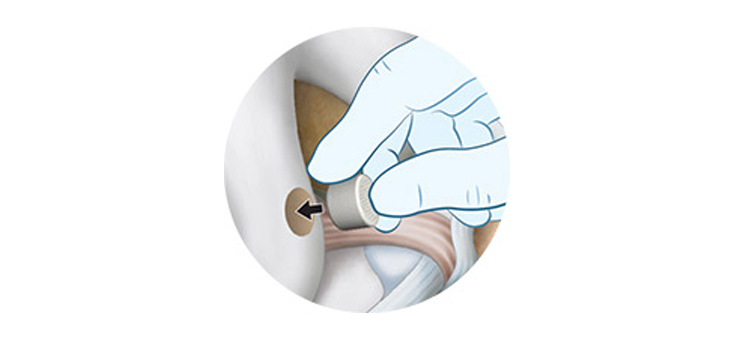
Agili-C, an implant to treat joint surface lesions developed by CartiHeal, Inc., showed promising regenerative capacity in a recent study (“Agili-C implant promotes the regenerative capacity of articular cartilage defects in an ex vivo model”)published online on November 1, 2018 in the Knee Surgery, Sports TraumatologyArthroscopyjournal.
CartiHeal Agili-C Implant Promotes Regeneration
2 min read Premium comments
Secondary#cartiheal#agillcimplant#cartilagedefects
Chicago’s Rush University researchers led by Professor Susan Chubinskaya, Ph.D., The Klaus Kuettner Professor of Arthritis Research and Vice-Chair, Research and Faculty Development Department of Pediatrics, investigated the ex-vivo mechanics of action of the Agili-C implant in the repair of full-thickness cartilage defects.
The researchers wanted to validate whether the Agili-C implant has the potential to stimulate cartilage in-growth through chondrocyte migration into the 3D interconnected porous structure of the scaffold, along with maintaining their viability and phenotype and the deposition of hyaline cartilage matrix.
For the study, Chubinskaya and her colleagues collected “…human articular cartilage cadaveric knee and ankle specimens within 24 hours of death from 14 donors, male and female. …donut-shaped cartilage explants were prepared from each tissue specimen” to model a chondral defect. Then “…cartilage explants with or without the Agili-C implant inside were cultured for 60 days.”
The results “…confirmed the ability of chondrocytes to migrate outside of the cadaveric cartilage explant tissue and into the porous structure of the Agili-C scaffold and fill its entire volume with newly formed extracellular matrix (ECM) enriched in hyaline cartilage components, such as collagen type II and aggrecan, and lacking collagen type I.”
The study was also able to demonstrate “…the formation of a layer populated by progenitor-like cells on the articular surface of the implant. These cells were able to produce a thin layer that covered the surface of the newly formed extracellular matrix, similar to a lamina. In the absence of a scaffold, chondrocytes did not migrate far from the tissue with probably some degree of hypertrophy.”
Overall, the data “…confirmed that the Agili-C implant induces deposition of new extracellular matrix with similar characteristics to the native hyaline cartilage inside the entire volume of the scaffold.”
Chubinskaya and colleagues wrote, “The analysis of samples taken from knee and ankle joints of human donors with a wide age range and both genders supports the potential of Agili-C scaffold to stimulate cartilage regeneration and repair. Based on these results, the present scaffold can be used in the clinical practice as a one-step procedure to treat full-thickness chondral defects.”
CartiHeal, headquartered in Israel, is a privately held medical device company. Its focus is on the development of proprietary implants for the treatment of cartilage and osteochondral defects in traumatic and osteoarthritic joints.
In the United States, the Agili-C is an investigational device limited for use in the IDE (Investigational Device Exemption) study and not available for sale.
Author
React:
Discussion
This is a fascinating development. In my practice we've seen similar outcomes with the revised protocol. The key differentiator seems to be patient selection criteria. Has anyone else noticed the correlation with BMI thresholds?
Great point. I'd push back slightly on the conclusion, the sample size in the cited study is too small to draw population-level inferences. That said, the directional signal is compelling and worth a larger RCT.
We implemented a similar approach last year. Early results are promising but we're still gathering 12-month follow-up data. Happy to share our protocol if anyone is interested.
Join the conversation
Orthopedic professionals are discussing this. Sign in and upgrade to read every comment and add your voice.