
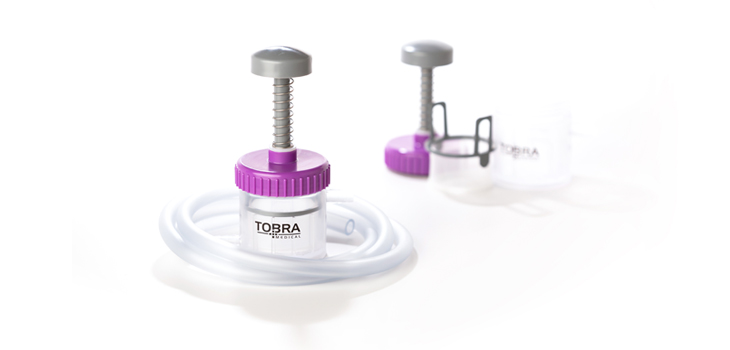
Wake Forest, North Carolina-based Tobra Medical Inc. has announced the national launch of its Tobra Bone Basket.
Tobra Medical Launches Tobra Bone Basket
1 min read Premium comments
Secondary#autograft#bloodclotting#tobrabonebasket
Brad Collins, founder and president of Tobra Medical Inc., told OTW, “The Tobra Bone Basket is ‘Bone Collection Made Easy.’”
“Tobra Bone Basket is easy to set-up and hassle/error free for surgical techs. The unique mesh basket allows for continuous capturing of drilled autograft bone while filtering out blood and irrigation and not clogging, thus not interrupting surgery. The continuous filtration also insures no blood clotting mixed in with captured bone.”
“The plunger separates the Tobra Bone Basket from all collectors by allowing a solid composite plunger that presses collected autograft bone eliminating excess fluid and leaving a bone output that has outstanding handling characteristics (not soupy). Finally, the mesh basket can be inverted allowing for easy removal and minimal staff handling of collected bone output. Ease of use, continuous filtration, maximum collection, bone handling characteristics, and bone removal are the reason surgeons prefer the Tobra Bone Basket.”
“A major milestone during the development of the Tobra Bone Basket was getting the precise size of the mesh utilized in the basket where blood and irrigations could be filtered out efficiently while capturing the smallest particle sizes of drilled autograft bone. It has been very gratifying to witness, after months of testing various mesh basket surface areas and the mesh sizes, surgeons looking in amazement at the amount of autograft bone collected from surgeries with minimal drilling.”
“The 2ndmilestone was designing a flow of material into and out of the basket below the press. This allowed for continuous circulation of air through the basket at all times for continuous movement and filtration of material and allowing the press to be utilized without blocking suction and interrupting surgery.”
Author
React:
Discussion
This is a fascinating development. In my practice we've seen similar outcomes with the revised protocol. The key differentiator seems to be patient selection criteria. Has anyone else noticed the correlation with BMI thresholds?
Great point. I'd push back slightly on the conclusion, the sample size in the cited study is too small to draw population-level inferences. That said, the directional signal is compelling and worth a larger RCT.
We implemented a similar approach last year. Early results are promising but we're still gathering 12-month follow-up data. Happy to share our protocol if anyone is interested.
Join the conversation
Orthopedic professionals are discussing this. Sign in and upgrade to read every comment and add your voice.