
It may be the alarming rise in sedentary life, in the U.S., say researchers, but the data is pointing to a clear decline in bone mineral density in the U.S. population.
New Data Confirms: Americans’ Bone Health Is Declining
2 min read Premium comments
#osteoporosis#bonemineraldensitySecondary
The research, “Decreasing trend of bone mineral density in US multiethnic population: analysis of continuous NHANES 2005–2014,” appears in the November 2018 edition of Osteoporosis International.
Qing Wu, M.D., Sc.D., with the Nevada Institute of Personalized Medicine at the University of Nevada, a member of the faculty in the university’s Department of Environmental and Occupational Health and study co-author told OTW, “Osteoporosis and low bone mass are currently estimated to affect 54 million people in the United States.”
“These two conditions may lead to adverse outcomes to patients, then economic loss to both their families and government. A recent study indicated the end of decreasing trend of osteoporosis. Since bone mineral density (BMD) is the single most important predictor of osteoporosis, we aimed to identifying whether there has been a corresponding change in the BMD trajectory for the U.S. population in the past decade with the data from National Health and Nutrition Examination Survey (NHANES).”
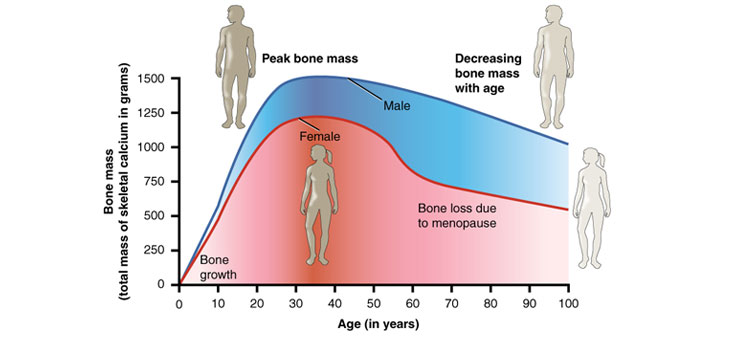
“After age standardization, the mean BMD of the femur neck for the first three NHANES cycles was stable (all p > 0.1) in both men and women, but significantly decreased in 2013–2014, from 0.864 g/cm2to 0.846 g/cm2(p = 0.0025) in men and from 0.789 g/cm2to 0.771 g/cm2(p = 0.03) in women. The mean BMD in 2013-2014 was significantly lower than that in earlier survey cycles in both men and women, even after adjusting for multiple covariates, including age, race, physical activity, previous fracture, BMI, and other variables.”
“In this study, the increased percentage for sedentary lifestyle for both men (from 5.87% to 22.38%) and women (from 9.59% to 31.82%) may contribute the decreasing BMD trend. Therefore, increased physical activity is recommended to ending decreased BMD trend and prevent osteoporosis.”
“The decreasing BMD in recent years indicate a future downward shift of Americans’ bone health may be occurring in both men and women, the prevention of osteoporosis and osteoporotic fracture is imperative. The incidence of osteoporotic fracture will be likely to increase, if no action is taken and the decreased BMD trend continue.”
Author
React:
Discussion
This is a fascinating development. In my practice we've seen similar outcomes with the revised protocol. The key differentiator seems to be patient selection criteria. Has anyone else noticed the correlation with BMI thresholds?
Great point. I'd push back slightly on the conclusion, the sample size in the cited study is too small to draw population-level inferences. That said, the directional signal is compelling and worth a larger RCT.
We implemented a similar approach last year. Early results are promising but we're still gathering 12-month follow-up data. Happy to share our protocol if anyone is interested.
Join the conversation
Orthopedic professionals are discussing this. Sign in and upgrade to read every comment and add your voice.