
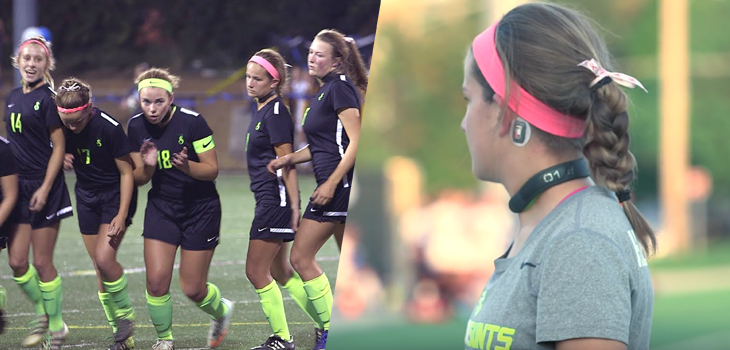
A recent study of female high school soccer players from Cincinnati Children’s Hospital suggests that a neck collar device, the Q-Collar, may help protect the brain from head impacts during the competitive soccer season.
Neck Device May Protect Brain of Female Soccer Players
2 min read Premium comments
Secondary#concussion#soccer#cumulativesubconcussiveimpacts#whitematterchanges
“In sports, there’s a heavy focus on single big blows to the head that might lead to what is subjectively described as a ‘concussion,'” said Greg Myer, Ph.D., director of sports medicine research at Cincinnati Children’s and lead author of the study.
“What we really wanted to look at now is the cumulative effect of head impact exposure over an entire season. Evidence indicates that cumulative load of head impacts is potentially more concerning than that one single blow.”
“The Q-Collar is designed to press gently on the jugular vein to slow blood outflow, increasing the brain’s blood volume… ” during competitive play. This causes the blood filling the brain vessel to help “…the brain fit tighter within the skull cavity, reducing the energy absorbed by the brain during collisions.”
The study, “Altered brain microstructure in association with repetitive subconcussive head impacts and the potential protective effect of jugular vein compression: a longitudinal study of female soccer athletes,” published on October 15, 2018 in the British Journal of Sports Medicine instead of focusing on single concussive blows, looked more closely at cumulative sub-concussive impacts to the head that change the white matter structure of the brain.
“White matter is essentially structural pathways that connect all the information/signal processing centers of the brain that support normal function,” Myer said.
Myer and his colleagues enrolled 46 female high school soccer players in their study. Twenty-four of them wore the Q-collar while all of them went through neuroimaging up to three times over a six month period, which included a three-month soccer season and a three-month post season rest period. The researchers tracked head impacts using accelerometers placed behind the left ear during practice and games.
According to the results, there was significant white-matter changes from pre- to post-season in those athletes who didn’t wear the collar, while no significant changes were found in those who did wear the collar. All athletes experienced a similar number and intensity of head impacts.
By the end of the post-season recovery period, the white matter of those athletes who didn’t wear a collar had either partly or completely returned to normal.
“Certainly, we know the benefits of playing soccer in female athletes far outweigh the risks that we are seeing and that’s an important message we have to take away from this study,” Myer said.
Previous studies on male hockey and football players using the Q-Collar have also shown similar positive benefits.
“This could be a paradigm shift in how we study the brain and protect the brain internally from head impact exposure,” Myer said.
“We need to continue to do larger studies with various populations and as we move forward with more research we will know more on how effective this approach can be to protect the brain.”
Q30 Innovations, LLC, designed the neck collar and provided funding for the research. “Q30 Sports Science, LLC, doing business as Q30 Innovations, LLC, is a research and development company dedicated to developing innovative products intended to reduce traumatic brain injury. Products using Q30 Technology have not yet received regulatory approval and are not available for purchase in the United States.”
Author
React:
Discussion
This is a fascinating development. In my practice we've seen similar outcomes with the revised protocol. The key differentiator seems to be patient selection criteria. Has anyone else noticed the correlation with BMI thresholds?
Great point. I'd push back slightly on the conclusion, the sample size in the cited study is too small to draw population-level inferences. That said, the directional signal is compelling and worth a larger RCT.
We implemented a similar approach last year. Early results are promising but we're still gathering 12-month follow-up data. Happy to share our protocol if anyone is interested.
Join the conversation
Orthopedic professionals are discussing this. Sign in and upgrade to read every comment and add your voice.