
A team from Finland and the Netherlands may have improved on the process of evaluating tissue integrity. Their work, “Arthroscopic near infrared spectroscopy enables simultaneous quantitative evaluation of articular cartilage and subchondral bone in vivo,” appears in the September 7, 2018 edition of Scientific Reports.
Near Infrared Light Spectroscopy Elevates Knee Diagnostics
2 min read Premium comments
Secondary#articularcartilage#mesenchymalstemcells
Co-author Jaakko Sarin, Ph.D., with the Department of Applied Physics at the University of Eastern Finland in Kuopio, told OTW, “Current arthroscopic diagnostics of articular cartilage pathology relies heavily on visual evaluation and manual palpation of tissue integrity, which are unreliable and subjective.”
“This influences the decision on the optimal treatment option and, therefore, has a substantial consequence on surgical outcome. Thus, we believe that addressing the shortcomings of arthroscopic diagnostics could reduce the global socio-economic impact of joint diseases, such as osteoarthritis and related conditions.”
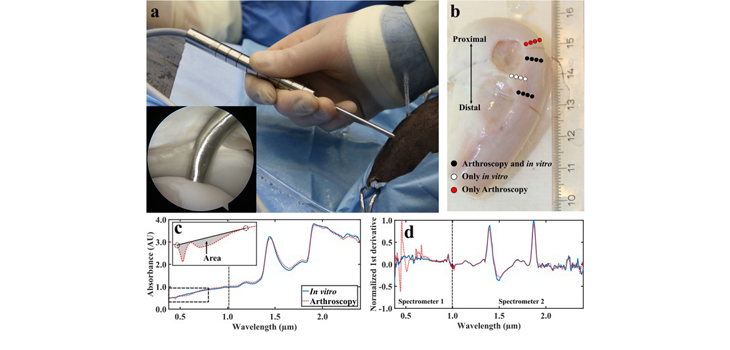
“In the Biophysics of Bone and Cartilage research group, we apply our extensive expertise in quantitative and reliable diagnostics of cartilage and bone pathologies to address the aforementioned limitations. The method adopted in this study utilizes harmless near infrared light (NIR), via a prototype NIR spectroscopy probe that resembles conventional arthroscopic hook. Near infrared light spectroscopy enables rapid non-destructive assessment of cartilage integrity, therefore making the approach highly promising for arthroscopic evaluation.”
The authors wrote, “Two cylindrical chondral lesions were surgically created on the medial femoral ridges of both femoropatellar joints of Shetland ponies (… total of 28 lesions). Each lesion was treated by filling it with Gelatin Methacryl (GelMA) hydrogel (3 varieties) or fibrin glue. The repair procedure (fibrin glue, GelMA cap, GelMA, or reinforced GelMA) was randomized (proximal or distal lesion site and left or right knee) for each defect. A mixture of allogeneic mesenchymal stem cells (MSCs) and chondrons (80/20% ratio) at different concentrations was implanted in each defect…”
“The optimal predictive models reliably predicted the tissue properties of the independent test group apart from subchondral bone volume from in vitro spectral data for the four locations at different distances from the repaired lesion, thus accurately differentiating between healthy and post-traumatic tissue …”
Dr. Sarin told OTW, “This work was the first to utilize near infrared light spectroscopy for simultaneous quantitative evaluation of cartilage stiffness and properties of underlying bone in vivo. The method enables reliable detection of cartilage lesions and can detect the extent of compromised cartilage around a localized lesion while no visible damage is yet evident. In addition, near infrared light spectroscopy could prove highly valuable for monitoring the efficacy of experimental cartilage repair techniques and the integrity of surrounding tissues when developing cartilage repair methods.”
“The proposed method provides diagnostically valuable quantitative information on cartilage and subchondral bone in arthroscopic surgery, therefore reducing the effect of subjectivity in arthroscopic evaluation of cartilage and subchondral bone integrity. Furthermore, the shape and size of the prototype near infrared light spectroscopy probe is similar to conventional arthroscopic hook, which is a standard tool in orthopedic joint surgery.”
Author
React:
Discussion
This is a fascinating development. In my practice we've seen similar outcomes with the revised protocol. The key differentiator seems to be patient selection criteria. Has anyone else noticed the correlation with BMI thresholds?
Great point. I'd push back slightly on the conclusion, the sample size in the cited study is too small to draw population-level inferences. That said, the directional signal is compelling and worth a larger RCT.
We implemented a similar approach last year. Early results are promising but we're still gathering 12-month follow-up data. Happy to share our protocol if anyone is interested.
Join the conversation
Orthopedic professionals are discussing this. Sign in and upgrade to read every comment and add your voice.