
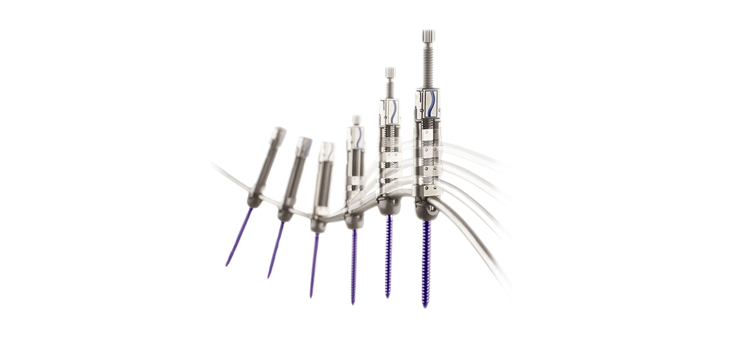
Leesburg, Virginia-based K2M Group Holding, Inc. has announced an U.S. FDA 510(k) clearance for the company’s Dual Differential Correction (DDC) Philosophy & Technique, which, according to the company, “combines rod rigidity and degree of bend with the MESA Platform Technology to help achieve quality outcomes in patients with sagittal imbalance.”
K2M: 510(k) Makes MESA More Patient-Specific
1 min read Premium comments
Secondary#k2m#dualdifferentialcorrection#mesaplatform
MESA can be used with the company’s BACS(Balance Axial/Coronal/Sagittal) Patient-Specific Rods to help surgeons create pre-contoured rods, rails, and templates. The announcement took place at the recent Scoliosis Research Society (SRS) annual meeting in Bologna, Italy.
Todd Ritzman, M.D., a pediatric orthopedic surgeon at Akron Children’s Hospital, explained, “Given the growing recognition of the importance of sagittal plane correction in idiopathic scoliosis, it is a valuable aid to objectively determine rod contour based off of a given patient’s pelvic incidence to help optimize surgical correction in the sagittal plane. The days of ‘eyeballing’ the rod contour are over.”
The company explained to OTWthat “K2M’s MESA Platform Technology features top-loading and low-profile screws and Zero-Torque Technologythat one-step locks without applying torsional stress to the spine. The MESA Platform includes the MESA 2 Deformity Spinal System, a state-of-the-art solution for the most difficult correction maneuvers in complex spine surgery.”
“K2M manufactures BACS Patient-Specific Rods and Rails using a machine rolling method, replacing the manual three-point bending method that often reduces rod fatigue strength. By incorporating data from BACS Surgical Planner—part of K2M’s comprehensive BACS Digital Platform—rods and rails can be manufactured with complex multi-contoured designs. BACS Patient-Specific Rods and Rails can be used with the MESA, EVEREST, and DENALISpinal Systems.”
Lane Major, chairman, CEO, and president of K2M, told OTW, “At this year’s SRS Meeting in Bologna, response to K2M and Dual Differential Correction (DDC) was overwhelmingly positive and reinforced our strategy of innovation. Surgeons continue to be interested in BACS Patient Specific Rods and Rails strengthened by the DDC technique clearance and are enthusiastic to see us introduce additional modules to the platform.DDC, together with MESA and BACS Patient-Specific Rods, provide surgeons and patients with a combined technique and implant system with the goal of providing predictable deformity correction.”
Author
React:
Discussion
This is a fascinating development. In my practice we've seen similar outcomes with the revised protocol. The key differentiator seems to be patient selection criteria. Has anyone else noticed the correlation with BMI thresholds?
Great point. I'd push back slightly on the conclusion, the sample size in the cited study is too small to draw population-level inferences. That said, the directional signal is compelling and worth a larger RCT.
We implemented a similar approach last year. Early results are promising but we're still gathering 12-month follow-up data. Happy to share our protocol if anyone is interested.
Join the conversation
Orthopedic professionals are discussing this. Sign in and upgrade to read every comment and add your voice.