
What guidance can you expect from the FDA’s Center for Devices and Radiological Health (CDRH) for 2019? Risk-benefit determinations, unique device identification and 510(k) program expansions, to name a few. And now, they want to hear from you.
FDA Releases Medical Device Guidance for 2019
2 min read Premium comments
#fdaSecondary#fdaguidance
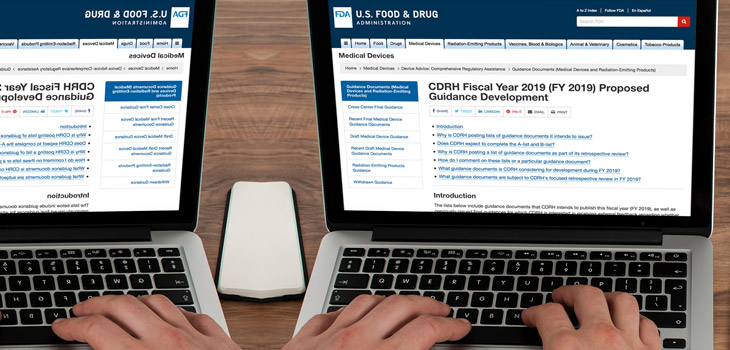
On October 5, 2018, the agency published three lists of guidance documents we can expect to see in the coming year. The lists are:
- The “A List” of guidance documents that the agency fully intends to publish;
- The “B List” of guidance documents that the agency intends to publish as resources permit; and,
- Finally, a list of final guidance documents issued in 2009, 1999, 1989, and 1979 that are subject to focused retrospective review.
The “A List” includes:
- Consideration of Uncertainty in Making Benefit-Risk Determinations in Medical Device Premarket Approvals, De Novo Classifications, and Humanitarian Device Exemptions
- Unique Device Identification: Policy Regarding Compliance Dates for Class I and Unclassified Devices and
- Direct Marking of Inventory
- Breakthrough Devices Program
- Expansion of the Abbreviated 510(k) Program: Demonstrating Substantial Equivalence through Performance Criteria
- The Least Burdensome Provisions: Concept and Principles
- Changes to Existing Medical Software Policies Resulting from Section 3060 of the 21st Century Cures Act
- Clinical and Patient Decision Support Software
- Multiple Function Device Products: Policy and Considerations
- Humanitarian Device Exemption (HDE) Program
- Requests for Feedback and Meetings for Medical Device Submissions: The Q-Submission Program
- The Special 510(k) Program
The FDA Wants to Hear From You
The agency says it would appreciate comments on any or all the guidance documents on the three lists to docket FDA-2012-N-1021. Specifically, the FDA seeks comments on the relative priority of guidance documents. Comments could also include draft language on the proposed A-list and B-list topics, suggestions for new or different guidance documents, for which they request that commenters state the potential guidance topic, reasons the guidance is needed, and proposed policy or information for FDA to consider on the topic.
You should submit written comments to the Dockets Management Staff, Food and Drug Administration, 5630 Fishers Lane, rm. 1061, Rockville, MD 20852. Identify comments with docket number FDA-2012-N-1021 for “Notice to Public of Website Location of CDRH Fiscal Year 2019 Proposed Guidance Development.” Submit electronic comments to http://www.regulations.gov.
To link to the FDA webpage for proposed guidance development information, click here.
Author
React:
Discussion
This is a fascinating development. In my practice we've seen similar outcomes with the revised protocol. The key differentiator seems to be patient selection criteria. Has anyone else noticed the correlation with BMI thresholds?
Great point. I'd push back slightly on the conclusion, the sample size in the cited study is too small to draw population-level inferences. That said, the directional signal is compelling and worth a larger RCT.
We implemented a similar approach last year. Early results are promising but we're still gathering 12-month follow-up data. Happy to share our protocol if anyone is interested.
Join the conversation
Orthopedic professionals are discussing this. Sign in and upgrade to read every comment and add your voice.