
The U.S. Food and Drug Administration (FDA) has granted 510(k) clearance for MedactaInternational’s Mpact 3D Metal Implants and Augments 3D Metal as enhancements to its MpactSystem for primary to complex hip revision procedures. The first surgery in the U.S. with the implant and augments was performed by Tyler Goldberg, M.D., of Austin-based Texas Orthopedics, Sports & Rehabilitation Associates.
FDA Grants 510(k) for Mpact 3D Metal Implants and Augments
2 min read Premium comments
#medactaSecondary#fdaclearance#mpactsystem
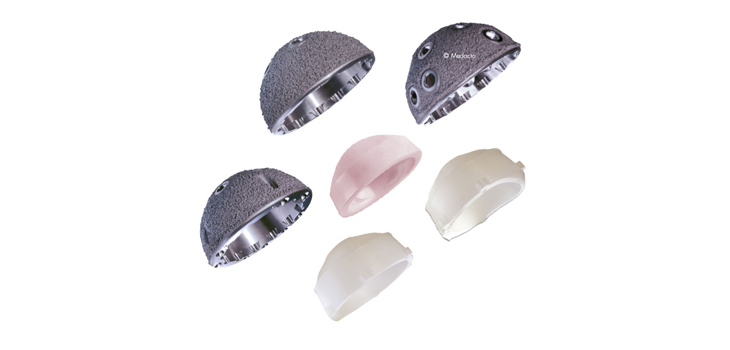
According to Medacta, “The new implants, Mpact 3D Metal Acetabular Two-Hole and Multi-Hole Shells, are hemispherical porous shells with multiple highly cross-linked polyethylene liner options. The implants’ ultra-porous material makes them ideal for more demanding primary patient cases or to address difficult revisions with compromised bone.”
“They are complemented by the porous 3D Metal Augments, designed to act as a defect-filling implant in cases of severe bone loss to help increase implant stability. The augments come in a variety of shapes and sizes, giving surgeons intraoperative flexibility to address a wide variety of acetabular defects. Together, these additions strengthen Medacta’s Mpact System and provide surgeons with more options when addressing complex primary hip replacements, as well as revisions.”
Dr. Goldberg had this to say about the Mpact Two-Hole Shell: “I was impressed with how firm the Mpact 3D Metal Implant was upon initial impaction. The shell has exceptional grip, making primary fixation easy and solid. Knowing the shell is of high porosity and solid nature gave me great confidence for durable bone ingrowth, and my patient is recovering very well.”
Francesco Siccardi, executive VP of Medacta International, told OTW, “3D Metal Technology allows us to meet the higher demands from our surgeon customers and their patients. Hip patients are getting younger and more active.”
“The favorable environment for bone growth provided by the ultra-porous 3D Metal addresses the need for long-term stability of acetabular cups. Combined with the low wear characteristics of HIGHCROSS polyethylene, the Mpact 3D Metal Cup can help meet the needs of these younger more active patients.”
“On the other side of hip arthroplasty, revision cases continue to increase each year. The high scratch-fit of the 3D Metal material along with its favorable bone environment for bone growth make the Mpact 3D Metal Multi-hole Shell and Augments a very good solution for these difficult revision cases. We will now be able to provide these revision products to our expanding customer base who use our primary hip implants.”
“3D Metal Technology allows Medacta to deliver solutions to other needs in the hip, knee, shoulder and spine market. We are already developing more revision products that will utilize 3D Metal Technology. The applications are really endless. As our portfolio of orthopedic products continue to expand, we see 3D Metal Technology being a big part of it.”
Author
React:
Discussion
This is a fascinating development. In my practice we've seen similar outcomes with the revised protocol. The key differentiator seems to be patient selection criteria. Has anyone else noticed the correlation with BMI thresholds?
Great point. I'd push back slightly on the conclusion, the sample size in the cited study is too small to draw population-level inferences. That said, the directional signal is compelling and worth a larger RCT.
We implemented a similar approach last year. Early results are promising but we're still gathering 12-month follow-up data. Happy to share our protocol if anyone is interested.
Join the conversation
Orthopedic professionals are discussing this. Sign in and upgrade to read every comment and add your voice.