
Baxter International Inc.’s Altapore bone graft can now be used in spinal fusion. The product had previously been cleared by the FDA for use in procedures in the extremities and pelvis.
Altapore Bone Graft Cleared for Spinal Fusion
1 min read Premium comments
Secondary#spinalfusion#fdaclearance#altaporebonegraft
Just a few weeks ago Baxter announced FDA clearance for its Actifuse Flow bone graft for use in a variety of orthopedic surgeries in the pelvis, extremities, and posterolateral spine applications.
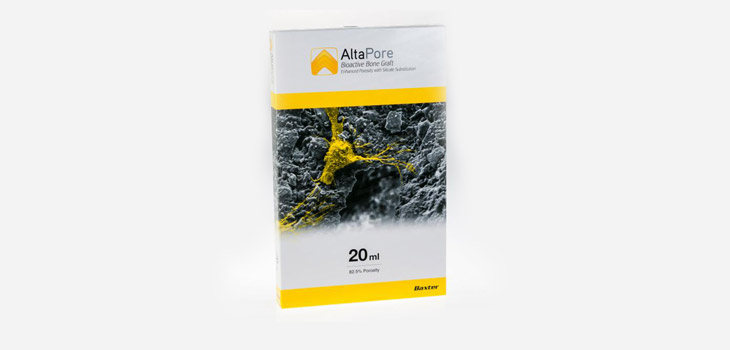
On September 26, 2018, the company said the FDA clearance of the Altapore Bioactive Bone Graft is for use as an autograft extender in posterolateral spinal fusion.
The product, which the company calls a “next-generation bioactive and osteoconductive bone graft substitute, is designed to enhance bone growth with optimized porosity that promotes earlier vascularization, which plays a central role in the bone formation process by providing oxygen, nutrients, and growth factors critical for bone development.”
“Altapore’s porosity also increases cellular activity by providing more surface area for cells to travel along the surface of the graft, which promotes new bone formation. Additionally, Altapore’s unique chemistry contains 0.8% silicon by weight, which was shown to be optimal for bone formation in preclinical studies.”
The company said Altapore’s handling characteristics allow the putty to be molded into multiple shapes to adapt to various surgical needs. In addition, the company said that in a pre-clinical posterolateral spinal fusion model, the product, when used as an extender, exhibited similar fusion rates to iliac crest autograft.
Roger Härtl, M.D., professor of neurological surgery, director of spinal surgery, and director of the Weill Cornell Medicine Center for Comprehensive Spine Care in New York, said the product provides for “earlier vascularization, increased cellular activity and improved volume of new bone growth.”
The product, cleared in a little less than four months, was deemed to be substantially equivalent to Medtronic Sofamor Danek USA, Inc.’s Mastergraft Putty and Baxter’s own Ultrafuse. Both of those products were cleared in April 2014. Altapore’s original clearance listed Baxter’s Actifuse as the predicate device.
According to FDA records, the first Actifuse clearance was granted in 2007 to Great Britain’s ApaTech Limited. Baxter acquired ApaTech for $330 million in 2010.
Author
React:
Discussion
This is a fascinating development. In my practice we've seen similar outcomes with the revised protocol. The key differentiator seems to be patient selection criteria. Has anyone else noticed the correlation with BMI thresholds?
Great point. I'd push back slightly on the conclusion, the sample size in the cited study is too small to draw population-level inferences. That said, the directional signal is compelling and worth a larger RCT.
We implemented a similar approach last year. Early results are promising but we're still gathering 12-month follow-up data. Happy to share our protocol if anyone is interested.
Join the conversation
Orthopedic professionals are discussing this. Sign in and upgrade to read every comment and add your voice.