
Antony, France-based SpineVision Inc. might just be opening the champagne these days.
Two Clearances for SpineVision’s HEXANIUM TLIF Cage
1 min read Premium comments
Secondary
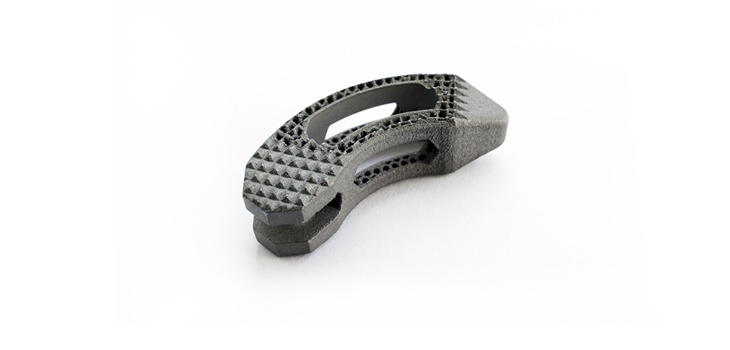
The company recently announced that it had received both an FDA clearance and a CE mark for its next-generation titanium 3D laser-printed Hexanium TLIF (transforaminal lumbar interbody fusion) cage.
According to the company, “The HEXANIUM TLIF cage combines a roughened titanium surface designed for fast osseointegration along with a honeycomb-like structure that features large windows for maximizing bone in-growth and on-growth from endplate to endplate.”
“While TLIF back surgery is successful at relieving patients’ pain in about 60 to 70 percent of cases, there is room for improvement,” said Arnaud Brisard, CEO of SpineVision. “In particular, our HEXANIUM TLIF cage is designed to reduce the risk of subsidence in disc height in the post-operative period. HEXANIUM represents a continuation of our substantial achievements in developing cutting-edge products for all spine pathologies. HEXANIUM TLIF is the first of a complete range of 3D-printed implants SpineVision will be introducing.”
“Hexanium TLIF is an advance for spine fusion surgery,” said Neurosurgeon Gary P. Colon, M.D., NCH Healthcare System, Naples, Florida. “I am able now to deploy the TLIF cage exactly where my intent is when I start the approach. And that’s been a big move forward compared to prior products that I used.”
Arnaud Brisard told OTW, “The optimized contact surface with the endplates and the honeycomb energy-absorbing structure of the Hexanium TLIF cage are designed to mitigate the risk of subsidence. In addition, we also designed Hexanium to facilitate bone in-growth and on-growth.”
Author
React:
Discussion
This is a fascinating development. In my practice we've seen similar outcomes with the revised protocol. The key differentiator seems to be patient selection criteria. Has anyone else noticed the correlation with BMI thresholds?
Great point. I'd push back slightly on the conclusion, the sample size in the cited study is too small to draw population-level inferences. That said, the directional signal is compelling and worth a larger RCT.
We implemented a similar approach last year. Early results are promising but we're still gathering 12-month follow-up data. Happy to share our protocol if anyone is interested.
Join the conversation
Orthopedic professionals are discussing this. Sign in and upgrade to read every comment and add your voice.