
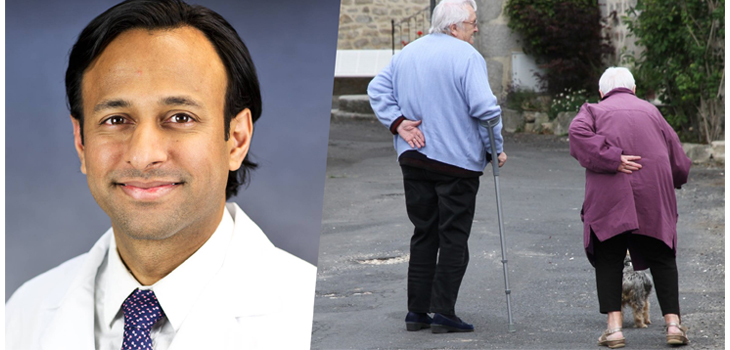
Sanjit Konda, M.D., an assistant professor in the Department of Orthopaedic Surgery at NYU Langone Health in New York City and co-author on the study, told OTW, “This paper is a direct extension of the work I have been doing over the past six years dealing with risk stratification in middle-aged and geriatric trauma patients.”
Sanjit Konda’s Key Study of Elderly Trauma Risk
2 min read Premium comments
Secondary#orthopedictrauma#sanjitkonda#sttgma
The study, “Use of the STTGMA Tool to Risk Stratify 1-Year Functional Outcomes and Mortality in Geriatric Trauma Patients,” was published in the September 2018 issue of the Journal of Orthopaedic Trauma.
“The STTGMA [score for trauma triage in the geriatric and middle-aged] algorithm is a risk stratification tool that takes specific patient variables that are available during their arrival in the emergency department and formulates a mortality risk calculation. The STTGMA tool was originally designed to predict risk of inpatient mortality.”
“Here, we asked the question, ‘Does the STTGMA tool have long-term predictive ability for our geriatric trauma patient?’”
“This was an extremely important question because current literature on the topic of geriatric trauma and in particular orthopedic geriatric trauma tends to clump the long-term outcomes of patients together without risk stratification. This is misleading because the average results of a large trauma population do not account for the healthier and less injured patients or the sicker and more severely injured patients.”
“So, when a physician needs to discuss long-term outcomes with a patient, the data we have available to discuss with the patient usually under or overestimates the true expected outcome.”
“We found a large distinction between low-energy trauma (fall from standing or a height less than 2 stairs) and high-energy trauma (falls from a height greater than 2 stairs, motor vehicle accidents, or blunt force trauma such as being struck by a vehicle) in the geriatric population.”
“With regards to function, geriatric trauma patients who sustain high-energy trauma do far worse at 1 year than their low-energy counterparts and the STTGMA score is able to predict this well. Only 44% of high-energy patients return to their baseline (pre-injury) level of function by 1 year compared to 60% of low-energy patients.”
“Both low and high-energy geriatric trauma patients struggle walking at 1 year with nearly 40% of patients in both groups requiring the use of a new assistive device. About 30% of low-energy patients require a home health aide at 1-year post-injury compared to only 10% of high-energy patients.”
“Also, of the patients who had the highest STTGMA scores, 0% of patients lived past 1 year. This accounted for 5% of the total study population. This gives practical information to the clinician, patient, and family members with regards to shared patient-physician decision making in the setting of undertaking high-risk and complicated surgeries.”
“The STTGMA tool is ideal to risk stratify patients to determine both short-term outcomes such as risk of postoperative complications, length of stay, and need for advanced level of care after hospital discharge and long-term outcomes as delineated by this paper.”
“The second point is that a significant number of geriatric trauma patients continue to have disfunction at 1-year post-injury. This dysfunction requires patients to use assistive devices, affects their ability to perform basic activities of daily living, and oftentimes requires the need for home health aides. These factors should be considered when discussing long-term prognosis for our injured geriatric population.”
Author
React:
Discussion
This is a fascinating development. In my practice we've seen similar outcomes with the revised protocol. The key differentiator seems to be patient selection criteria. Has anyone else noticed the correlation with BMI thresholds?
Great point. I'd push back slightly on the conclusion, the sample size in the cited study is too small to draw population-level inferences. That said, the directional signal is compelling and worth a larger RCT.
We implemented a similar approach last year. Early results are promising but we're still gathering 12-month follow-up data. Happy to share our protocol if anyone is interested.
Join the conversation
Orthopedic professionals are discussing this. Sign in and upgrade to read every comment and add your voice.