
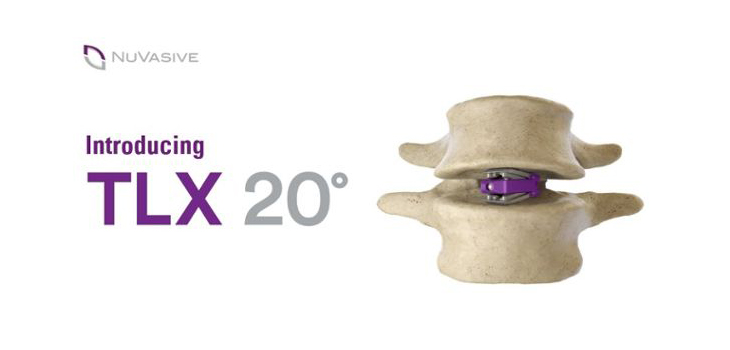
San Diego-based NuVasive, Inc. has announced the launch of its TLX 20-degree expandable spinal interbody implant with, says the company, a first-of-its-kind oblique profile designed for transforaminal lumbar interbody fusion (TLIF) procedures.
NuVasive Launches TLX 20 Degree Spinal Implant
1 min read Premium comments
Secondary
According to NuVasive, “The TLX 20 expandable implant’s integrated auto-lock feature allows surgeons to incrementally customize expansion up to 20 degrees of oblique lordosis and tailor implant expansion based on a patient’s clinical need, compared to many expandables in the market which only offer up to 15 degrees of lordosis.”
“The implant profile is designed to optimally contour to a patient’s interdiscal space to help maintain coronal alignment while achieving sagittal correction, an important aspect of desired patient outcomes that has been clinically validated through research and data from NuVasive’s Integrated Global Alignment® (iGA®) platform.”
“In addition, the TLX 20-degree implant system includes a single, low-profile instrument to position, expand and post-pack the implant with bone graft, improving visualization into the disc space and surgical workflow. The implant also features increased tapering at the distal tip to aid insertion into a collapsed disc space, common among patients with degenerative disc disease, while minimizing the disruption to the surrounding anatomy.”
Matt Link, executive vice president, strategy, technology and corporate development for NuVasive, told OTW, “The NuVasive TLX 20’s oblique implant profile was developed to best fit within the anatomical structure of the disc space, and allows the highest expansion point to be at the midline which helps maintain coronal alignment and correct sagittal alignment. NuVasive designed the oblique profile to help surgeons achieve optimal spinal alignment for their patients, an important aspect of best clinical outcomes for patients. Also, TLX 20 offers up to 20 degrees of lordosis, allowing the surgeon to customize lordosis to a patient’s clinical need.”
Author
React:
Discussion
This is a fascinating development. In my practice we've seen similar outcomes with the revised protocol. The key differentiator seems to be patient selection criteria. Has anyone else noticed the correlation with BMI thresholds?
Great point. I'd push back slightly on the conclusion, the sample size in the cited study is too small to draw population-level inferences. That said, the directional signal is compelling and worth a larger RCT.
We implemented a similar approach last year. Early results are promising but we're still gathering 12-month follow-up data. Happy to share our protocol if anyone is interested.
Join the conversation
Orthopedic professionals are discussing this. Sign in and upgrade to read every comment and add your voice.