
After three and half months of review, the FDA cleared Genesys Spine’s AIS-C Stand-Alone System on August 29, 2018.
Genesys Spine’s Cervical Fusion System Cleared for Marketing
2 min read Premium comments
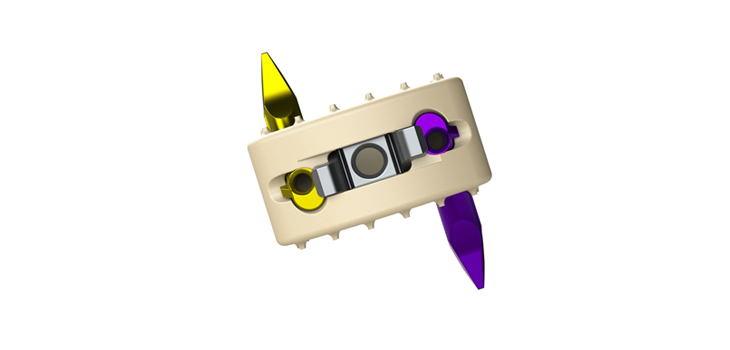
Secondary
The company said the cervical intervertebral body fusion device, “is a first of its kind, non-screw based, zero-profile, direct-anterior stand-alone interbody system for the cervical spine.”
In a September 10, 2018 press release, J. Landon Gilkey, the company’s senior principal design engineer, said the most significant aspect of the AIS-C design, “is its simplicity to implant. From a surgeon’s perspective, there’s only one extra step compared to a standard cervical fusion. Once everything is loaded, they simply squeeze the trigger of the inserter and detach from the implant.”
The company said the “Advantages of the AIS-C Stand-Alone System include:
- Direct anterior approach – Allows for a smaller, mid-line incision.
- Non-screw-based fixation.
- Quick, simple, non-impacting anchor insertion – Does not need an awl or drill.
- Zero-step locking mechanism – Contains a locking feature that provides visual confirmation of engagement, but allows for anchor removal when desired.
- Easily revised or removed – Use of the removal instruments allows the locking mechanism to be defeated so the anchor can be extracted. No drilling is required.”
Predicate Devices
The primary predicate device used by the company to demonstrate substantial equivalence was LDR Spine’s Cervical Interbody Fusion System – ROI-C. Additional predicates included Genesys’ AIS-C Anchored Cervical Interbody Fusion System, the Apache Anchored Cervical Interbody Fusion System, and the Apache IBFD System.
AIS-C System
The FDA documents state that “… the AIS-C system includes PEEK interbodies and titanium interbodies, which utilize an integrated titanium alloy locking mechanism. Both PEEK interbodies and titanium interbodies are to be anchored to patient anatomy via two (2) titanium alloy bone anchors.”
The interbody devices are available in Invibio’s Optima LT1 PEEK (polyether-ether-ketone) configuration with tantalum markers or in a titanium alloy version. “Both versions,” according to the documents, “use the same integrated titanium alloy locking mechanism.”
The devices are also to be available in several footprints, configurations, and heights. “The titanium alloy cervical bone Anchors provide integrated fixation for the system and are to be offered in various lengths. The bone Anchors are deployed through the channels in the interbody and embed into the adjacent cervical vertebrae.”
The FDA documents caution that the integrated fixation anchors “may not provide adequate stability for all situations. The Surgeon should consider the appropriate fixation required for each patient and determine if additional supplemental fixation (e.g. anterior plate, posterior cervical screws) may be needed.”
Matthew Philips, M.D., a director of the Brain and Spine Center at SouthCoast Health in Dartmouth, Massachusetts, said the ease of application of the AIS-C Stand-Alone “will reduce both my surgical times and the morbidity associated with plate and screw constructs. This advantageous technique has made this my implant of choice for ACDFs.”
Author
React:
Discussion
This is a fascinating development. In my practice we've seen similar outcomes with the revised protocol. The key differentiator seems to be patient selection criteria. Has anyone else noticed the correlation with BMI thresholds?
Great point. I'd push back slightly on the conclusion, the sample size in the cited study is too small to draw population-level inferences. That said, the directional signal is compelling and worth a larger RCT.
We implemented a similar approach last year. Early results are promising but we're still gathering 12-month follow-up data. Happy to share our protocol if anyone is interested.
Join the conversation
Orthopedic professionals are discussing this. Sign in and upgrade to read every comment and add your voice.