
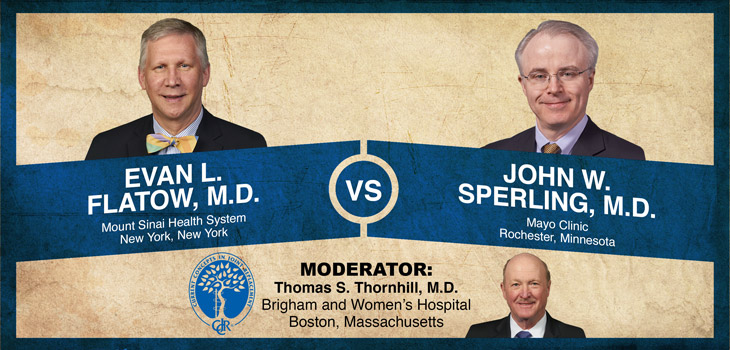
This week’s Orthopaedic Crossfire® debate was part of the 18th Annual Current Concepts in Joint Replacement® (CCJR®), Spring meeting, which took place in Las Vegas. This week’s topic is “Flatow v. Sperling: Lateralization in Reverse TSA: Bone Graft & Long Stem Outdistances Metal” For is Evan L. Flatow, M.D., Mt. Sinai Health System, New York, New York. Opposing is John Sperling, M.D., Mayo Clinic, Rochester, Minnesota. Moderating is Thomas S. Thornhill, M.D., Brigham and Women’s Hospital, Boston, Massachusetts.
Flatow v. Sperling: Lateralization in Reverse TSA: Bone Graft & Long Stem Outdistances Metal
9 min read Premium comments
#bonegraftGreat Debates#ccjr#lateralization#longstem
Dr. Flatow: I’m going to talk about the value of bone graft and a long post and some subtleties on it.
To begin, there are different approaches to inclination and lateralization in the reverse shoulder and some really brilliant people have weighed in on this. With all due respect to Seth, it’s hard to be completely binary in this debate and you’ll see as our remarks go on, that there are roles for metal and there are roles for bone even though I’m defending bone graft.
I think when you say, “Should we rebuild bone loss with bone or metal?” surgeons need versatile tools. Much of the literature and experience came from Switzerland with Christian Gerber who taught us to always have a lot of options like a Swiss army knife. Of course, the French school also taught us to have versatile tools. What I am going to give you is a lot of opinion, there’s not a lot of science on this particular one.
I don’t like to lateralize completely with graft because of its weak initial strength, the fact that it can resorb, and the long cantilever moment. I think if you put on a dead piece of bone completely circumferentially, there is the risk that with offset loading and time, as the bone resorbs, it puts a rocking moment on the fixation that’s deep in the canal. Circumferential graft is a means of lateralization and has many risks.
I prefer to use a combination of bone graft with the system I use that has a lateral offset built in with porous material (tantalum) that allows bone to grow in. So, it has initial strength and later has bone ingrowth to become like a “metal bone graft.”
Each system is different. You have to add it up whether it’s in the glenosphere or in the baseplate. Some amount of offset can be achieved through metal within the system or in the size of the glenosphere that is used.
Now the offset compensation. If you take all of the bone away when you want to put on a baseplate, you have to go medial in order to get your fixation. I think that’s the role of the long post which is in the title of our debate because you can’t hold on completely with screws.
You can have a larger glenosphere to give you some offset or you can have it in the baseplate, but when you do use metal, you really have to have fixation that goes medial in the scapula not in the soft resorbed bone laterally and that’s the challenge of metal. Whereas bone graft over time, as it reconstitutes, is able to bear load.
My own preference is to graft an eccentric defect which I think is better than metal because it allows for reconstitution. I like to have a portion of the native bone supporting the construct laterally otherwise everything is hinging on the cantilever loading of the long post. I like to have at least 40% living bone-implant contact so there is some compression and then have a long post with a textured surface to the distal cortex.
I like to use porous tantalum but there are other options. In general I like a post rather than a screw because a screw is the strongest when you first put it in and an ingrowth post gets stronger with time.
A guide is utilized to find the cortex, so that we deliberately penetrate it, and get fixation from the screw and from the post in the distal cortex. My final point is, would you take advice from a guy who is described by his own patients on the doctor-rating websites as “the best, but if you are looking for Dr. Warm and Fuzzy he’s not your doctor”?
Dr. Sperling: So, I’ll talk about lateralization in reverse total shoulder arthroplasty where metal outdistances bone graft with a long post.
There are some potential benefits of lateralization and reverse arthroplasty. It allows the surgeon to more effectively tension the remaining rotator cuff and it also can decrease the rate of scapular notching. Other potential benefits of lateralization include improved cosmetic appearance of the shoulder, improved stability, as well as increased impingement-free arc of motion.
There are different ways to do this. One way, of course, is to use bone graft. Another option is to lateralize using metal. You can either use a thicker glenosphere itself in different lateralization options or a thicker metal glenoid baseplate.
One of the concepts from France was the BIO RSA. The concept is to lateralize the glenoid by placing the center of rotation, still in glenoid bone, without causing undue stress on the baseplate itself. One of the other goals of this, of course, is to be able to use the patient’s own proximal humeral bone to be able to create the offset on the shoulder, but there are challenges with it.
When you use a graft like that and you are placing that between the native bone and the baseplate, it could be more complex, you could crush the bone during the procedure itself, and there could be fragmentation as well as significant cases of non-union.
What are the benefits of metal? It’s simple, reproducible, and a time efficient method to be able to provide lateralization for your patient.
A great prospective study by Brad Edwards (AAOS 2013) of BIO RSA compared to standard Grammont design—18 shoulders in the BIO RSA group and 20 in the control group. He found no significant difference in outcome in the groups and the notching rates are frankly very concerning — 78% rate in the BIO RSA compared to 70% in the controls. Even more concerning, I think, is the rate of graft resorption or failure to incorporate with 33% of patients only having partial incorporation or actually frank failure to incorporate the bone graft itself.
How about lateralizing with metal? Mark Frankle’s study (JBJS 2015) reported quite good, long-term survival —94% survival with minimum 5-year follow-up, low rate of scapular notching, and no cases of baseplate loosening itself. So, lateralizing patients with metal, the results can be maintained at a minimum follow-up of 5 years.
I think, in conclusion, the complexity of a BIO RSA or a lateralization together with concerns about non-union, fragmentation, and actually lack of strong evidence of superiority do not warrant from changing from metal.
In my practice I like to lateralize with metal: it’s safe, reliable, a simple approach, and clinically sound.
Moderator Thornhill: John, when is there too much glenoid bone loss…when you just want to abandon trying to put a reverse in?
Dr. Sperling: I think that’s probably a two-part question, First, it’s probably the most common problem I see in my practice. We used to tell people, “Don’t come back and have the procedure done until you can’t take it anymore.” I see a number of people come back with a significant amount of bone loss. The second aspect is, we are better able to manage bone loss with a baseplate with a reverse rather than an anatomic glenoid. But, no doubt, some patients are burning a bridge by waiting too long.
Moderator Thornhill: When is there too much glenoid bone loss to do it and how do you evaluate the amount of the bone loss?
Dr. Flatow: If you have only a shell of bone, like an eggshell, and you don’t have really any good medial bone to get into, and you start putting screws into the acromial base you can cause a fracture. It doesn’t suddenly become impossible, but it becomes very, very tricky and so I have the same view that John has.
When it’s early on and there’s good bone, I’m fine with people waiting, but the minute I see bone loss, I talk about getting this done at a reasonable time.
There are newer devices that make it easier. In some of Frankle’s early experiments with lateralization he had trouble with that loading. We’ve gotten better, but when you lose your bone it gets risky.
Tom, I don’t think there is a specific amount, but when I don’t have anything distally, any triangle of bone, it’s just an eggshell, and all I have is that lateral border and the base of the acromion—I tend to shy away.
Moderator Thornhill: John, at CCJR in Orlando we had an evening meeting talking about 3D printing for big league acetabular defects and pelvic discontinuity. Is there any experience with 3D printing about the shoulder or anything coming down the line?
Dr. Sperling: No doubt about it. Having a better sense of what the anatomy is preoperatively is critical, so I use a CT scan on every patient preoperatively. It really helps plan the procedure itself.
I tend to use patient specific guides in the extreme cases…people who have glenoid dysplasia and associated bone loss. The guides themselves can prevent the outliers on either side of the bell-shaped curve. The challenge is as we move forward perhaps in a bundle payment model is the most expensive part of the preoperative evaluation for the patient is the CT scan and the guide itself.
There is a desire to be able to use some of this technology, but it has to be balanced out against perhaps in the associated cost and who is the ideal patient for that.
Dr. Flatow: John’s point is true. If you put a rough surface post deep into the cavity but don’t really anchor it, it can start to windshield wiper and you don’t get good strength.
When I use a long post, I like to deliberately penetrate so it just goes through the cortex like a distal screw, so you get a really solid fix. Then if you have one point of fixation, compression on a part of the rim laterally, you have that post there, and then you have the two screws with distal cortices, you have a more stable construct and you can fill in the rest with bone graft. I won’t use a long post if I am not going to penetrate. With the shorter post I typically don’t penetrate if it’s good bone, I just fit it into the cancellous bone.
Moderator Thornhill: You showed one case where it looked like you had a metal augment lateralizing the humerus. Can you get any value if you’re concerned about getting too far lateralized or losing stability in the glenoid? Can you do that on the humerus?
Dr. Sperling: Yeah, you can do that on the humerus. You can either tension on the humeral side or the glenoid side itself and the entire concept of lateralization is also on the revision side not the primary side.
We have some evidence from Mayo that if you over-lateralize these revision cases, they have a higher rate of failure. So sometimes it’s like playing golf, I play the ball where it lies, if it’s deep in the rough, that’s where you have to play it. If some of these patients are very far medial in that way, sometimes I won’t force them into lateralization that way.
We’ve looked at a variety of different implants, but in terms of the bread and butter of reverse you can either tension typically on the glenoid side, some people like to use a thicker tray perhaps to lateralize on the humeral side itself.
Dr. Flatow: We had the reverses that failed 30-40 years ago because they had the long very lateralized center of rotation. Then when Grammont got it right, we all sort of adhered to those principles and then, you got to give Mark Frankle a lot of credit to really play with different angles and different offsets.
We were very scared…until you get multi-year follow-up we weren’t quite sure we saw benefits. We are only beginning I think to feel our way out there and know how much we can accept, what’s the right inclination, where to put the offset.
So, the answer to your question, I think, is that we are sort of figuring that out now, we don’t have a lot of long-term follow-up on each variation of that.
Dr. Sperling: I think we’ve learned that with the baseplate under compression, the grafts tend to do much better than on the anatomic side, so again, great opportunity to help our patients with that, with the reverse, and those severe bone loss cases.
Moderator Thornhill: It was a very informative session, particularly for me and we’d like to thank everybody for their participation.
Please visit www.CCJR.com to register for the 2018 CCJR Winter Meeting, – December 12 – 15 in Orlando.
Author
React:
Discussion
This is a fascinating development. In my practice we've seen similar outcomes with the revised protocol. The key differentiator seems to be patient selection criteria. Has anyone else noticed the correlation with BMI thresholds?
Great point. I'd push back slightly on the conclusion, the sample size in the cited study is too small to draw population-level inferences. That said, the directional signal is compelling and worth a larger RCT.
We implemented a similar approach last year. Early results are promising but we're still gathering 12-month follow-up data. Happy to share our protocol if anyone is interested.
Join the conversation
Orthopedic professionals are discussing this. Sign in and upgrade to read every comment and add your voice.