
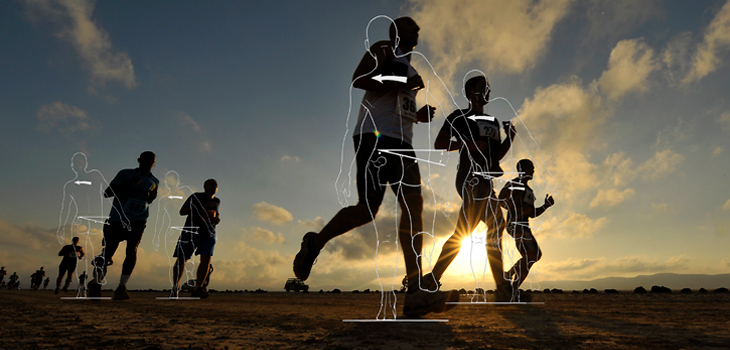
In a recent study, “Is There a Pathological Gait Associated With Common Soft Tissue Running Injuries?” published on September 7, 2018 in the American Journal of Sports Medicine, researchers identified running with greater contralateral pelvic drop (CPD) as a strong risk factor for common running-related injuries.
Contralateral Pelvic Drop Linked to Running Injuries
1 min read Premium comments
Secondary
The researchers compared 72 injured runners to 36 healthy controls using three-dimensional running kinematics. In the injured group, there were 4 subgroups of runners with either patellofemoral pain, iliotibial band syndrome, medial tibial stress syndrome or Achilles tendinopathy. A logistic regression model was used to determine which parameters could be used to identify injured runners.
According to the data, the injured runners exhibited greater contralateral pelvic drop (CPD) and forward trunk lean at midstance and a more extended knee and dorsiflexed ankle at initial contact. These kinematic patterns were consistent across each of the 4 injured subgroups.
Most significantly, contralateral pelvic drop was found to be the strongest predictor of injury. For every 1 degree increase in pelvic drop, there was an 80% increase in the odds of being classified injured.
The researchers wrote, “This study identified a number of global kinematic contributors to common running injuries. In particular, we found injured runners to run with greater peak CPD and trunk forward lean as well as an extended knee and dorsiflexed ankle at initial contact. CPD appears to be the variable most strongly associated with common running-related injuries.”
They added, “The identified kinematic patterns may prove beneficial for clinicians when assessing for biomechanical contributors to running injuries.”
Author
React:
Discussion
This is a fascinating development. In my practice we've seen similar outcomes with the revised protocol. The key differentiator seems to be patient selection criteria. Has anyone else noticed the correlation with BMI thresholds?
Great point. I'd push back slightly on the conclusion, the sample size in the cited study is too small to draw population-level inferences. That said, the directional signal is compelling and worth a larger RCT.
We implemented a similar approach last year. Early results are promising but we're still gathering 12-month follow-up data. Happy to share our protocol if anyone is interested.
Join the conversation
Orthopedic professionals are discussing this. Sign in and upgrade to read every comment and add your voice.