
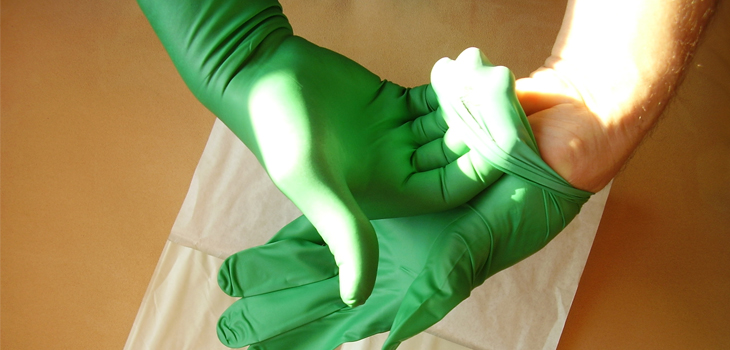
Should you worry about a screw or drill bit getting contaminated because of a glove tear? “Yes,” says a novel study on this topic.
Contaminated Gloves to Contaminated Implants
2 min read Premium comments
Secondary#orthopedictrauma#gloveperforation#surgicalglove
The paper, “Glove Perforation in Orthopaedics: Probability of Tearing Gloves During High-Risk Events in Trauma Surgery,” appears in the September 2018 edition of the Journal of Orthopaedic Trauma.
J. Todd Lawrence, M.D., Ph.D., an attending orthopedic surgeon at the Children’s Hospital of Philadelphia, called his work a “pet peeve” project.
As Dr. Lawrence explained to OTW, “Every once and a while I will turn around and see a new nurse or new resident cleaning a drill bit with their gloves. I had a sense that this put them at a high risk of tearing their gloves…and that just checking the glove visually doesn’t help because you can’t see the hole. I decided to try to quantify that risk.”
Quoting from the study itself, “Four investigators executed 6 high-risk maneuvers in a simulated laboratory setting. Alternative techniques were also performed for most maneuvers.”
“Glove integrity was examined by 2 standard methods of fluid leak testing…By checking their gloves like you would in the OR looking for a hole, investigators were only able to identify 14.3% of perforations.”
“Cleaning drill bit flutes by hand had the highest overall tear rate (85%). Catching a glove along the guide wire when passing a cannulated drill bit resulted in a 50% perforation rate.”
“Catching a glove around a rotating drill shaft had a tear rate of 40%. Palpating the end of a flexible nail cut with a wire cutter had a significantly higher perforation rate than a nail cut with a proprietary, nail-specific tool.”
“Blind digital fracture reduction had a tear rate that was not statistically different than directly visualizing the reduction. Inserting screws while stabilizing the threads with one’s fingers resulted in a perforation rate of 15%.”
So what initial instructions are given to new OR team members? Not much, says Dr. Lawrence. “Team members are not typically instructed to clean the drill bits, but these bits get bone debris stuck in the flutes and it’s human nature to want to clean them out.”
“A common error that junior residents make is putting their fingers too close to the action as they are guiding a cannulated screw or drill bit onto a guide wire and the glove gets caught at the interface. Now I look at it as a teaching point: ’Ok, we’re going to call that screw or bit contaminated and get a new one…and change gloves…and next time we are going to keep our fingers away from that pinch point.’”
“This study helps me say, ‘Look, there is a xyz% chance that what you just tore your glove and contaminated that instrument. Get it out of the surgical field and change gloves.’ And I am now much more explicit when I hand off clogged up drill bits…now I say, “‘Can you clean that out with gauze—NOT your fingers?!’”
“My sincere hope is that the results of this study can be used by training programs to promote safe surgical practice.”
Author
React:
Discussion
This is a fascinating development. In my practice we've seen similar outcomes with the revised protocol. The key differentiator seems to be patient selection criteria. Has anyone else noticed the correlation with BMI thresholds?
Great point. I'd push back slightly on the conclusion, the sample size in the cited study is too small to draw population-level inferences. That said, the directional signal is compelling and worth a larger RCT.
We implemented a similar approach last year. Early results are promising but we're still gathering 12-month follow-up data. Happy to share our protocol if anyone is interested.
Join the conversation
Orthopedic professionals are discussing this. Sign in and upgrade to read every comment and add your voice.