
ConforMIS, Inc. just announced that Smith & Nephew has agreed to pay $10.5 million to settle and enter a limited cross-license agreement over a patent dispute.
ConforMIS and Smith & Nephew Settle Patent Disputes
1 min read Premium comments
Smith NephewSecondary#conformis#patentlitigation
In a statement issued on September 17, 2018, ConforMIS announced the settlement to put an end to numerous intellectual property battles between the two companies in the federal courts and the Patent Trial and Appeal Board (PTAB) over individually sized knee implant tools.
The settlement comes after the U.S. Supreme Court got involved ruling that PTAB can’t pick and choose which challenged claims it wants to review. Law360 reported that PTAB initially agreed to take up some but not all the patent claims challenged by Smith & Nephew, but then revived those rejected claims and ordered an additional briefing.
Mark Augusti, president and CEO of ConforMIS said, “We have once again monetized our patient-specific instrument patents and steadfastly protected our core business of patient-specific implants.”
A Smith & Nephew spokesperson told Law360 that the company “is pleased to have reached agreement with ConforMIS regarding the licensing of certain patents related to patient-specific instruments including its VISIONAIRE Patient Matched Instrumentation, ending all litigation between the two companies.”
The two companies have been in the Federal Circuit, where several appeals filed by ConforMIS were currently pending. Those appeals challenged five of the board’s final decisions striking down claims in ConforMIS’ U.S. Patent Numbers 8,551,169; 7,981,158; 9,216,025 and 9,055,953. Smith & Nephew reportedly confirmed that the settlement resolves all patent issues between the companies.
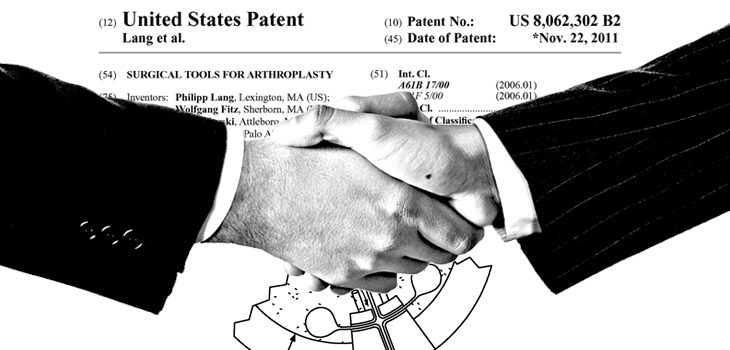
The patent in this dispute was U.S. Patent No. 8,062,302.
According to Google Patents, the patent describes “methods, compositions and tools for repairing articular surfaces repair materials and for repairing an articular surface. The articular surface repairs are customizable or highly selectable by patient and geared toward providing optimal fit and function. The surgical tools are designed to be customizable or highly selectable by patient to increase the speed, accuracy and simplicity of performing total or partial arthroplasty.”
Author
React:
Discussion
This is a fascinating development. In my practice we've seen similar outcomes with the revised protocol. The key differentiator seems to be patient selection criteria. Has anyone else noticed the correlation with BMI thresholds?
Great point. I'd push back slightly on the conclusion, the sample size in the cited study is too small to draw population-level inferences. That said, the directional signal is compelling and worth a larger RCT.
We implemented a similar approach last year. Early results are promising but we're still gathering 12-month follow-up data. Happy to share our protocol if anyone is interested.
Join the conversation
Orthopedic professionals are discussing this. Sign in and upgrade to read every comment and add your voice.