
A new retrospective analysis from Rush University Medical Center in Chicago has tackled the topic of using a minimally invasive approach for iliac crest bone graft harvesting. The study, “Iliac Crest Bone Graft for Minimally Invasive Transforaminal Lumbar Interbody Fusion: A Prospective Analysis of Inpatient Pain, Narcotics Consumption, and Costs,” appears in the September 15, 2018 edition of Spine.
Can Iliac Crest Bone Graft Be Cheaper Than BMP?
2 min read Premium comments
Secondary
Co-author Kern Singh, M.D. co-director of the Minimally Invasive Spine Institute at Rush, explained the rationale behind his study to OTW, “In patients undergoing minimally invasive transforaminal lumbar interbody fusion (MIS TLIF), there is a current debate regarding the utility of iliac crest bone graft (ICBG) versus alternative options such as allografts, synthetic bone grafts, and recombinant bone morphogenetic protein-2 (BMP-2) for enhancing fusion.”
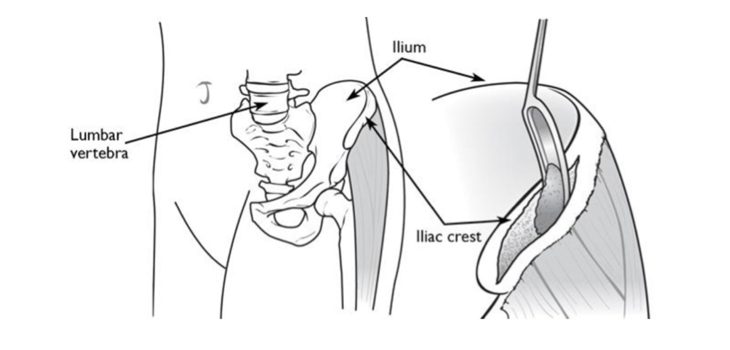
“Although ICBG has been a traditional standard for its superior osteoinductive, osteoconductive, and osteogenic properties, there has been a recent drop in popularity due to fears of postoperative donor site pain and decreased mobility. However, recent advances in spine surgery have afforded a minimally invasive approach for ICBG harvesting which may mitigate previous surgical and clinical disadvantages of the open technique. Thus, it was in our interest to compare the immediate postoperative course and surgical costs of patients receiving either minimally invasive ICBG harvesting or a combination of allograft and BMP-2.”
The authors wrote, “Prospective, consecutive analysis of patients undergoing primary, single-level MIS TLIF with ICBG was compared to a historical cohort of consecutive patients that received BMP-2. Operative characteristics were compared between groups using χ2 analysis or independent t test for categorical and continuous variables, respectively. Postoperative inpatient pain was measured using the Visual Analog Scale, and inpatient narcotics consumption was quantified as oral morphine equivalents. Outcomes were compared between groups using multivariate regression controlling for preoperative characteristics. A total of 98 patients were included in this analysis, 49 in each cohort…”
Dr. Singh commented to OTW, “Our investigation demonstrated that although patients undergoing minimally invasive ICBG harvesting have marginal increases in operative time and blood loss, they experience no differences in pain or narcotics consumption immediately after surgery compared to patients receiving allograft and BMP-2.”
“Furthermore, the use of ICBG harvest saved over $2,300 in surgical costs on average compared to synthetic bone grafts in our study. Thus, minimally invasive ICBG harvesting offers economic advantages over the use of adjuncts without differences in immediate postoperative clinical recovery. However, before making practice-changing decisions, surgeons should consider long-term outcomes and arthrodesis rates amongst graft options which were outside the scope of our study.”
“Not only does the minimally invasive ICBG harvesting technique offer the well-established fusion enhancing properties of autograft, it also reduces the feared postoperative course of donor site pain and reduced mobility related to the traditional open approach. The minimally invasive ICBG technique also provides a significant saving in surgical costs compared to use of synthetic grafts. Thus, although further studies comparing long-term outcomes of available bone graft options are still required, minimally invasive ICBG harvesting remains a suitable choice during MIS TLIF.”
Author
React:
Discussion
This is a fascinating development. In my practice we've seen similar outcomes with the revised protocol. The key differentiator seems to be patient selection criteria. Has anyone else noticed the correlation with BMI thresholds?
Great point. I'd push back slightly on the conclusion, the sample size in the cited study is too small to draw population-level inferences. That said, the directional signal is compelling and worth a larger RCT.
We implemented a similar approach last year. Early results are promising but we're still gathering 12-month follow-up data. Happy to share our protocol if anyone is interested.
Join the conversation
Orthopedic professionals are discussing this. Sign in and upgrade to read every comment and add your voice.