
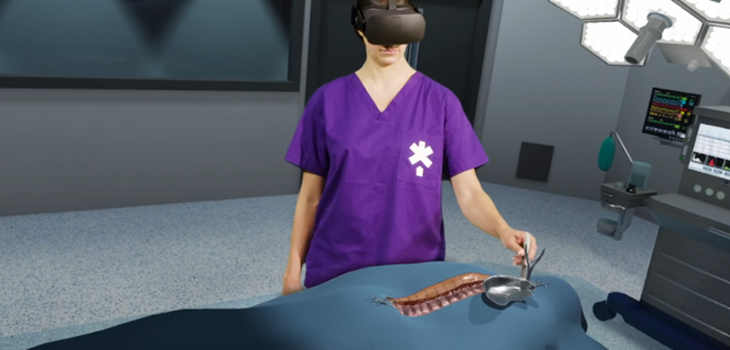
UK-based FundamentalVR has launched Fundamental Surgery, a first-of-its-kind SaaS software platform that combines virtual reality (VR) with the latest haptics (the sense of touch) so that surgical training involves a flight simulator experience.
Surgical Training Platform Combines Virtual Reality-Latest Haptics
2 min read Premium comments
Secondary#fundamentalvr#fundamentalsurgery#surgicalhapticintelligenceengine
According to the company, Fundamental Surgery creates an authentic environment that allows users to experience and navigate the same visuals, sounds and feelings they would during a real surgical procedure.
Asked how much of a leap this is for surgical training, FundamentalVR Co-Founder and CEO Richard Vincent told OTW, “Never before has haptics and VR been combined in this way to deliver orthopedic training at such a dramatically lower cost. For effective training in surgical skills one needs to be involved with all the surgical challenges, this involves all the senses, that’s why our low-cost haptic integration is so important. Practice makes perfect, repetition is key, our system means that surgical training can be within arm’s reach of any surgeon at a realistic cost.”
“The FundamentalVR Surgical Haptic Intelligence Engine (SHIE) is a proprietary system that allows us to create compelling sense of touch and tissue interaction within our VR simulations across a range of haptic hardware devices.”
“It involves creating ‘Haptic Actions’ which define the interactions between the surgical tools and the patient’s virtual anatomy. To do this we create haptic baselines through close consultation with our Global Medical Panel, senior clinicians, comprising a range of surgical specialisms and then, with our unique calibration tools we are able to refine these through the development process to achieve the appropriate interaction. This requires a deep understanding of tissue behaviour under various conditions aligned with deep physics and mathematical computation.”
“It’s Fundamental Surgery’s unique combination of SHIE technology with VR simulation that generates maximum and consistent immersion. So, the surgical experience delivered remains incredibly realistic. As we continue to develop and deploy our Haptic Intelligence Engine (SHIETM) we are in-effect building a hardware agnostic haptic map of the human body which as other hardware solutions such as haptic gloves become economically viable for widescale medical use we will be able to port directly into.”
Also, says the company, the system will be able to be programed to present users with branched outcomes—rare complications or scenarios that can happen during live procedures such as unexpected bleeding, abnormal anatomy or a change in a patient’s condition.
Asked about a branched scenario in orthopedics, Vincent told OTW, “A rupture within a pedicle channel during screw placement, sawing too deep during a TKA [total knee arthroplasty] tibia, or over reaming the acetabulum during the THR [total hip replacement]. Note that branched outcomes are being introduced as part of roll out of system.”
Author
React:
Discussion
This is a fascinating development. In my practice we've seen similar outcomes with the revised protocol. The key differentiator seems to be patient selection criteria. Has anyone else noticed the correlation with BMI thresholds?
Great point. I'd push back slightly on the conclusion, the sample size in the cited study is too small to draw population-level inferences. That said, the directional signal is compelling and worth a larger RCT.
We implemented a similar approach last year. Early results are promising but we're still gathering 12-month follow-up data. Happy to share our protocol if anyone is interested.
Join the conversation
Orthopedic professionals are discussing this. Sign in and upgrade to read every comment and add your voice.