
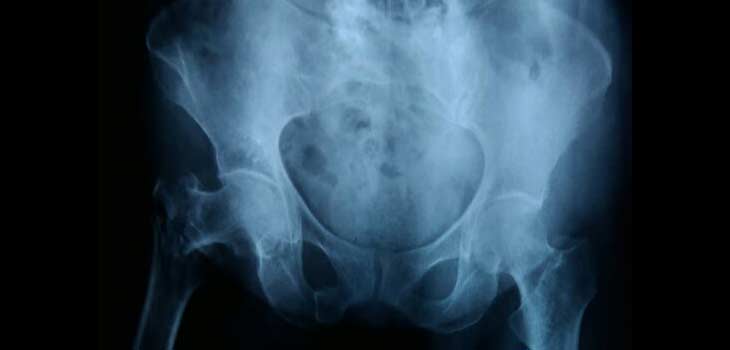
Researchers from Australia set out to highlight how long the increased risk of dying exists from low trauma fractures—other than hip fractures.
Study: Long-Term Mortality Risk Following Fractures
2 min read Premium comments
Secondary#fracture#fragilityfracture
Their study, “Persistence of excess mortality following individual non-hip fractures: A relative survival analysis,” appears in the Journal of Clinical Endocrinology and Metabolism.
The study used registry data to look at 21,123 women and 9,481 men (average age of the women was 72, the average age of the men was 67) who experienced a fragility fracture and for whom 10-year follow-up data was available.
Jacqueline Center, Ph.D., senior staff specialist and deputy director in the Department of Endocrinology at St Vincent’s Hospital in New South Wales, Australia and a co-author commented to OTW, “We know that there is an increased risk of dying after most fracture types, excluding minor or distal fractures (e.g. fractures of the ankle, foot, wrist, hand etc.).”
“However, although there are many studies looking at what happens after hip fracture, there have never previously been large enough data sets to look at other specific fracture types to identify for how long the increased risk of dying lasts.”
“We studied a remarkable health resource—the Danish national register, which has for decades monitored the diagnoses and healthcare use of the entire population of Denmark. It was only by using a dataset this extensive and robust that we were able to learn about individual fracture sites, the risks they carry, and the length of time that risk persists.”
“For older people who break a bone, the risk of death goes up—and that risk can stay high for years. This is true for most fracture sites, including the upper arm, spine, rib, pelvis and hip. Importantly, the risk of dying is highest in the year immediately after the fracture.”
“We knew before that hip fractures led to a heightened risk of death, but we didn’t know if the same was true for broken bones elsewhere, and we had no clear understanding of how long the heightened risk persisted, for any fracture. The heightened risk can last for over a decade after a hip fracture, and for most other fractures the increased risk is for about 5 years.”
The authors wrote, “Hip fractures were associated with the highest excess mortality (33% and 20% at one-year post-fracture in men and women, respectively). One-year excess mortality was 20-25% after femur or pelvis, 10% following vertebral, 5-10% following humerus, rib or clavicle, and 3% following lower leg fractures…”
“The research highlights the important contribution of a wide variety of fragility fractures other than hip to excess mortality (meaning the extra deaths above what would have been expected for someone of that age and sex without a fracture). While hip fractures are regarded as significant and recognized as causing increased mortality, non-hip fractures are often seen as not being very important. This study highlights the need for early intervention following any low trauma fracture to minimize the wide treatment gap that is present internationally.”
“Orthopaedic surgeons should consider that the treatment of the patient requires more than just fixing the bones acutely. Osteoporosis is a condition that has adverse consequences including premature mortality following a fracture.”
“Orthopaedic surgeons should tell the patient that he/she requires further follow-up from their general practitioner or specialist to understand why the bone broke and investigate whether their bones are fragile and require specific treatment.”
Author
React:
Discussion
This is a fascinating development. In my practice we've seen similar outcomes with the revised protocol. The key differentiator seems to be patient selection criteria. Has anyone else noticed the correlation with BMI thresholds?
Great point. I'd push back slightly on the conclusion, the sample size in the cited study is too small to draw population-level inferences. That said, the directional signal is compelling and worth a larger RCT.
We implemented a similar approach last year. Early results are promising but we're still gathering 12-month follow-up data. Happy to share our protocol if anyone is interested.
Join the conversation
Orthopedic professionals are discussing this. Sign in and upgrade to read every comment and add your voice.