
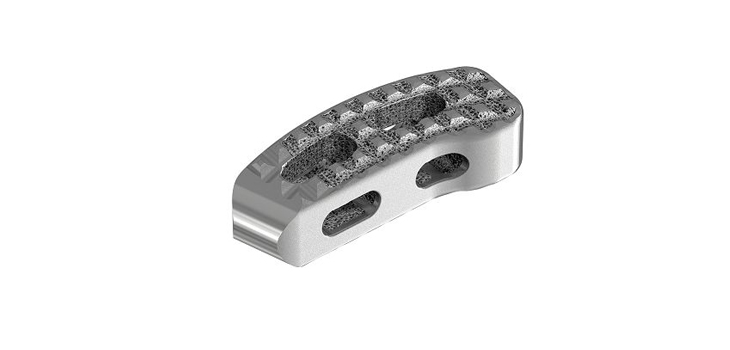
A comparison of interbody cages has resulted in the publication of new results on Allendale, New Jersey-based Stryker Spine’s 3D-printed Tritanium cages.
Stryker’s 3D-Printed Tritanium Cage Shines in Study
2 min read Premium comments
#strykerSecondary#tritanium
The pre-clinical animal study, “Bony Ingrowth Potential of 3D Printed Porous Titanium Alloy: A Direct Comparison of Interbody Cage Materials in an In Vivo Ovine Lumbar Fusion Model,” was published in the July issue of The Spine Journal.
“The results demonstrated that the Tritanium cages exhibited significantly greater total bone volume within the graft window at both 8 and 16 weeks compared to PEEK cages. Tritanium cages also were the only cages that showed a decrease in range of motion and an increase in stiffness across all three loading directions (axial rotation, flexion-extension, and lateral bending) between the 8-week and 16-week time points.”
“The results of this study provide an evidence-based approach to decision-making regarding interbody materials for spinal fusion, as there is significant variability in the materials commonly used for interbody cages in spine surgery,” said Sigurd H. Berven, M.D., orthopedic surgeon at the University of California, San Francisco. “The study showed the potential for bone in-growth into and around the Tritanium cages.”
According to Michael Carter, vice president and general manager of Stryker’s Spine division, 3D printing, also known as additive manufacturing, allows the creation of a material with “precisely randomized” porous structures designed to mimic bone. “Stryker’s proprietary Tritanium Technology, a novel, highly porous titanium alloy material designed for bone in-growth and biological fixation, is based on additive manufacturing techniques for orthopaedic surgery pioneered by Stryker over 15 years ago,” Carter said. “This important study reinforces the value of our growing line of Tritanium interbody cages and demonstrates Stryker’s commitment to bringing the latest in advanced technologies to our customers.”
Michael Carter told OTW, “The ultimate goal with spinal implants is to get a fusion. The study results demonstrating that the Tritanium cages exhibited significantly greater bone volume within the graft window at key timepoints compared to the PEEK cages should be of great importance to spine surgeons.”
“We are continuing our efforts to expand our highly successful Tritanium portfolio, which has been embraced by spinal surgeons nationwide. We also are focused on taking the next steps toward human studies, based on the positive results of our recently published animal study.”
Author
React:
Discussion
This is a fascinating development. In my practice we've seen similar outcomes with the revised protocol. The key differentiator seems to be patient selection criteria. Has anyone else noticed the correlation with BMI thresholds?
Great point. I'd push back slightly on the conclusion, the sample size in the cited study is too small to draw population-level inferences. That said, the directional signal is compelling and worth a larger RCT.
We implemented a similar approach last year. Early results are promising but we're still gathering 12-month follow-up data. Happy to share our protocol if anyone is interested.
Join the conversation
Orthopedic professionals are discussing this. Sign in and upgrade to read every comment and add your voice.