
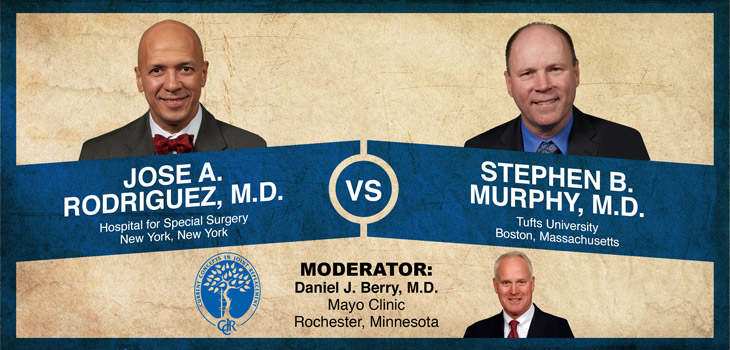
This week’s Orthopaedic Crossfire® debate was part of the 18th Annual Current Concepts in Joint Replacement® (CCJR®), Spring meeting, which took place in Las Vegas. This week’s topic is “The Direct Anterior Approach: First Among Equals.” For is Jose A. Rodriguez, M.D., Hospital for Special Surgery, New York, New York. Opposing is Stephen B. Murphy, M.D., Tufts University, Boston, Massachusetts. Daniel J. Berry, M.D., Mayo Clinic, Rochester, Minnesota is the Moderator.
Rodriguez v. Murphy: The Direct Anterior Approach: First Among Equals
9 min read Premium comments
#hipreplacement#joserodriguez#ccjr#stephenmurphy
Dr. Rodriguez: I’d like to begin with two great quotes. First, “Whole Trunnion Failure” or WTF! Then “Death. It’s a life changing event.”
Today I’m debating the venerable Stephen B. Murphy and he and I have history together. His cerebral nature is such that he makes me want to just be nice and be a good boy with him. And yet I need to poke him just a little bit as he plans to take over the world.
We published a study some years ago (CORR 2014) that basically looked at a comparable series of 60 anterior and 60 posterior approach hip arthroplasties with objective measures of function. We found a clear objective improvement with the direct anterior approach in terms of patient speed and extent of recovery as well as the time-up and go time.
However, by 2 weeks only the time-up and go test remained significantly better. And by 6 weeks everything had normalized.
In our study there were no differences in the functional milestone attainment and at 1 year they were the same. We concluded that both approaches were excellent. There was probably a little more rapid recovery with the direct anterior approach, but everything improved after that.
However, there was probably some element of bias because people came to me looking for the direct anterior approach.
A great study out of Mayo really eliminated those biases because they had 100 patients that presented to all the surgeons and then they were randomized to either an anterior surgeon or a posterior surgeon, and they had good objective in-hospital PT and functional data and home wearable activities (Taunton, et al., AAHKS Annual Meeting 2016). In all the activities that were measured—discontinuing walker, gait aids, opioids, stairs without a gait aid and walking 6 blocks—all were significantly better for the anterior patients over those first 2 weeks.
They also concluded that both approaches are excellent in terms of earlier recovery, but anterior had probably objectively faster recovery for the first 2 weeks. There is no question on that.
We looked at our patients—or my personal patients—in terms of gait, anterior and posterior, with comparable demographics assessing pre-op and at 6 months (Rathod, et al., JOA 2014). We found similar differences in terms of the kinematic variables—how the leg moved during the gait pattern. The only difference we noted was in the transverse plane—how the hip rotated internally and externally—there was a slight improvement with the direct anterior approach, but no change with the posterior approach.
We also assessed muscle strength in a comparable series of 15 anterior and 15 posterior—all my patients—and we used a hip isometric strength portable tester that has been objectively identified and tested previously (Thorborg et al., Scand J Med Sci Sports 2010). We found, in terms of change from pre-op to 6 weeks, a clear weakness in external rotation for the posterior approach group and weakness in flexion at 6 weeks.
Now we move to 3 months, and by 3 months there was improvement in both. There was still some persisting external rotation weakness in the posterior group, but there was normalization in the flexion weakness in the anterior group.
Precision. I had a learning curve. My precision was scattered in the beginning and as I got better I became more reliable.
Muscle volume. We did a prospective assessment using MRI pre-operatively and post-operatively and we measured them at 9 weeks and at 24 weeks. We did an objective measurement with 2 independent measurers of muscle volumes.
We found that the direct anterior group had a slight ding to the gluteus medius and the gluteus minimus after 9 weeks and by the 3-month follow-up they came back. There was a sustained loss in muscle volume in the obturator internus muscle, which is something we routinely release in almost every case.
With the posterior group, similar subtle changes in the minimus, but more importantly at the internus, the externus, the piriformis and the quadratus, there was a sustained loss of volume post-operatively.
We can conclude but one thing from this. A released muscle undergoes atrophy. Beyond that I cannot claim any clinical significances to these findings.
We have fewer precautions with the anterior technique, the way we do it with provocative testing in every single case and we have had 2 dislocations in 1,800 hips, both in the first 60 hips.
That’s why I use it. Should you use it? Maybe not, because there’s no free lunch. Everything has downsides.
Specifically, wound healing complications. There is a dose response curve to BMI [body mass index] and wound healing complications, as well as diabetes. For those patients we generally using this Provena vac, which has markedly diminished our issues.
Finally, periprosthetic fractures—we had 13 out of 916 hips using the direct anterior approach with a mean time to fracture of 33 days. And we identified females over 70 and anyone over 70 with a BMI of 25 or less as significant risk factors. For those people we are generally cementing on a routine basis.
The learning curve is real and think that’s the main issue in the reports that you’re finding. It’s not specific to an approach, but newness and unfamiliarity.
Dr. Murphy: I have used the anterior exposure for over 25 years. But, I have never felt it was a very good exposure for total hip arthroplasty and I’ll tell you why.
If you look at an ideal exposure for a hip replacement, it would be extensile; allow any femoral component design; maximally preserve soft tissues; allow anatomic closure of the hip joint capsule; minimal dependence on intra-operative radiography; and personnel.
Require no additional equipment. Easily allow for intra-operative trial reduction; assessment of tissue tension and stability. Place an incision in a location that is clean and easy to heal. And can be performed in nearly all patients.
The anterior exposure fails to meet any of those criteria for a well-designed hip operation.
Increasingly we’ve all become aware of many, many complications from anterior hip exposure throughout the world and in the United States in particular. Femoral fracture, trochanteric fracture, femoral component loosening, dislocation, wound drainage, infection, more, and more papers documenting this.
In many cases a simple straightforward operation becomes immediately complex for actually no reason.
Here’s what I do and have done since 2002 about 3,000 times – superior hip approach.
Now, again, going back to those criteria for a well-designed operation, this operation meets all those criteria. The anterior approach meets none of those criteria.
In our bioskills lab we did 11 cadavers, 22 hips, anterior on one side, superior on the other side with experienced surgeons on both. Independently analyzed by a fellow and resident. The superior is much better at preserving the medius, minimus short external rotators and capsule compared to the anterior.
What about economics? We have shown previously that the anterior exposure is more expensive over a 90-day period.
So, I thought we’d do something interesting. We decided to randomly pick a surgeon from Manhattan and see what his cost was. I can’t actually identify this person, all I can say is he’s an excellent surgeon. He’s passionate about the anterior exposure. And he’s passionate about wearing bow ties. And we’ll abbreviate him with the letters J.R. So, here’s J.R. versus his own group in the same hospital. He was the least expensive surgeon by far at his hospital in 2014 with anyone that had any volume of cases. He was about $3,500 less.
If you look at the superior hips compared to all the hips at our hospital in the same year, they were less expensive $4,100 on average.
If you compare J.R.’s cost with that of the superior hips, he is significantly more expensive with the anterior approach.
If the anterior exposure was a safer operation and patients got better more quickly, it would cost less. It actually costs more.
In summary, I would say based on clinical outcomes, based on complications, based on anatomical studies; based on basic surgery design principles, and based on economic data, the anterior exposure is certainly not the first among equals.
Anterior is not superior.
Moderator Berry: Okay. So, guys the reality is that most surgeons, at least in North America, are making a choice between 3 approaches. One of which is not the superior approach, Steve. It’s either the posterior approach which is used by about 60% of surgeons and anterior lateral which is down to maybe about 10-15%, and direct anterior somewhere around 20-30%.
Jose, you did a nice job and I think pretty honestly of going through the data on the functional results of direct anterior. I think it’s fair to say that there is some very minor advantage for a few days early on. However, if you look at those data, even those seem to be shrinking. In other words, as people do a better job of randomization, the differences between posterior and direct anterior seem to shrink. And we haven’t really ever been able to do a blinded study, so one suspects if you could actually blind the patients the numbers are probably even less since most of them come in with a preconception that direct anterior might be better.
So, as you start to whittle it down, the functional benefit seems to be pretty darned small. Is that a fair statement to say?
Dr. Rodriguez: If I had to have my own hip done, I would much rather have a great posterior surgeon or great superior surgeon, than a bad anterior surgeon, or even a mediocre one. As was said, I do believe that the anterior approach is harder to do. I believe that in my soul. And you have to dedicate time no matter what you do. Even with the superior approach, you have to dedicate time to learn how to do it without hurting people.
Moderator Berry: I think that’s a really good point. Steve, will you concede that most posteriorly based approaches—I know you may not consider your superior approach posteriorly based—have a little bit higher risk of posterior dislocation than anteriorly based approaches? Fair to say?
Dr. Murphy: I would say if you release a lot on the back, you will create potential instability at a higher rate.
Moderator Berry: Do you feel, and I think all the data show, generally speaking, if you do a posterior approach there is a little higher risk of dislocation. That’s the reality. People accept that because of the other potential benefits of it. But if we accept that there is a little higher risk of instability, are there some patients who might just be the candidates where you say, “This is the patient I should send to my colleague who does an anteriorly based approach.” So, they have no disruption of posterior tissues and that whole posterior soft tissue sleeve is kept intact.
Dr. Murphy: I think when you look at the evidence, there’s more release in the back with an anterior exposure than there is with a careful posterior exposure a lot of the time.
I don’t think that an anterior exposure is more preserving of the posterior structures than a posterior exposure is, but many people are evolving their posterior exposure to be more like a superior exposure to be more short rotator preserving; excising the head instead of dislocating; being more meticulous about repairing the hip joint capsule, and so I think the posterior exposure of today, for many people, is a much, much technically superior operation to what it was 20 years ago. And, of course, with more emphasis on component positioning, preoperative planning and larger bearing sizes, certainly dislocation has become much, much less common than it was. I’m not sure if it’s really any more common now than it is through the front.
Moderator Berry: Ladies and gentlemen, please join me in thanking the panelists for an honest and very valuable discussion.
Please visit www.CCJR.com to register for the 2018 CCJR Winter Meeting, – December 12 – 15 in Orlando.
Author
React:
Discussion
This is a fascinating development. In my practice we've seen similar outcomes with the revised protocol. The key differentiator seems to be patient selection criteria. Has anyone else noticed the correlation with BMI thresholds?
Great point. I'd push back slightly on the conclusion, the sample size in the cited study is too small to draw population-level inferences. That said, the directional signal is compelling and worth a larger RCT.
We implemented a similar approach last year. Early results are promising but we're still gathering 12-month follow-up data. Happy to share our protocol if anyone is interested.
Join the conversation
Orthopedic professionals are discussing this. Sign in and upgrade to read every comment and add your voice.