
Abs of steel are fine. But tight calf muscles will subject you to all manner of foot pain.
Podiatrist Invents Brace to Heal Own Foot Pain
2 min read Premium comments
Secondary#footpain#dpm#equinus
Patrick DeHeer, DPM, a podiatrist from Westfield, Indiana, learned this the hard way as he suffered from posterior tibial tendonitis after taking up running.
His pain was related to a condition called, Equinus, or tightness of the calf muscle.
He tried every nonsurgical thing he could think of to relieve his pain, including getting a prescription for night splints. After realizing the splints weren’t doing anything for him, he healed himself by developing a better brace.
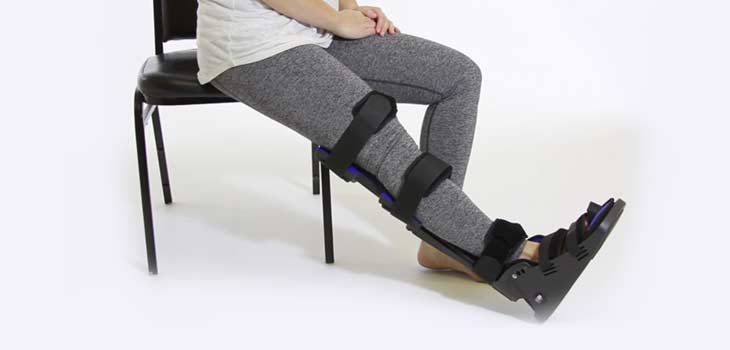
The Equinus Brace
“You need to wear [night splints] all night and they’re not super comfortable to sleep with. Patients are always complaining about waking up with them,” said DeHeer. “I consistently woke up in the middle of the night while sleeping on my side with my knee bent. I realized the night splint wasn’t doing anything, because to effectively stretch your calf muscle, you must have the knee fully extended. That’s where I came up with the idea for ‘The Equinus Brace.'”
DeHeer says the braces solves the problem of compliance by only having to be used one hour a day. He adds that it’s also a much better way to stretch the two calf muscles—the gastrocnemius and soleus—which is critical for proper treatment and long-term results for plantar fasciitis, Achilles tendonitis and other disorders.
His brace extends above the knee to lock it into full extension, which is critical to stretching the calf muscle. An adjustable ankle hinge give precise control of the amount of ankle joint dorsiflexion and is the only brace to engage the Windlass Mechanism.
The physician adjusts the brace during three monthly visits over 12 weeks.
IQ Medical
It took DeHeer nearly five years to create his boot. Then along with Carmel, Indiana, residents John Moorin (owner of another medical distribution business) and Ricky Heath (a long-time executive in medical devices), they formed IQ Medical LLC to market the invention.
It’s a good market. Moorin says tight calf muscles result in about seven million foot and ankle injuries a year. He adds that $1 billion dollars a year is spent surgically and non-surgically just to fix plantar fasciitis alone.
Medicare and nearly all insurance carriers cover the brace. A shorter version, “The Equinus Brace” 2.0, became available in June for children and smaller adults.
By the end of the year, the company plans to have a consumer brace that it can sell to athletes and others without them having to go through a doctor. The consumer brace will be a simplified version of “The Equinus Brace™” because a physician will not be guiding the user through the process.
Author
React:
Discussion
This is a fascinating development. In my practice we've seen similar outcomes with the revised protocol. The key differentiator seems to be patient selection criteria. Has anyone else noticed the correlation with BMI thresholds?
Great point. I'd push back slightly on the conclusion, the sample size in the cited study is too small to draw population-level inferences. That said, the directional signal is compelling and worth a larger RCT.
We implemented a similar approach last year. Early results are promising but we're still gathering 12-month follow-up data. Happy to share our protocol if anyone is interested.
Join the conversation
Orthopedic professionals are discussing this. Sign in and upgrade to read every comment and add your voice.