
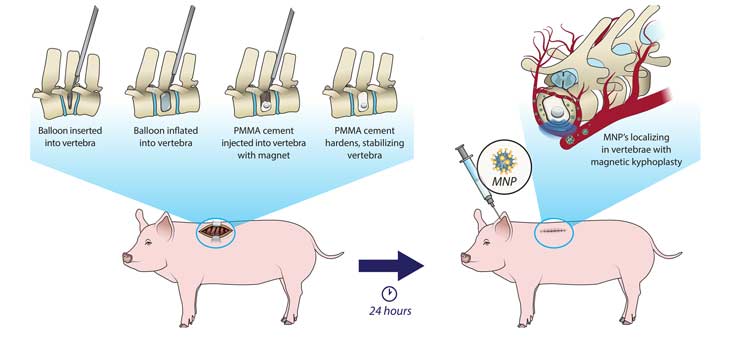
Using a porcine model, a team of researchers from Chicago have injected magnetic nanoparticles (MNPs) into the vertebral column to determine if they could treat the underlying causes of vertebral compression fractures (VCFs).
Magnetically Guided Drug Delivery for Kyphoplasty?
1 min read Premium comments
Secondary#kyphoplasty#spinalfracture
Their study, “Magnetic kyphoplasty: A novel drug delivery system for the spinal column,” appears in the July 27, 2018 edition of PLOS ONE.
The authors wrote, “…Minimally invasive kyphoplasty is a common procedure used for symptomatic amelioration. However, it fails in treating the underlying etiologies of VCFs. Use of systemic therapy is limited due to low perfusion to the spinal column and systemic toxicity.”
“Localized delivery of drugs to the vertebral column can provide a promising alternative approach. A porcine kyphoplasty model was developed to study the magnetically guided drug delivery of systemically injected magnetic nanoparticles (MNPs).”
“Jamshidi cannulated pedicle needles were placed into the thoracic vertebra and, following inflatable bone tamp expansion, magnetic bone cement was injected to the vertebral body.”
A co-author on the paper, Ankit I. Mehta, M.D. is assistant professor of neurosurgery and director of spinal oncology at the University of Illinois at Chicago. He told OTW, “This is the first time we can localize drug delivery to an individual vertebral body that could be useful for pathological spinal fractures, tumors, or other pathologies in the spinal column.”
“We were able to localize magnetic nanoparticles in a pig model to an individual vertebral body effectively and cause parenchymal penetration. The potential for a common kyphoplasty procedure to be utilized as a treatment platform for various diseases. As spinal surgeons we can translate our operative techniques for providing localized specific medical therapy.”
When asked about any advice on how surgeons can counsel patients on this subject, he commented to OTW, “Give them hope. The future of therapeutics through a minimally invasive option is coming and holds great promise.”
Author
React:
Discussion
This is a fascinating development. In my practice we've seen similar outcomes with the revised protocol. The key differentiator seems to be patient selection criteria. Has anyone else noticed the correlation with BMI thresholds?
Great point. I'd push back slightly on the conclusion, the sample size in the cited study is too small to draw population-level inferences. That said, the directional signal is compelling and worth a larger RCT.
We implemented a similar approach last year. Early results are promising but we're still gathering 12-month follow-up data. Happy to share our protocol if anyone is interested.
Join the conversation
Orthopedic professionals are discussing this. Sign in and upgrade to read every comment and add your voice.