
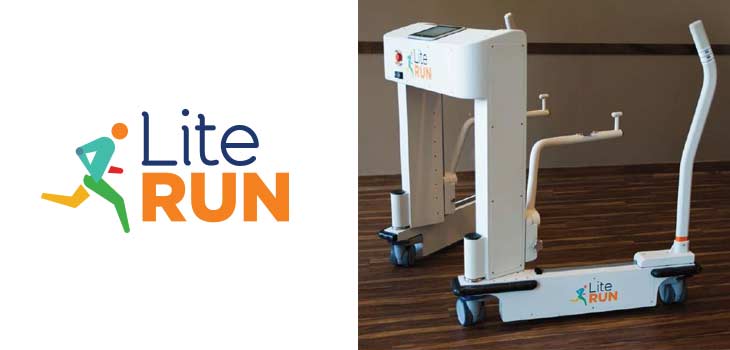
New technology that combines a walker with space suit technology is turning gait therapy on its head. The Lite Run Gait Trainer helps patients get back up on their feet more quickly after surgery by reducing the pressure on the body so the patient can walk more comfortably.
Lite Run Gets Patients Mobile After Surgery
2 min read Premium comments
Secondary#gaitpattern#literun
John Hauck, president of Lite Run Inc., told OTW, “The Lite Run soft Exosuit creates lift on the patient using the same principle that’s used in an air piston in a cylinder, or a cork popping out of a champagne bottle.
“The Exosuit is open at the waist, and just as the pressure in the bottle pushes up on the cork, the pressure in the Exosuit pushes up on the human body,” he said.
The level of pressure, which is less than 45 mmHg or 1 PSI, is controlled by the device and the therapist can adjust it from just a few pounds to up to one-half of the patient’s body weight depending on how much of a lift is needed.
He added, “The resumption of weight bearing is important as soon as possible after surgery. At the same time, fall risk and pain must be managed. The Lite Run Gait Trainer provides a fall safe and very comfortable way for patients to resume ambulation soon after surgery.”
The Lite Run Gait Trainer is targeted to inpatient rehabilitation facilities and transitional care facilities to be used for gait therapy. Gait therapy applications cover a wide range of conditions including stroke, spinal cord injury, traumatic brain injury, polytrauma and orthopedic applications.
Hauck said, “There is also a large need in skilled nursing facilities to mobilize infirm, obese and otherwise non-ambulatory residents, purely for health and wellness reasons. The Lite Run Gait Trainer is a labor efficient way to provide that benefit, as a single therapist or aide can use it to lift a subject out of a wheelchair and ambulate them. If the subjects have enough strength they may walk themselves in the device.”
Charlotte Brenteson, DPT, a physical therapist at the Minneapolis VA Medical Center, uses Lite Run with some of her patients including Vietnam veteran Al Retting who at 75 years of age was able to take his first steps with the device after being in a wheelchair for seven years.
She explained that at first he had some independence and could transfer himself safely in and out of his chair, but because of weight gain and lack of mobility he eventually lost all his independence.
Brenteson’s and his wife’s goal for using the Lite Run Gait Trainer was for him to lose weight and become more independent with moving from the bed to his chair and with changing his clothes.
When he first started Brenteson offloaded him 150 lbs. and now that he has lost some weight she only has to off-load him 90 lbs.
She explained that the difference in quality of life is night and day. Retting’s wife now feels comfortable enough with his independence that she can go on vacation with her grandkids.
Currently there is one Lite Run Gait Trainer at the Minneapolis VA Medical Center, and it is being trialed at Courage Kenny Institute. The Lite Run was designed to preclude falls, have exceptional patient comfort, and it includes sit-to-stand capability to remove the lifting burden from the therapists.
For more information, visit http://www.literun.com.
Author
React:
Discussion
This is a fascinating development. In my practice we've seen similar outcomes with the revised protocol. The key differentiator seems to be patient selection criteria. Has anyone else noticed the correlation with BMI thresholds?
Great point. I'd push back slightly on the conclusion, the sample size in the cited study is too small to draw population-level inferences. That said, the directional signal is compelling and worth a larger RCT.
We implemented a similar approach last year. Early results are promising but we're still gathering 12-month follow-up data. Happy to share our protocol if anyone is interested.
Join the conversation
Orthopedic professionals are discussing this. Sign in and upgrade to read every comment and add your voice.