
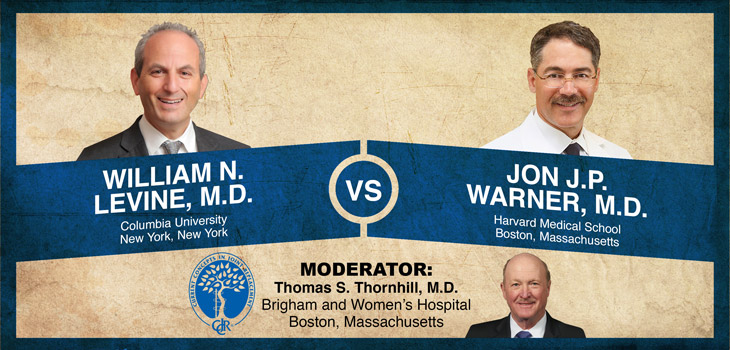
This week’s Orthopaedic Crossfire® debate was part of the 18th Annual Current Concepts in Joint Replacement® (CCJR®), Spring meeting, which took place in Las Vegas. This week’s topic is “Four-Part FX in an Active 70-Year-Old: Reverse Is Overkill” For is William N. Levine, M.D., Columbia University, New York, New York. Opposing is Jon J.P. Warner, M.D., Harvard Medical School, Boston, Massachusetts. Moderating is Thomas S. Thornhill, M.D., Brigham and Women’s Hospital, Boston, Massachusetts.
Levine v. Warner: Four-Part Shoulder FX in an Active 70-Year-Old: Reverse Is Overkill
9 min read Premium comments
#shouldersurgeryGreat Debates#ccjr
Intro: Moderator Thornhill: Ringling Brothers Barnum and Bailey circus closed their tent after 146 consecutive years so now the greatest show on earth is CCJR.
Seth is the CCJR ringmaster and has put this meeting on for 36 years in Orlando and 18 years here in Las Vegas for a total of 54 times. He has trained over 2,500 orthopedic surgeons from around the world. Seth you are a true innovator in orthopedic education. You can see this sort of electronic use and everything else that we have and we all owe you a great deal of gratitude.
We are going to start out with a very interesting and very pertinent shoulder debate; “Four-Part FX in an Active 70-Year-Old: Reverse is Overkill” and the affirmative is my friend Bill Levine, Chairman at Columbia University.
Dr. Levine: We are talking about reverse shoulder and I am against a guy who is brilliant, erudite and Past President of the American Shoulder and Elbow Society (ASES).
He runs an institute for crying out loud, so it’s really hard to go against that.
AND he is friends with legendary Harvard Professor Michael Porter which he’ll tell you about, I’m sure, throughout his talk.
I’m just a simple guy from Fargo, North Dakota. I was born in 1964—which was the same year Supreme Court Justice Potter Stewart said about pornography; “I know it when I see it”. I feel the same way about value.
Point number 1: we are operating on way too many proximal humeral fractures and I think all of us need to recognize that.
Vani Sabesan from Michigan did a registry review looking at 550,000 patients from 2004-2014 (Aging Clin Exp Res, 2017). The ORIF prevalence in that 10-year period is going through the roof and the reverse shoulder is starting to come close to hemiarthroplasty for four-part fractures. They extrapolated their data out to 2032 and pretty much everybody in the room is going to get a plate and lots of us are going to have reverses on the current trend.
So why would you use a reverse total shoulder arthroplasty? It’s more expensive. It leads to more functional restrictions for this active 70-year-old patient. And there are more long-term durability concerns than other options.
Why not use a hemiarthroplasty? It’s less expensive, there are no restrictions in function and it leads reliably to pain relief.
Here is a real problem JP is going to have to defend. His good friend Rich Hawkins from South Carolina recently published a paper with JT Tokish showing that reverse isn’t even better than doing nothing in their small cohort (JSES, 2016). I am wondering what JP is going to say to us in a few minutes.
Point number 2: comparing hemiarthroplasty to reverse. We have poor studies of a retrospective nature, very small numbers.
If we look at what is available there is a study back in 2009 (Gallinet, Orthop Trauma) that showed better forward elevation and better abduction with reverse but, not surprisingly, better rotation because of tuberosity healing with hemiarthroplasty. Their DASH scores or patient reported outcomes were identical.
Here is the real concern reported in this paper: 3 patients had tuberosity failure which we know leads to catastrophic failure for hemiarthroplasty (n=21). But 15 of this very small cohort of reverse patients (n=19) had scapular notching, which initially we thought wasn’t a big deal, but now following the French 30-year history with reverse, we know is a big deal and does lead to clinical failures.
A systematic review by my former fellow, John Bell (JSES, 2013), showed improved forward flexion and functional outcomes with reverse as well as equal complications. And our Canadian colleagues showed in a cost utility model using Canadian data, very clear to point out, not American data, found a reverse was more cost effective than a hemiarthroplasty (Osterhoff, Value in Health, 2017).
That is counteracted by a study from the United States from 2016 (Solomon, Orthopedics) which showed that the costs for hemiarthroplasty were less than reverse and reverse had better pain and outcome scores but that the functional outcome was the same.
A multicenter study from 2016 (Bonnevialle, Orthop Trauma) showed hemiarthroplasty had higher complications, but again, 20% scapular notching for the reverse; those are real concerns we are going to have to deal with.
This is the biggest concern we have with the reverse compared to hemiarthroplasty—with longer term follow-up, the functional outcome scores decrease as their deltoid starts to peter out.
The advantages of reverse arthroplasty are that you don’t have to worry about tuberosities, rehab is easier, outcomes, I would admit, are better overall but what about cost and what about value ultimately?
The disadvantages are that you don’t get rotation if the tuberosities don’t heal, the scapular notching issue is intense, the restricted function is real, not imaginary. Costs are higher and long-term durability remains a concern.
The pros for hemiarthroplasty: costs, function, no functional limitations and ultimately value.
The cons: it is a hard operation, Dr. Neer talked about that a long time ago. To get the tuberosities to heal is not easy. The outcomes are inconsistent and related to the tuberosity healing. If we get tuberosity failure we get a catastrophic outcome.
So, my final thoughts are that we are operating on far too many proximal humerus fractures. Non-operative options may be better for many and for the active 70-year-old that Tom and Seth asked me to talk about, hemiarthroplasty with tuberosity reconstruction is the better option and is better value and “we know it when we see it.”
Dr. Warner: I’m not going to talk too much about value. Instead, I’m going to present an overview that is really eminence-based and evidence-based.
What is 70 years of age? It’s highly variable and biology says that women age slower than do men.
I think we probably agree on when it’s appropriate to do conservative management. We probably also agree on notching and I can tell you how to solve that.
Our institute is predicated on Codman’s concepts that measuring outcomes is the most important thing. Through critical introspection it is evident that in the last several years there has been virtually no utilization of hemiarthroplasty anymore because it just has been so unpredictable.
How about eminence? There are so many failures of hemiarthroplasty that I see—typically with tuberosity failure.
Yes, it is a difficult operation. Even the specialist doesn’t do that great with this. Why? Because age is a surrogate for bone quality and the problem with the bone quality that you deal with when you do your hemiarthroplasty and expect the tuberosity to heal.
With reverse prosthesis you can circumvent this issue of bone quality and solve your problems very reproducibly…with case after case of good outcomes.
Neer started this whole thing, he was far and away the biggest influence of the last generation. When you look at his approaches, he had beautiful diagrams on how to do it. He even had relatively good series although small numbers for sure.
What’s interesting to me is when you look at those who learned from him first hand, the results are not particularly great. What Bill just showed you is probably not his case after case, it’s his best one. So like Evan Flatow just told me, keep a camera on your desk in order to have it available when you have a good outcome.
A series from the Mayo Clinic (Cofield, et al., JSES 2008): 47% satisfactory, 53% unsatisfactory, good pain relief but unpredictable function.
If we look at Level II evidence (it’s very hard to get to Level I) we find a study that compared hemiarthroplasty versus reverse total (Cuff and Pupello, JBJS-Am 2013). They found a statistically significant difference in the ASES score and active flexion in terms of hemiarthroplasty versus reverse total (62 vs. 77 and 100 vs. 139, respectively). Another study (Chalmers, et al., JSES 2014), same thing, very significant difference in reverse total versus hemiarthroplasty. In a Level II comparative analysis (Sebastia-Forcada, et al., JSES 2014), the authors report that reverse total shoulder procedures, if done properly, and I think the learning curve is dropping significantly for people, are very successful.
Why is this a problem?
If you have a malunion and the anatomy is distorted, Gerber and others (Raiss, et al, JBJS 2016) have shown us that the outcome of reverse as a salvage is poor. Your best shot is your first shot.
If you look at the Constant score and flexion in those settings, not so good: 9.5% complication rate, improvement is not as good as with a primary reverse for proximal humerus fracture. Your best success is acute reverse and if you look at primary versus revision you can see the difference (Dezfuli, et al., JSES 2016).
Now, one word about value.
Reverse is more cost effective than hemiarthroplasty whether it’s Canadian dollars or U.S. dollars. It doesn’t matter because the complications in post-acute care are critically affected by the speed with which an individual mobilizes and the lack of complications.
Final point. I would tell you that I can show you show case after case after case of individuals over 70 who would agree with me about the quality of life that this gives them.
Moderator Thornhill: You know it’s very interesting that Dr. Neer who taught all of us a whole lot had a very good way of taking the patients who weren’t going to do well and put them into the category of limited goals, so I think it would be a nice thing to be able to take a Mulligan when you can.
I have a question and maybe to both of you. Bill, tell me do you think that the status of the rotator cuff at the time of the fracture would alter or have you chosen reverse versus hemi?
Dr. Levine: Oh, no question. If you are considering a standard hemiarthroplasty we always have to talk to the patient about making an intraoperative switch to a reverse if there is any question about the cuff integrity or the tuberosities.
If the tuberosities are quite poor, horribly osteoporotic, where you know you are going to have tuberosity concerns, I don’t think you are doing that patient any favors by doing a hemiarthroplasty. The only thing I would say about this debate, since we are supposed to choose the sides and go with it in a biased fashion, is that J.P. gave a phenomenal talk, but he didn’t really talk about the main issue. This being, what do you do with the 71-year-old active patient? Not most 70-year olds. The 71-year-old who wants to play tennis and wants to do higher level activities. Are you going to let that patient do all of those things with the reverse and then potentially diminish their durability? That’s the challenge I think we face with the reverse because of course we get the great results that you showed for routine daily life activities.
Moderator Thornhill: So, J.P., rotator cuff, is it important? And my second question to you is: Would you let a patient on the dominant side play tennis after a reverse?
Dr. Warner: The answer is yes and not just yes but yes with evidence, at least individual evidence. At 71-years old they are playing recreational tennis and golf for that matter. The other point about the rotator cuff I think is less the issue than bone quality to be fair. And as long as we are talking about data, the Australian registry has clearly shown that reverse has greater durability than total shoulder arthroplasty.
Moderator Thornhill: Who should do these reverse shoulders?
Dr. Warner: Well, I think anyone can do them although there is a significant learning curve. Outcomes drive things, period, end of story.
Moderator Thornhill: Okay gentlemen, thank you very much, it’s a wonderful debate. It’s interesting this sort of is the old adage that orthopedists use data like drunks use lamp posts much more for support than illumination so they did a great job. Thank you.
Please visit www.CCJR.com to register for the 2018 CCJR Winter Meeting, – December 12 – 15 in Orlando.
Author
React:
Discussion
This is a fascinating development. In my practice we've seen similar outcomes with the revised protocol. The key differentiator seems to be patient selection criteria. Has anyone else noticed the correlation with BMI thresholds?
Great point. I'd push back slightly on the conclusion, the sample size in the cited study is too small to draw population-level inferences. That said, the directional signal is compelling and worth a larger RCT.
We implemented a similar approach last year. Early results are promising but we're still gathering 12-month follow-up data. Happy to share our protocol if anyone is interested.
Join the conversation
Orthopedic professionals are discussing this. Sign in and upgrade to read every comment and add your voice.