
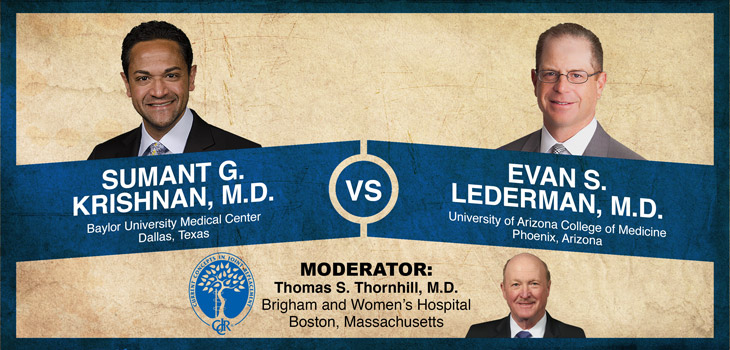
This week’s Orthopaedic Crossfire® debate was part of the 18th Annual Current Concepts in Joint Replacement® (CCJR®), Spring meeting, which took place in Las Vegas. This week’s topic is “Dr. Krishnan v. Lederman: OA in a 50-year-old: Stemless TSA Trumps Resurfacing Arthroplasty.” For is Sumant G. Krishnan, M.D., Baylor University Medical Center, Dallas, Texas. Opposing is Evan S. Lederman, M.D., University of Arizona, College of Medicine, Phoenix, Arizona. Moderating is Thomas S. Thornhill, M.D., Brigham and Women’s Hospital, Boston, Massachusetts.
Krishnan v. Lederman: OA in a 50-year-old: Stemless TSA Trumps Resurfacing Arthroplasty
9 min read Premium comments
#totalshoulderarthroplastyGreat Debates#resurfacingarthroplasty
Dr. Krishnan: I’ll say it right off the bat that my debate opponent, Evan Lederman, can probably put any shoulder arthroplasty in better than any human being in this room. Because of that he’s going to make anything look anatomic.
For the rest of us, we have to find a way to do this operation reliably. This quote was attributed to da Vinci, “Simplicity is the ultimate sophistication.” I’ll have you keep that in mind.
Dr. Neer, who taught all of us about shoulder arthroplasty, wrote; “My philosophy is as near normal anatomy as possible. And the radius of curvature of the humeral head, matching it anatomically, allows the cuff to be repaired and rehabilitated around it.”
Again, we are talking about the rotator cuff and replacing the proximal humerus with something metallic to give you this same function that we would have with normal anatomy. Well, we know the last 20 years have taught us many things about the proximal humerus—it’s not so forgiving. Increasing the thickness of the humeral head by just 5 millimeters decreases the range of motion of the glenohumeral joint. This is because of the concavity compression effect of the rotator cuff. So, the humeral head doesn’t just sit in the middle of the glenoid it actually glides on the glenoid.
Dr. Warner and his group have demonstrated beautifully the motion patterns that occur in a normal anatomy of the glenohumeral joint and how that’s necessary to be replicated with prosthetic anatomy. But we also know that you can’t make it too small because by decreasing the thickness of the humeral head, you affect glenohumeral joint excursion—which, again, is purely related to rotator cuff function.
The consequences of shifting the humeral articular surface is rotator cuff tendinopathies and, potentially, glenoid loosening.
When we talk a stemless replacement we are referring to resecting the articular surface of the proximal humerus and replacing it versus a resurfacing arthroplasty, which is putting a cap on a humeral head. So, I’ll just ask you a couple key questions; would you like something that’s too big? Would you like a cap that’s too small? A cap that’s too high? A cap that’s too low? Or perhaps something that looks anatomic?
The advantage of stemless total shoulder arthroplasty is that it is canal sparing. As shoulder surgeons we have tried to invade the proximal humerus less and less over the years. We’ve tried to become bone sparing. We try to preserve the proximal humerus for the next operation, if necessary, especially in a 50-year-old patient.
Easier glenoid exposure; there is no debate about that. If you have the humeral head sitting in your face and you’re trying to replace the glenoid it’s more technically challenging than simply resecting the proximal humerus and replacing the glenoid.
If you are doing a resurfacing arthroplasty, you have to exactly match the thickness of your implant to the thickness or thinness of the cartilage that you’ve removed and also replace the bone in such a way that the cuff functions anatomically. Which, I submit, is pretty easy to do if you actually cut the humeral head and replace the head with what you took off.
There are disadvantages. The FDA approval is pending for many of the designs and at this point I believe that there is still only one implant that is FDA approved for use in the United States. There is no mid- to long-term outcome data and no real durable studies on implant longevity beyond a two-year time frame as this is an evolving concept.
Worldwide, as of 2014, there were more than ten thousand cases reported.
Prospective two year follow up studies have now been performed in Austria, France, Belgium, Canada, and here in the U.S., demonstrating that at least in the short-term—and for anything regarding arthroplasty, whether it’s hip, knee, shoulder, elbow or ankle, two years is by and large just short-term data-this can be a very viable option.
Is this really a debate? In your own mind, in your hands, you decide.
Dr. Lederman: I appreciate the opportunity to debate Butch, who I have the utmost respect for. Butch probably has a breadth of experience and a breadth of knowledge beyond his years, and he’s always probably the worst person you want to debate.
To achieve an anatomic total shoulder replacement one of the most important factors is anatomic humeral reconstruction. The indications for the stemless and the resurfacings are quite similar-to avoid the diaphysis and to be able to put the humeral head independent of the diaphyseal axis and perhaps, easier revisions which may be one of the main indications.
As Butch mentioned, the ability to recreate the center of rotation of the humeral head was challenging with the first and second generation implants. Resurfacing arthroplasty was introduced in 1986 so it’s been around for quite some time to try to deal with this. With improvements in stem designs with third and fourth generation implants, the ability to recreate the normal anatomy has gotten much better.
Does the stem really matter? We have a lot of options.
What matters is the ability to reproducibly get the anatomy right, to get glenoid access and to get the ability to revise without challenges. The advantage of a surface replacement is that it is a relatively simple technique. We can maintain the normal anatomy, there is a large surface area for ingrowth, and it may be cheaper by the nature of its one-piece design.
So, what does literature tell us?
An original study by Levy and Copeland (JBJS-Br, 2001): 285 prostheses, 7-year follow up, 8% revision rate primarily due to glenoid-based problems and they were implanted both as a total and as a hemi.
Looking at patients in the 50-year-old range—Dave Bailie, et al. (JBJS-A, 2008) did 36 patients of hemiarthroplasties with 3 biologic resurfacings, 35 of the 36 were satisfied at a follow up of a little over 3 years. Levy, et al. (JSES, 2015) looked at a mean follow up 14.5 years with 54 shoulders and 49 patients. There were 2 revisions for infections, 7 revised to a stem, but none of these were due to humeral component complications. It had an overall revision free survivorship at an average of 14.5 years of 81%.
Looking at the Australian Registry in 2016, resurfacing and stemless represent only 12% with the stemmed implant being the primary go-to implant—at least in Australia. As we look at the revision rates at 7 years, the revision rates are similar but slightly higher revisions for resurfacing over stemmed implants (12.6 v. 10.3, respectively). The main reason for revision is only 18% when it’s related to the implant. The others are related to issues such as glenoid-based problems or rotator cuff insufficiency.
Butch is right, the ability to get these resurfacing implants right is difficult. Proper sizing and positioning is a challenge and the same challenges exist for the stemless arthroplasty. They are mostly placed in varus when they are missed. They can be oversized or undersized and getting it right can be challenging. Multiple authors have pointed this out and a lot of the surgeons performed better at anatomically reproducing the premorbid humeral head anatomy with a stemmed arthroplasty compared to a resurfacing arthroplasty.
Stemless devices are built to have robust metaphyseal fixation. Is there potentially a problem in removing these? Nowadays short stem devices can be easily removed preserving the bone envelope of the proximal humerus.
There are many options for anatomic humeral replacement. The resurfacing implants are bone preserving, there is minimal concern for stress shielding and loosening over the long term, they have stood the test of time in use for 30 years and they are revisable.
Stemmed devices may be more predictable for anatomic restoration, and stemless may offer improved glenoid exposure as a primary advantage.
Moderator Thornhill: Do you both agree, Butch, that you want to put the humeral head in an anatomic position compared to the native anatomy?
Dr. Krishnan: We do.
Moderator Thornhill: Evan, you’re saying don’t put one of those in because when you take it out, it’s going to be a lot harder for the revision.
Dr. Lederman: Well potentially. They are different and frankly there haven’t been many revisions. The resurfacings can be easy to revise assuming it’s been done right in the first place. I think these are both good options, the stemless being the newer device with short term follow up. It may be the future, particularly because of access to the glenoid. But resurfacing is a great tried and true operation for anatomic reconstruction.
Moderator Thornhill: I’m going to move down to the hip. For many years we’ve had experience with hip resurfacing arthroplasty. Lot of bone loss around the periphery of the cup—which is what we would see in failure of hip hemiarthroplasty. Does that not concern you at all?
Dr. Lederman: From a long-term clinical outcome standpoint, we are not seeing loosening of the resurfacing implants based upon the published literature. There is enough ingrowth where it is stable and the hip and shoulder are different, we are not walking on it so I don’t think it’s as big of an issue. Fixation isn’t a problem with the resurfacing.
Dr. Krishnan: I hate revising resurfacings. The reason for the resurfacing head revision is completely different from the reason for stem revisions as far as the proximal humerus goes. So, with any kind of a stem there is still bone around that proximal humerus just like you find with resurfacing hips but with resurfacing shoulders, that proximal humerus is destroyed and it takes away a lot of clubs from my bag to be able to revise that. So, I tell my residents and my fellows, “I hate that operation.” I use that line…every day of the week, twice on Sundays I’ll do a stemmed revision versus a resurfacing hip revision.
Moderator Thornhill: If you look at a knee replacement one of the real problems in tibial fixation or tibial alignment in knee replacement is using too short a stem. What the stem does is sort of centralize the implant. What made you go away from using a stem? Did you want to improve your anatomic capability?
Dr. Krishnan: What I actually do is use a short stem because metaphyseal fixation allows you to put the humeral head where it should be. With a resurfacing you have to be exactly perpendicular and perfect to the humerus just like you would with a hip to make it anatomic.
Dr. Lederman: I agree with Butch. The stem is the training wheels for the shoulder arthroplasty surgeon to get the anatomy closer to right than the resurfacing implants. My go-to implant is also a short stem implant.
Moderator Thornhill: Now we have a 50-year-old person, so we assume the bone quality is pretty good. What do you do in people with marginal bone quality or metabolic bone disease and you are doing a shoulder?
Dr. Krishnan: With the current stem designs that we use, it’s relatively easy if you cannot obtain perfect cementless fixation just with the implant. Take some bone from the proximal humerus, impact it as you would in impaction grafting and implant the stem. So, we haven’t used cement in the proximal humerus for any type of shoulder arthroplasty, other than revisions occasionally, in more than three years.
Moderator Thornhill: You ever use cement?
Dr. Lederman: Same answer as Butch, I rarely use cement. The exception would be in a situation of very large cystic cavities in a bad rheumatoid or a very elderly patient.
Moderator Thornhill: Well this is very interesting. I think you both handled this very well, thank you and let’s appreciate them.
Please visit www.CCJR.com to register for the 2018 CCJR Winter Meeting, – December 12 – 15 in Orlando.
Author
React:
Discussion
This is a fascinating development. In my practice we've seen similar outcomes with the revised protocol. The key differentiator seems to be patient selection criteria. Has anyone else noticed the correlation with BMI thresholds?
Great point. I'd push back slightly on the conclusion, the sample size in the cited study is too small to draw population-level inferences. That said, the directional signal is compelling and worth a larger RCT.
We implemented a similar approach last year. Early results are promising but we're still gathering 12-month follow-up data. Happy to share our protocol if anyone is interested.
Join the conversation
Orthopedic professionals are discussing this. Sign in and upgrade to read every comment and add your voice.